
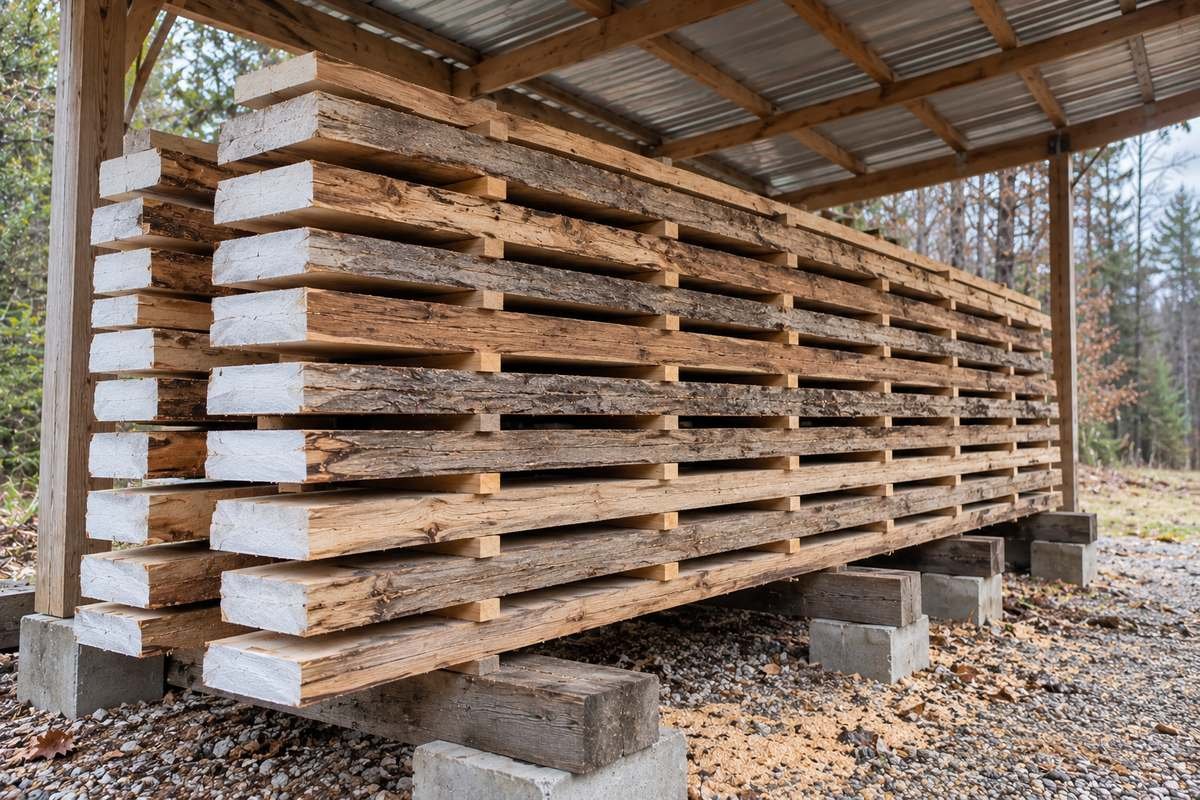
Wood never stops exchanging water with the surrounding air. Leave a board in one place long enough, and it settles at a moisture content that matches that spot's temperature and humidity. That number is the equilibrium moisture content, or EMC.
For anyone who mills their own lumber, EMC answers two practical questions. How dry can my boards get if I air dry them here? And how dry do they need to be before I build something that lives indoors? The calculator and charts below use the equation and climate data published by the USDA Forest Products Laboratory, so you can check both in about a minute.
Table of Contents
Equilibrium Moisture Content Calculator
Enter the air temperature and relative humidity where the wood will sit. The first part gives the EMC for those conditions. The second part shows the average outdoor EMC for each month in 50 U.S. cities, which is about as dry as air-dried lumber gets in that area.
EMC from temperature and humidity
Uses equation 4-5 from the Wood Handbook (USDA Forest Products Laboratory, 2021). Works from 30°F to 220°F (about −1°C to 104°C) and 1% to 99% relative humidity.
Average outdoor EMC by month
Wood sheltered from rain and direct sun. Monthly values from Wood Handbook Table 13-1 (NOAA weather averages through 2010). The yearly average is the mean of the 12 monthly values.
EMC calculator by MillingGuidemillingguide.com
The calculator uses equation 4-5 from Chapter 4 of the Wood Handbook. We checked its output against the handbook's own EMC table (Table 4-2) from 30°F to 100°F and from 5% to 95% humidity. Every result matched to within 0.1 percentage point.
What Equilibrium Moisture Content Means
Moisture content is the weight of the water in a piece of wood, shown as a percentage of the weight of the same wood when it is completely dry. A board that weighs 10 pounds oven-dry and holds 1.5 pounds of water has a moisture content of 15%.
Fresh logs and green lumber hold a lot more water than that. As wood dries, it first loses the free water in its cells. Below roughly 30% moisture content, called the fiber saturation point, the cell walls start giving up water too. That is when wood starts to shrink, and its strength and stiffness start to change. The Wood Handbook notes that the 30% figure is an average and can vary by several points between species and between boards.
Below that point, wood keeps moving toward the EMC of the surrounding air. It gives up water in dry air and picks water back up in damp air.
Humidity matters far more than temperature
Look at the numbers from the Wood Handbook table. At 70°F, wood settles at about 6.2% in 30% humidity, 9.2% in 50% humidity, and 16.0% in 80% humidity. Now hold humidity at 50% and change the temperature from 30°F to 100°F. EMC only moves from 9.5% to 8.7%.
So when you think about how dry your lumber can get, start with humidity. That is why a closed shed that stays dry beats an open stack in a damp yard, even at the same temperature.
EMC Chart by Temperature and Humidity
This chart is a shortened version of Table 4-2 in the Wood Handbook. Find the row closest to your temperature, then the column closest to your humidity. The calculator above gives values for anything in between.
| Temperature | 20% RH | 30% RH | 40% RH | 50% RH | 60% RH | 70% RH | 80% RH | 90% RH |
|---|---|---|---|---|---|---|---|---|
| 30°F | 4.6% | 6.3% | 7.9% | 9.5% | 11.3% | 13.5% | 16.5% | 21.0% |
| 40°F | 4.6% | 6.3% | 7.9% | 9.5% | 11.3% | 13.5% | 16.5% | 21.0% |
| 50°F | 4.6% | 6.3% | 7.9% | 9.5% | 11.2% | 13.4% | 16.4% | 20.9% |
| 60°F | 4.6% | 6.2% | 7.8% | 9.4% | 11.1% | 13.3% | 16.2% | 20.7% |
| 70°F | 4.5% | 6.2% | 7.7% | 9.2% | 11.0% | 13.1% | 16.0% | 20.5% |
| 80°F | 4.4% | 6.1% | 7.6% | 9.1% | 10.8% | 12.9% | 15.7% | 20.2% |
| 90°F | 4.3% | 5.9% | 7.4% | 8.9% | 10.5% | 12.6% | 15.4% | 19.8% |
| 100°F | 4.2% | 5.8% | 7.2% | 8.7% | 10.3% | 12.3% | 15.1% | 19.5% |
How Dry Can Air-Dried Lumber Get Where You Live?
Air drying can only take lumber down to the EMC of the outdoor air. Chapter 13 of the Wood Handbook says long exposure brings 1 inch and 2 inch lumber close to the average outdoor EMC for the area, within one or two points. For much of the United States, thoroughly air-dried lumber bottoms out at 12% to 15%.
The table below shows where your area falls. These values are for wood under cover, out of rain and direct sun, as a good drying stack should be set up. The driest and wettest months show how much the stack can swing through the year.
| City | State | Yearly average | Driest month | Wettest month |
|---|---|---|---|---|
| Juneau | AK | 16.3% | May (13.4%) | Oct (18.5%) |
| Mobile | AL | 13.7% | Oct (13.1%) | Jul (14.3%) |
| Little Rock | AR | 13.2% | Mar (12.8%) | Jan (13.8%) |
| Flagstaff | AZ | 9.9% | Jun (7.0%) | Jan (11.5%) |
| Phoenix | AZ | 6.9% | Jun (4.4%) | Dec (9.0%) |
| Fresno | CA | 10.9% | Jul (7.4%) | Jan (15.8%) |
| Los Angeles | CA | 10.6% | Jan (9.4%) | Jun (11.7%) |
| Denver | CO | 9.1% | Jul (8.0%) | Dec (10.5%) |
| Washington | DC | 11.8% | Apr (11.0%) | Sep (12.6%) |
| Miami | FL | 13.3% | Apr (12.2%) | Sep (14.4%) |
| Atlanta | GA | 12.8% | Apr (11.8%) | Aug (13.5%) |
| Honolulu | HI | 11.9% | Aug (11.0%) | Jan (13.1%) |
| Des Moines | IA | 13.5% | May (12.5%) | Dec (14.9%) |
| Boise | ID | 10.3% | Jul (6.9%) | Jan (14.8%) |
| Chicago | IL | 13.4% | May (12.3%) | Dec (15.1%) |
| Indianapolis | IN | 13.7% | Apr (12.5%) | Dec (15.5%) |
| Wichita | KS | 12.8% | Jul (11.7%) | Dec (13.8%) |
| Louisville | KY | 12.8% | Apr (11.6%) | Dec (14.1%) |
| New Orleans | LA | 14.3% | Mar (13.7%) | Aug (15.0%) |
| Boston | MA | 12.1% | Apr (11.5%) | Sep (12.8%) |
| Portland | ME | 13.1% | Apr (12.0%) | Sep (14.1%) |
| Detroit | MI | 13.4% | May (12.0%) | Dec (15.1%) |
| Minneapolis/St. Paul | MN | 13.2% | May (11.7%) | Dec (14.9%) |
| St. Louis | MO | 13.1% | Apr (12.3%) | Dec (14.3%) |
| Jackson | MS | 14.1% | Mar (13.5%) | Dec (14.7%) |
| Missoula | MT | 12.6% | Aug (9.1%) | Dec (17.3%) |
| Raleigh | NC | 12.8% | Apr (11.6%) | Sep (14.0%) |
| Fargo | ND | 13.8% | May (11.8%) | Dec (15.3%) |
| Omaha | NE | 13.4% | Apr (12.1%) | Dec (14.5%) |
| Albuquerque | NM | 8.1% | Jun (6.0%) | Dec (10.1%) |
| Las Vegas | NV | 5.9% | Jun (3.7%) | Jan (8.3%) |
| Reno | NV | 9.2% | Jul (7.2%) | Dec (12.1%) |
| New York | NY | 12.0% | Apr (11.0%) | Sep (12.7%) |
| Cleveland | OH | 13.5% | May (12.4%) | Jan (14.9%) |
| Oklahoma City | OK | 12.6% | Aug (11.8%) | May (13.3%) |
| Pendleton | OR | 11.3% | Jul (7.2%) | Dec (16.4%) |
| Portland | OR | 13.9% | Jul (11.2%) | Dec (17.2%) |
| Philadelphia | PA | 12.2% | Apr (11.2%) | Sep (12.8%) |
| San Juan | PR | 13.4% | Mar (12.5%) | Nov (13.9%) |
| Charleston | SC | 13.4% | Apr (11.6%) | Aug (14.5%) |
| Sioux Falls | SD | 13.5% | Apr (12.6%) | Dec (14.9%) |
| Memphis | TN | 12.8% | Mar (12.2%) | Jan (13.4%) |
| Dallas/Fort Worth | TX | 12.2% | Aug (11.0%) | May (12.9%) |
| El Paso | TX | 7.6% | May (5.5%) | Dec (9.3%) |
| Salt Lake City | UT | 10.4% | Jul (6.8%) | Dec (14.9%) |
| Richmond | VA | 12.6% | Apr (11.3%) | Sep (13.6%) |
| Seattle | WA | 14.3% | Jul (12.0%) | Dec (16.9%) |
| Madison | WI | 13.8% | May (12.6%) | Dec (15.4%) |
| Charleston | WV | 13.3% | Apr (11.5%) | Aug (14.3%) |
| Cheyenne | WY | 10.1% | Jul (9.5%) | May (10.7%) |
A few patterns stand out:
- Most cities in the East, South, and Midwest average between about 12% and 14%. Air-dried lumber there is ready for sheds, fences, and other outdoor work, not for indoor furniture.
- Desert cities sit far lower. Las Vegas averages 5.9% and Phoenix 6.9%, with June readings of 3.7% and 4.4%.
- The dry interior West swings hard with the seasons. Salt Lake City drops to 6.8% in July and climbs to 14.9% in December. Boise runs from 6.9% in summer to 14.8% in winter.
- The Pacific Northwest is damp in winter. Seattle reaches 16.9% in December and Portland, Oregon, 17.2%. Juneau, Alaska, has the highest yearly average in the table at 16.3%.
Target Moisture Content for Your Project
The right moisture content depends on where the finished piece will live. Table 13-2 of the Wood Handbook gives these targets for wood at the time it is installed or built into something:
| Use of wood | Most of the U.S. | Dry southwestern area | Damp, warm coastal areas |
|---|---|---|---|
| Interior: furniture, woodwork, flooring, trim | 8% (6% to 10%) | 6% (4% to 9%) | 11% (8% to 13%) |
| Exterior: siding, trim, sheathing, laminated timbers | 12% (9% to 14%) | 9% (7% to 12%) | 12% (9% to 14%) |
Compare this with the city table, and the problem is clear. In most of the country, air-dried lumber sits 4 to 7 points wetter than the 8% indoor target. The Wood Handbook warns that when wood goes into service wetter than recommended, shrinkage can be expected. In furniture and cabinets, that means gaps, cracks, and loose joints as the wood dries out in a heated house. The handbook also notes that in heated homes in cold climates, joists over heated basements, studs, and ceiling joists can drop as low as 6% to 7%.
Using EMC to Dry and Store Lumber
- Air dry first. Stack and sticker the boards under a roof, and let them reach your area's outdoor EMC. Our guide to air drying lumber covers the stack itself. The Wood Handbook says air-drying time varies widely by species, thickness, location, and the time of year the lumber is stacked, so go by readings, not the calendar.
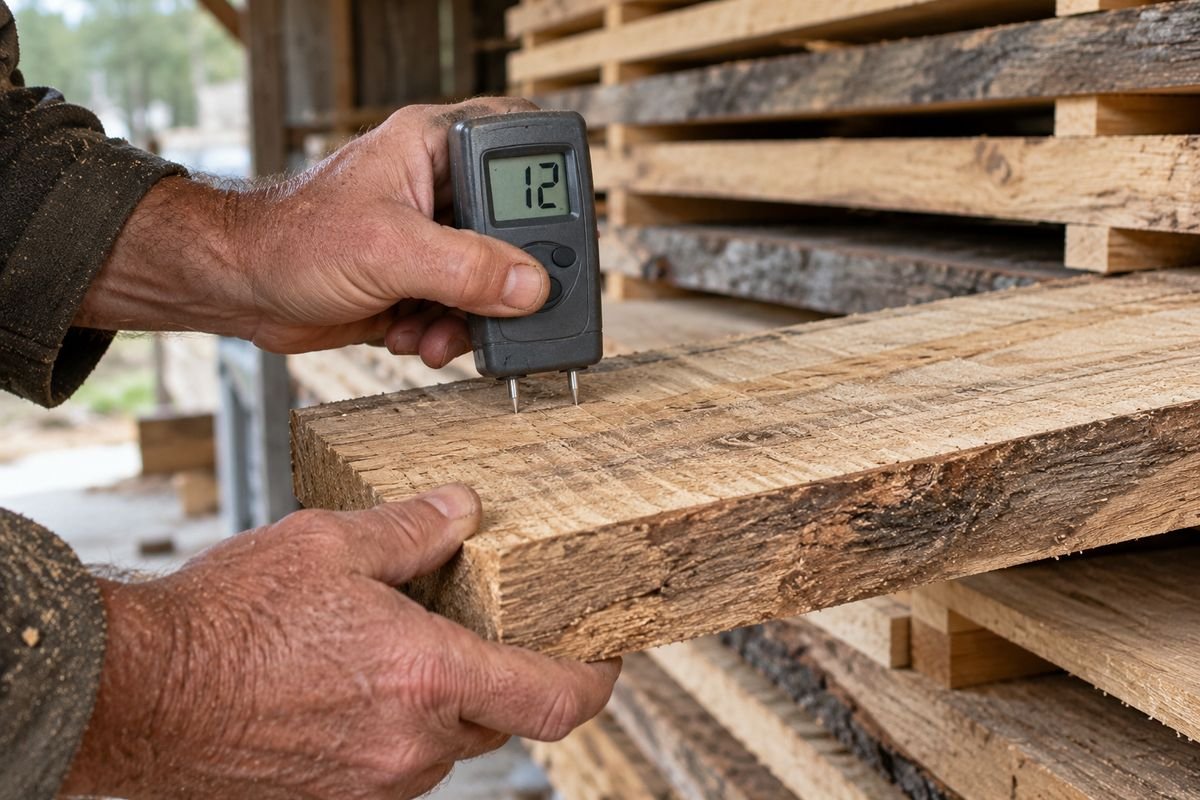
- Measure, don't guess. Check boards from the top, middle, and bottom of the stack with a moisture meter. When readings stop dropping from one check to the next, the stack is close to the outdoor EMC. The Wood Handbook puts the reliable range at about 6% to 30% for pin (resistance) meters and 4% to about 30% for pinless (dielectric) meters.
- Finish drying in warmer, drier air. To get below the outdoor EMC, the wood needs air with a lower EMC. That means a kiln, such as a small solar or dehumidification kiln, or a closed, heated space. Use the calculator to check the conditions inside.
- Store dry lumber where it stays dry. Kiln-dried wood picks up moisture if it sits in damp air. The Wood Handbook describes 1-inch hardwood lumber, kiln-dried to 8% or less, piled solid under a roof outdoors in warm, humid weather. It gained about 2% per month for the first 45 days and about 1% per month after that. In an open shed with a roof, it gained about 1% per month. In a closed shed, it was about 0.3% per month.
How much heat it takes to keep stored lumber dry
Heating a closed shed lowers the relative humidity inside, as long as no other water gets in. Warm air holds more moisture, so the same amount of water reads as lower humidity. Here is an example from the calculator. Outside air at 50°F and 80% humidity gives an EMC of about 16.4%. Warm that same air to 70°F, and the humidity drops to about 39%, putting the EMC near 7.6%.
The Wood Handbook calls heating a closed space slightly above the outdoor temperature the simplest way to lower storage humidity. Its Table 13-4 shows how many degrees warmer than outside the storage space needs to be:
| Outside humidity | For 6% MC | For 7% MC | For 8% MC | For 9% MC | For 10% MC | For 11% MC | For 12% MC |
|---|---|---|---|---|---|---|---|
| 90% | 33°F | 29°F | 23°F | 18°F | 15°F | 11°F | 9°F |
| 80% | 30°F | 25°F | 19°F | 14°F | 11°F | 8°F | 6°F |
| 70% | 25°F | 20°F | 15°F | 10°F | 7°F | 4°F | 3°F |
| 60% | 20°F | 15°F | 9°F | 6°F | 3°F | None | None |
| 50% | 15°F | 10°F | 5°F | 1°F | None | None | None |
The handbook adds that a dehumidifier can do the same job in a small, well-enclosed space. It also warns about the opposite problem. Wood waiting in a shop heated to 70°F or more while it is cold outside can become too dry. The handbook says this often happens in the northern United States in winter.
This kind of control matters most for lumber headed for furniture. The handbook says furniture stock should be stored in a room or closed shed with controlled humidity. In uncontrolled storage, board ends can end up wetter than the rest. When you rip and glue that stock, the ends shrink later and can split or open the glue joints.
Limits of These Numbers
- Species. The Wood Handbook table was built mainly from Sitka spruce. The handbook says species differences are usually minor at low and moderate humidity but become considerable at high humidity. Species with more extractives tend to settle lower in very humid air.
- Drying versus soaking up water. Wood that is drying down settles at a slightly higher EMC than wood that is picking up water from the dry side. This is called sorption hysteresis. The table values sit about midway between the two, so a board coming off a wet stack may read a little above the chart.
- Practical, not lab grade. A 2014 Forest Products Laboratory review of its own EMC data found the numbers useful for practical work like lumber drying. It also found them not reliable enough for scientific modeling because the original test methods were not well documented.
- Averages, not forecasts. The city values are long-term monthly averages. A rainy week or a dry spell will push real boards above or below them.
Frequently Asked Questions
What is a good equilibrium moisture content for wood indoors?
For furniture, trim, and flooring in most of the U.S., the Wood Handbook recommends an average of 8%, with individual boards between 6% and 10%. In the dry Southwest, the target is about 6%, and in damp, warm coastal areas it is about 11%.
Can air-dried lumber be used for furniture?
Usually not straight off the stack. In most of the country, air-dried lumber levels off at 12% to 15%, which is 4 to 7 points wetter than the indoor target. Finish drying it in a kiln or a heated, closed space, and check it with a moisture meter before you build. Desert areas of the Southwest are the main exception, because their outdoor EMC is already low.
Does temperature or humidity affect EMC more?
Humidity, by a wide margin. At 70 degrees Fahrenheit, EMC rises from about 6.2% at 30% humidity to 16.0% at 80% humidity. At a steady 50% humidity, EMC changes from 9.5% at 30 degrees to 8.7% at 100 degrees.
Does equilibrium moisture content change with wood species?
A little. The standard EMC table is based mostly on Sitka spruce. The Wood Handbook says species differences are minor at low and moderate humidity and larger at high humidity, where species with more extractives tend to settle lower.
How do I lower the moisture content of lumber in storage?
Keep rain and sun off the lumber and lower the humidity of the air around it. In a closed space, the simplest way is to keep it a few degrees warmer than outside. The Wood Handbook says that with 70% outside humidity, keeping the space about 15 degrees Fahrenheit warmer holds wood near 8%. A dehumidifier also works in a small, well-enclosed space.
Sources
- Glass, S.V. and Zelinka, S.L. 2021. Chapter 4: Moisture relations and physical properties of wood. In: Wood Handbook, FPL-GTR-282. USDA Forest Products Laboratory. (EMC equation and Table 4-2)
- Bergman, R. 2021. Chapter 13: Drying and control of moisture content and dimensional changes. In: Wood Handbook, FPL-GTR-282. USDA Forest Products Laboratory. (Tables 13-1, 13-2 and 13-4, storage guidance)
- Simpson, W.T. 1998. Equilibrium moisture content of wood in outdoor locations in the United States and worldwide. FPL-RN-0268. USDA Forest Products Laboratory.
- Glass, S.V., Zelinka, S.L. and Johnson, J.A. 2014. Investigation of historic equilibrium moisture content data from the Forest Products Laboratory. FPL-GTR-229.