
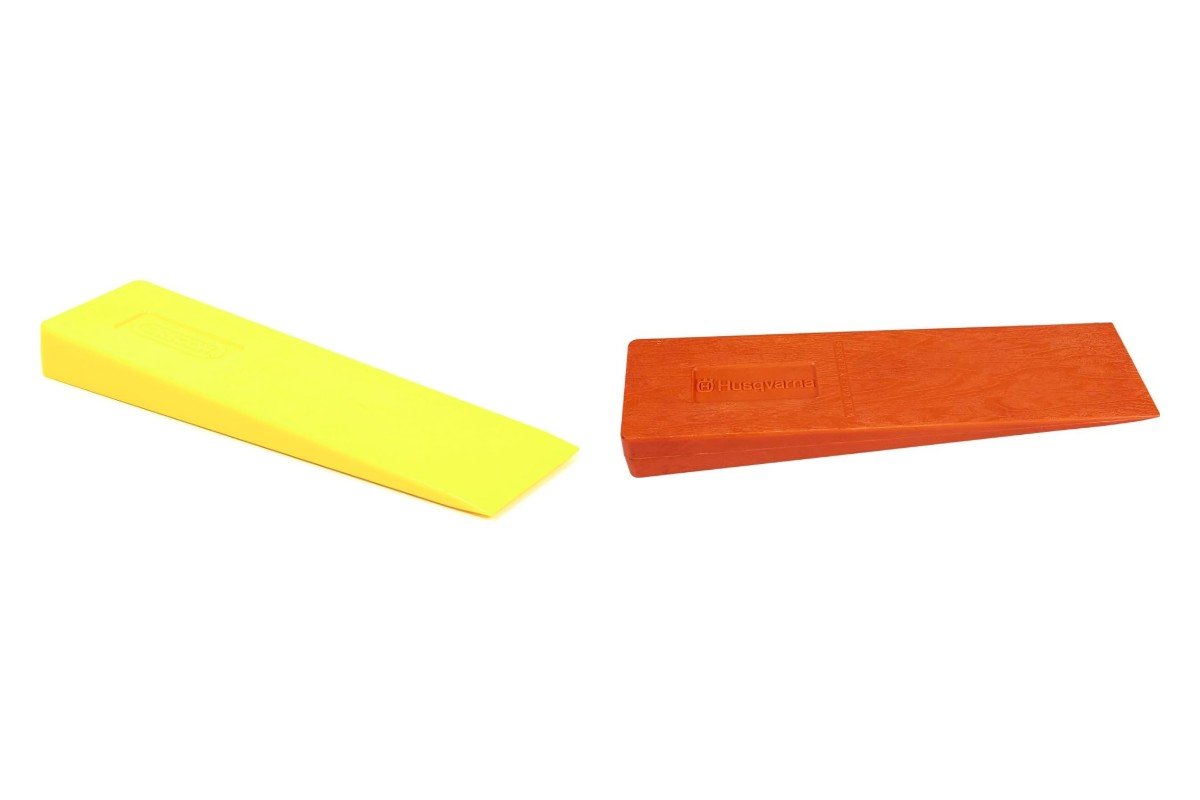
A felling wedge is a small piece of gear that solves a big problem: a tree that wants to sit back on your bar the moment your back cut opens up. Drive one in behind the chain and it holds the kerf (the slot a blade or chain cuts) open, adds lift, and keeps the tree moving in the direction you cut it to fall.
This guide covers how felling wedges work, why plastic replaced steel in almost every modern wedge, how to size a set to the trees you're cutting, a few real products worth buying, and how to use them without losing control of the tree.
Table of Contents
What a Felling Wedge Does and Why You Need One
A felling wedge is a single-taper block, thick at the heel and thin at the tip, driven into the back cut with an axe or a wedge hammer. As it seats deeper, the incline does the work: it lifts the trunk above the hinge and tips the tree toward the intended lean, much like a doorstop pushed under a door lifts it. Two things make this necessary rather than optional.
First, any tree with back lean, meaning it leans slightly away from your intended felling direction, will settle back onto the bar as the back cut opens, pinching the saw before the cut is finished. Second, even a tree with no back lean can settle onto the bar just from its own weight once enough wood is removed. A wedge inserted early keeps the kerf open in both cases.
The OSHA logging eTool's wedge section (OSHA is the federal workplace safety agency) frames this as a segment calculation. Split the tree into imaginary segments the height of the distance from the hinge to the tree's back. Lifting the stump by one inch moves the top of each segment by roughly one inch.
A tall, narrow tree has more segments stacked on top of each other than a short, wide one, so the same one-inch lift at the stump swings a narrow tree's top much farther than it swings a wide tree's top. That's why a wedge that comfortably corrects a modest lean on a slim tree may not be enough on a short, heavy one.
Wedge Materials: Why Plastic Replaced Steel
Older wedges were forged steel, and some are still sold today, but nearly every wedge on the market now is high-impact plastic, most often ABS, a tough, impact-resistant plastic. The reason is chain safety, not cost. If a running chain contacts a steel wedge, metal meets metal and the impact can throw off sharp fragments. A plastic wedge lets the chain cut into it instead of ricocheting off it, and while repeated hits will eventually mushroom the head and dull the tip, that wear is a maintenance issue rather than a safety one.
Aluminum and magnesium wedges exist as a middle ground, lighter and less prone to fragmenting than steel, but they still risk chain damage on contact in a way plastic doesn't. For anyone running a chainsaw mill or bucking near their felling cuts regularly, plastic is the safer default, and it's what the vast majority of current production wedges are made from.
Choosing the Right Wedge Size
Wedge length and heel height both matter. Length determines how far the wedge can travel into the back cut before it bottoms out, and heel height (the thickness at the thick end) determines how much lift it delivers once it's fully seated. A standard heel is about 1 inch. Taller heels in the 1.5 to 2 inch range exist for situations that need more lift than a standard wedge can deliver.
| Typical tree diameter (DBH) | Wedge length to carry | Notes |
|---|---|---|
| Up to 12 inches | 5.5 inch | Standard starter size, fits most small-diameter felling |
| 12 to 20 inches | 8 inch | Covers the bulk of general firewood and milling-log felling |
| 20 inches and up | 10 to 12 inch | Needed for heavier trees and larger sawlogs |
Most people who fell regularly end up carrying more than one size rather than trying to make a single wedge handle everything. A common working set is a 5.5 inch, an 8 inch, and a 10 or 12 inch wedge, which covers most trees a portable sawmill operator or firewood cutter will drop.
Stacking two wedges on top of each other for extra lift is a technique you'll see mentioned in older references. But it carries a real slippage risk since the upper wedge has nothing but friction holding it to the lower one. Reaching for a taller-heeled wedge, or inserting a second wedge beside the first rather than on top of it, is the safer way to get more lift when one wedge isn't enough.
Felling Wedges Worth Buying
These are current, real products spanning the common sizes and a couple of pack formats, chosen to cover a spread of tree diameters rather than one "best overall" pick.
Oregon 5.5-inch Felling Wedge
A lightweight ABS plastic wedge with stabilizing serrations on the flat face to help it hold its bite once driven in. The 5.5 inch length is the standard starter size and the one most people reach for on everyday small-diameter trees.
- Lightweight ABS construction makes it easy to carry several at once
- Serrated flat face bites and holds without slipping under hammer strikes
- Right-sized for the small-diameter trees most people cut most often
- 5.5 inch length runs out of lift on trees at the larger end of the sizing chart
- Single size only, so a bigger tree still means reaching for a second wedge
Stihl 7.5-inch OEM Felling Wedge
Stihl's own plastic wedge in the popular 7.5 inch mid-size length, a factory-brand option for anyone who already runs Stihl equipment and wants a wedge built to the same standard.
- Mid-size 7.5 inch length covers a wider range of everyday trees than the shorter 5.5 inch size
- Made by Stihl to the same standard as its own equipment
- Plastic construction won't damage a chain the way a steel wedge can on an accidental bar strike
- Carries a brand premium over generic ABS wedges of the same size
- Still just one size, so it doesn't scale up to the larger sawlog end of the range
Husqvarna 12-inch Wood Grain Felling Wedge
A full 12 inch wedge for the larger end of what a portable sawmill operator is likely to fell, sized for bigger sawlogs where a shorter wedge would bottom out before delivering enough lift.
- Full 12 inch length delivers enough lift on the larger sawlogs a portable-sawmill operator is likely to fell
- Sized specifically so it won't bottom out the way a shorter wedge does on a big trunk
- Wood-grain textured face designed to grip and resist kickback under the hammer
- More length than you need for small-diameter, everyday trees where a 5.5 to 7.5 inch wedge does the job faster
- Larger size means fewer wedges fit in a saddle pouch or pack
UNCO Tree Felling Wedges, 4-Pack (5.5-inch and 8-inch)
A starter set pairing two of each size with a storage bag, a practical way to cover the two most commonly needed lengths without buying them separately.
- Covers the two most commonly needed lengths in one set instead of buying sizes separately
- Includes a storage bag, keeping wedges organized and easy to grab in the field
- Two of each size means a spare is on hand if one gets buried or lost during a cut
- Tops out at 8 inches, so it doesn't cover the larger sawlog sizes a 12 inch wedge is built for
- A 4-pack of two sizes is bulkier to carry than a single wedge
RNA ABS Felling Wedge Combo Pack, Set of 6 (7.5-inch, 10-inch, 12-inch)
Two each of three larger sizes, aimed at anyone who regularly deals with bigger trees and wants a full range on hand rather than a single size that only sometimes fits the job.
- Two each of three larger sizes gives a full range for bigger trees without hunting down individual sizes
- Set format means there's always a backup if a wedge splits or gets left in a stump
- Covers exactly the larger-diameter gap the smaller starter packs leave open
- No small 5.5 inch size included, so everyday small-diameter trees still need a separate wedge
- Six wedges add meaningful bulk and weight to a gear bag compared to buying just what's needed
How to Use Felling Wedges Safely
Insert the wedge into the back cut as soon as there's room for it, rather than waiting until the tree has already started to settle onto the bar. Once a tree begins sitting back, driving a wedge in becomes much harder and the saw may already be pinched. Set the wedge in the center of the kerf, not off to one side, and account for the width of the cut itself. A wedge has to fill the saw's kerf before it can start lifting the tree.
Keep wedges away from the hinge. Placing a wedge too close to the hinge concentrates force where you need the wood to stay intact and controlled, and can cause the hinge to lift or break before the tree has committed to falling in the intended direction. At that point, control of the fall is lost. A hinge that fails unpredictably is one of the more dangerous outcomes in felling, so the wedge's job is to lift the tree, not to load the hinge.
Never let the running chain contact a wedge. Plastic wedges are built to reduce the danger if this happens by accident, letting the chain cut into the material instead of throwing fragments the way metal-on-metal contact does, but a hit still dulls the chain and damages the wedge.
Wear eye protection, since repeated impacts on a plastic wedge can mushroom the head and send small plastic fragments outward. Replace a wedge once it's heavily damaged or deeply cut rather than continuing to drive it. A badly worn wedge holds less reliably and is more likely to slip out from under load.
Maintenance and Care
Felling wedges need very little upkeep, but a few habits keep them working the way they're rated to. Check the tip and heel after heavy use for mushrooming, cracking, or a taper that's been worn down unevenly by repeated axe or hammer strikes, since a rounded-off taper won't seat as reliably.
Store wedges somewhere they won't get crushed under other gear, and keep them in the bag or pouch they came with if one was included. That protects the taper and to make sure you have the right size with you in the field. A wedge that's cracked through the body should be retired rather than pressed back into service, since a wedge that fails under load can let the tree settle back onto the bar without warning.
Frequently Asked Questions
What size felling wedge do I need?
Match wedge length to the diameter of the trees you're cutting: 5.5 inch for trees up to about 12 inches, 8 inch for 12 to 20 inches, and 10 to 12 inch for anything larger. Most people who fell regularly carry more than one size.
Why are most felling wedges plastic instead of steel?
Plastic wedges let a chainsaw chain cut into them if accidental contact happens, rather than throwing off metal fragments the way a steel wedge can when struck by a running chain. That chain-safety difference is why plastic replaced steel as the standard material.
How many felling wedges should I carry?
A common working set is a 5.5 inch, an 8 inch, and a 10 or 12 inch wedge, which covers most trees a portable sawmill operator or firewood cutter will drop. Carrying at least two wedges also means you have a backup if one gets stuck or damaged mid-cut.
Can I stack two felling wedges for more lift?
You can, but it carries a real slippage risk since the top wedge only has friction holding it to the one underneath. A taller-heeled wedge, or a second wedge placed beside the first rather than on top of it, is the safer way to add lift.
What happens if my chainsaw chain hits a felling wedge?
With a plastic wedge, the chain cuts into the material instead of throwing sharp fragments, which is safer than metal-on-metal contact with a steel wedge. It still dulls the chain and damages the wedge, so it's worth avoiding, but the result is far less dangerous than with steel.
A felling wedge is inexpensive, simple, and one of the few pieces of gear that directly prevents a stuck saw and a tree that falls somewhere other than where you aimed it. For the tool that turns and rolls a log once it's already on the ground, see our guide to cant hook vs. peavey, and for moving a felled log from one spot to another, see our guide to log tongs.