
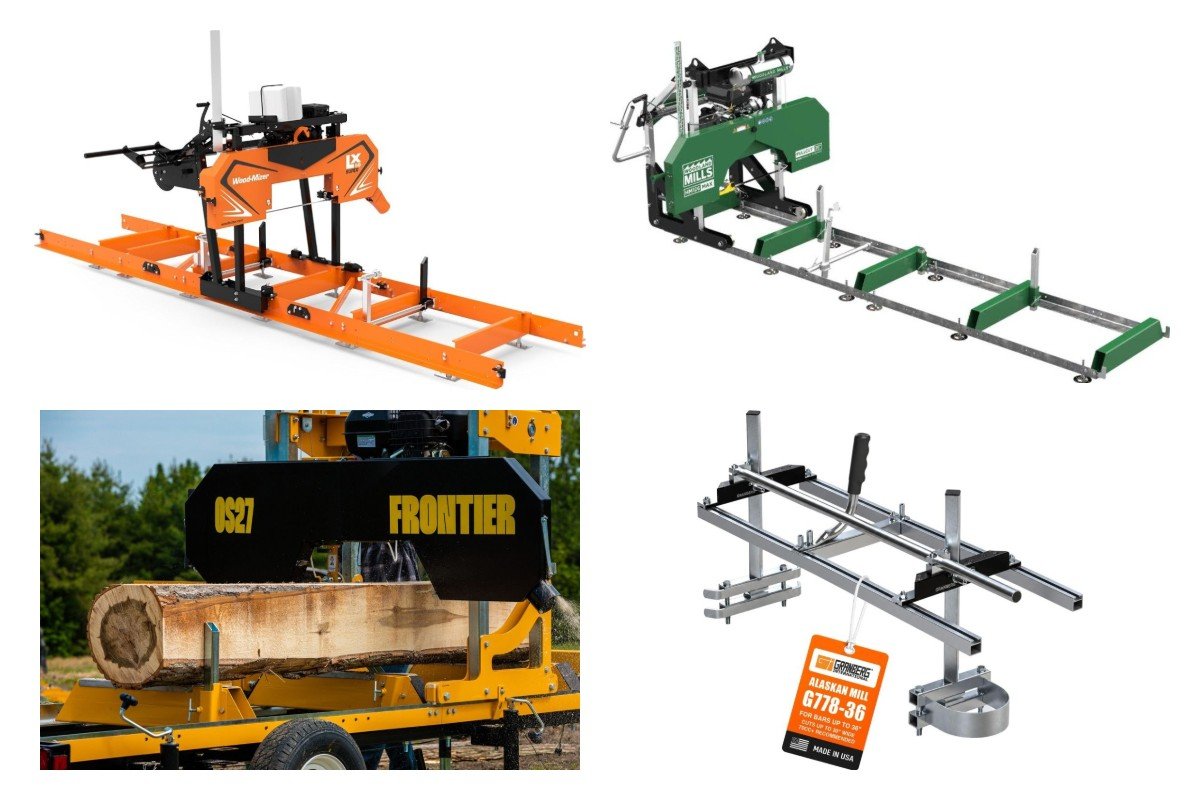
This table lines up the published specs of 45 portable band sawmills and 15 chainsaw mills from 14 brands, so you can compare them in one place instead of opening a dozen tabs. Pick a brand, type in the biggest log you need to cut, or tap any column to sort by it. Every number comes from the maker's own product page or official listing, checked on October 15, 2026. If a maker doesn't publish a number, the cell says so instead of guessing.
How to read the specs
Max log diameter is the widest log the mill can hold. Max width of cut is the widest cut the blade can make, which sets your widest board or slab. It is usually the same or a few inches smaller than the log diameter. A mill that takes a 26 inch log might only cut a 20 or 22 inch board, because the blade guides take up room on each side. If you want wide slabs, shop by width of cut, not log diameter.
Log length is the longest log the mill handles on the track or bed it ships with. Most brands sell bed extensions, so this is a starting point, not a hard limit. TimberKing lists its number as an extendable cut length.
Engine is the base engine. Many mills come with bigger gas engines, diesel, or electric options for more money.
Weight is the hardest spec to compare, because brands don't measure it the same way. Woodland Mills lists shipping weight. Wood-Mizer lists the weight with its heaviest engine on most models. MechMaxx lists the mill's own weight. Frontier, Norwood, BILT HARD and Hud-Son don't publish a weight at all. The table shows each number the way the maker gives it, so treat weight as a rough guide.
Choosing a mill from the table
Start with the logs you will cut most, not the biggest one you might find someday. A mill sized for your usual logs is lighter, cheaper and easier to move. Then check width of cut, since that sets the widest boards and slabs you can sell or use.
If price is the main limit, our guide to the best portable sawmill under $2,000 covers the budget end. For a single pick, see the best portable sawmill overall. Not sure you need a band mill at all? Our chainsaw mill vs bandsaw mill comparison walks through the tradeoffs.
Chainsaw mill specs
A chainsaw mill is a frame that clamps to your chainsaw's bar and rides along a rail or a flat board on top of the log. The key number is the longest bar it fits, since your bar length sets how wide a slab you can cut. On the Granberg Alaskan MKIV sizes from 24 to 48 inches, the max cut width runs 4 inches less than the bar length, so a 36 inch mill cuts slabs up to 32 inches wide. The bigger 60 and 84 inch frames lose a little more.
The bar is only half the story. A long bar needs a strong saw to pull it through hardwood, so check our guide on what size chainsaw you need for a chainsaw mill before you buy a big frame.
How we built this table
We took every number from each maker's own product page, or from the brand's official Amazon listing for brands that only sell there. We did not use dealer sites, forums or review sites. We don't test these mills ourselves, so this table only shows what the makers publish.
Makers update their lineups and specs, so check the current spec sheet before you buy. We left out models the makers list as discontinued, and models whose product pages give conflicting numbers.
Common questions
What is the difference between log diameter and width of cut on a sawmill?
Log diameter is the widest log the mill can hold. Width of cut is the widest board or slab it can cut. Width of cut is usually the same or smaller. In this table the gap runs from zero up to about 8 inches, because the blade guides limit how wide a cut can be.
Which portable sawmill in the table cuts the widest board?
Among the band mills, the Hud-Son Oscar 52 lists the widest board at 48 inches, followed by the Wood-Mizer LT15WIDE at 39 inches. Among chainsaw mills, the Granberg Alaskan MKIV 84 inch lists slabs 70 to 78 inches wide.
Why are some cells blank?
A blank cell means the maker doesn't publish that spec. We leave it empty rather than fill it with a guess from another site.