
Search for the best chainsaw mill attachment for beginners and you'll find two very different kinds of advice. One camp says go straight for the professional-grade mill everyone recommends. The other says just grab whatever's cheapest and see if you even like milling. Both miss the actual problem a first-timer has: you don't yet know if this hobby is for you, but you also don't want to buy a tool that can't do the one thing you bought it to do.
We've now reviewed all three tiers on this site, the industry-standard overall pick, the budget option, and the dedicated Granberg deep-dive, and the beginner question turns out to have its own answer, separate from either "best overall" or "cheapest."
Table of Contents
Two ways beginners get this wrong
The first mistake is overspending before you know if you'll stick with it. The Granberg Alaskan MKIV is an excellent mill and the closest thing this category has to an industry standard, but it's also real money to put down on a hobby you haven't tried yet.
The second mistake is underspending on the wrong kind of tool entirely. We covered this in our budget chainsaw mill attachment review: the budget VEVOR option isn't a smaller rail mill, it's a small bracket-clamp tool built for narrow rip cuts near a board's edge. It's a useful tool for what it does, but it can't produce a real slab across the width of a log: which is usually the whole reason someone wants to try milling in the first place.
A true beginner pick needs to split the difference: real rail-mill capability, at a price that doesn't punish you for trying something new.
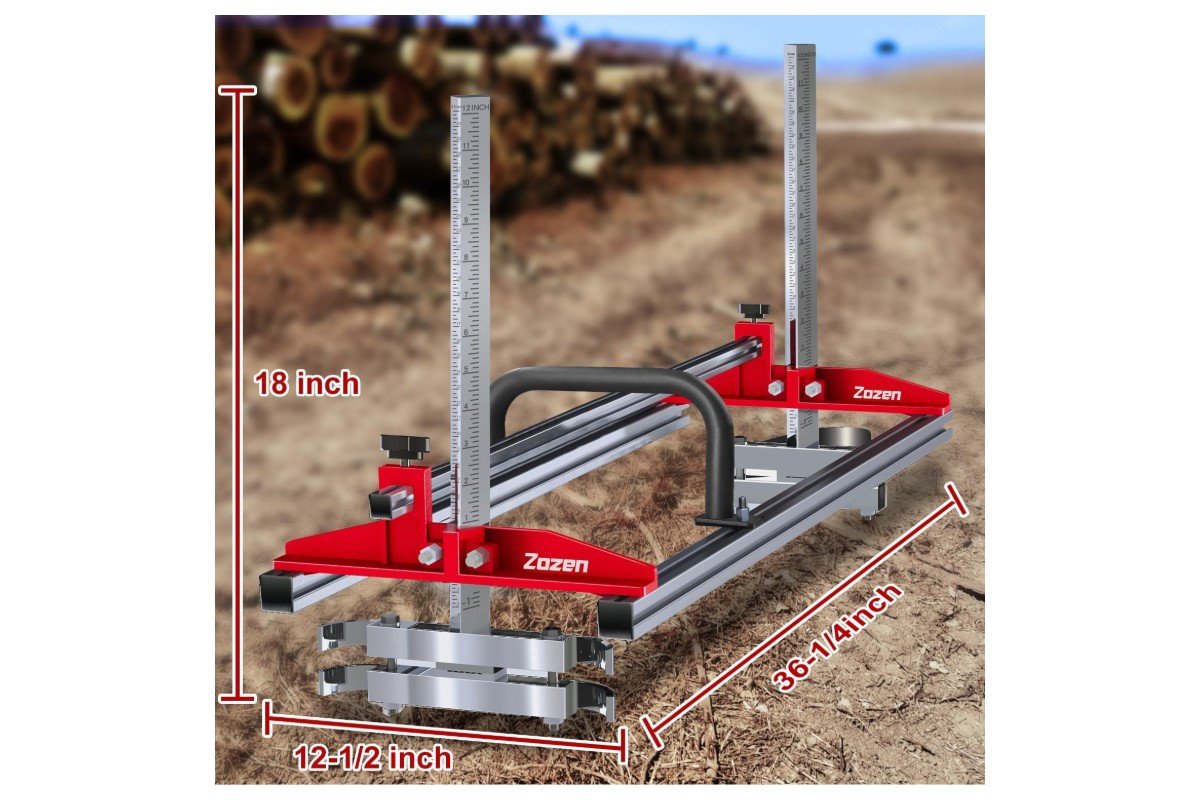
Our pick: Zozen Chainsaw Mill (14" to 36")
The Zozen Chainsaw Mill is rated 4.4 out of 5 across more than 1,100 ratings, and carries Amazon's Choice for this category, a real, established product rather than an unknown. It's our pick for the best chainsaw mill attachment for beginners, and the reasoning is straightforward once you see what it gets right.
It's a genuine rail-style mill, not a bracket, so it does the same basic job as the Granberg: it rides along the top of a log or a set-up rail system and lets a chainsaw make a level, repeatable cut across the full width. What makes it the beginner pick is the modular build. It assembles into three different sizes and can be used at the smallest one on its own. So a first-timer with a smaller saw and smaller logs isn't forced to wrestle with hardware sized for a 36" bar.
It ships with four felling wedges, the assembly tools, a storage bag, and a printed manual, and the depth scale is marked in both metric and imperial.
What makes it realistic for a first mill
Assembly is the part beginners worry about most, and it's the part that's straightforward here. Owners consistently describe getting it together from the manual without needing outside help, and several mention it going together "quickly" with all parts accounted for. That's worth more than it sounds for a first attempt: nothing kills a beginner's interest in a new hobby faster than fighting the instructions before you've even touched a log.
The price also matters in a way that's easy to underrate. It's a real commitment but not a painful one if it turns out milling isn't for you: a fraction of the flagship mill's cost, with none of the narrow-rip limitation of the true budget pick.
Expect a learning curve
No chainsaw mill is easy the first time you use one, and the Zozen is no exception. A handful of real, consistent notes from owners are worth knowing before your first cut:
The mounting hardware takes up some of your usable bar length: several owners running 18" to 24" bars report their maximum cut width ends up several inches narrower than the bar itself, since the brackets and how they clamp on take up real space. Plan your bar length with that margin already subtracted, not as an afterthought.
The adjustment hardware can be fiddly. More than one owner describes the track extension screws working loose over time and recommends a drop of thread locker to keep them seated. A few also mention the tightening mechanism takes some trial and error to get right on the first assembly.
And like any Alaskan-style mill, the actual milling technique, starting level, setting wedges as you clear the log, watching your depth markings, takes a log or two to get comfortable with, no matter how good the tool is. That part isn't a Zozen problem. It's a chainsaw milling problem, and every beginner runs into it.
How the three mills we've reviewed compare
If you want the short version: the Granberg Alaskan Mill is the one to buy once you know you're sticking with this: decades of track record, the deepest parts and accessory ecosystem, and the pick in our overall best chainsaw mill attachment guide. The budget VEVOR bracket is the one to buy if a narrow rip cut is all you need, covered in our budget pick review.
The Zozen is the one that sits in between: a real rail mill, assembled from a manual most owners handle without help, at under a third of the flagship's price: which is what makes it the best chainsaw mill attachment for beginners specifically, as opposed to the best mill outright.
A second beginner option: Timber Tuff TMW-56 edging guide
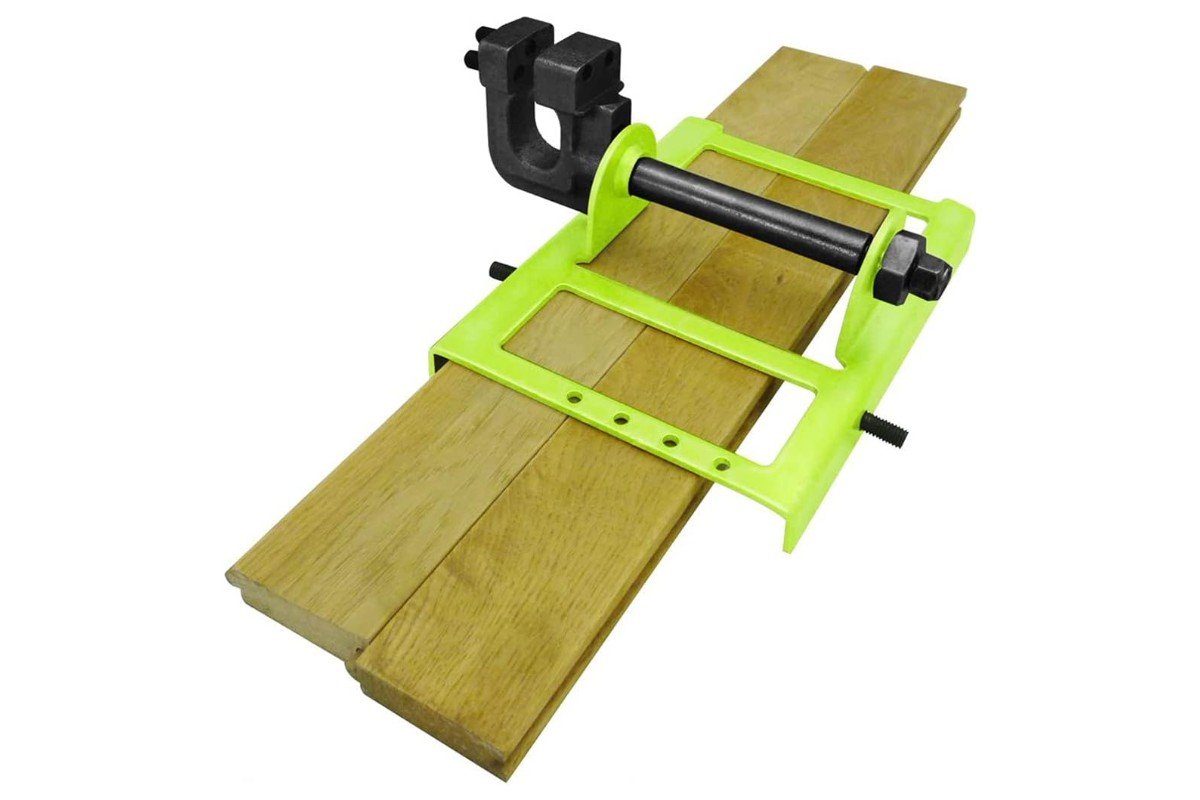
The Zozen isn't the only reasonable beginner option. The Timber Tuff TMW-56 takes a completely different approach. Instead of a rail-and-clamp mill that rides across the top of the log, it's a small steel guide that clamps to your bar and rides directly on the flat cut face of the log itself, rather than needing a separate straight guide board. It's the cheapest real way to try chainsaw-guided cutting, and it carries the largest review base of any attachment covered on this site: over 3,200 ratings at a 4.3-star average.
The limitations matter more than usual here. Owners consistently report the clamp's set screws work loose under vibration unless you drill through the bar and bolt it on permanently, which the manufacturer itself recommends for anything beyond occasional use. And this isn't a slabbing tool the way the Zozen is: it's built for rough beams, posts, and squared-up lumber rather than clean, wide slabs. Several long-time owners describe it as the tool that convinced them milling was worth it before they moved up to a full mill, not as something they kept using once they were doing this regularly.
Best for: the absolute lowest-cost way to find out if chainsaw milling interests you at all, especially if you mainly want rough beams or posts rather than furniture-grade slabs.
Not ideal for: anyone who wants real slab-width capability out of the gate, or who isn't willing to drill their bar for a secure long-term mount. That's exactly the gap the Zozen fills instead.
Zozen vs. Timber Tuff: which beginner path fits you
Both are reasonable beginner paths, and they answer slightly different questions. The Zozen is the pick if you want to experience something close to real slabbing from day one: a true rail mill, modular into smaller sizes, at a price that's still a real commitment but not a painful one. The Timber Tuff is the pick if you want the cheapest possible test of whether chainsaw milling interests you before spending anything meaningful, understanding that it's suited to rough beams and posts rather than clean wide boards.
Neither is the wrong choice. The mistake would be buying the Timber Tuff expecting Zozen-style slabs, or buying the Zozen when what you wanted was the cheapest possible first attempt.
Chain, bar length, and what beginners get wrong
The most common first-timer mistake isn't choosing the wrong mill. It's underestimating how much bar length the mounting hardware takes up. Plan on losing 3 to 4 inches of usable cutting width once any of these attachments is clamped on, rail mill or bracket alike. A saw with an 18-inch bar realistically cuts something closer to 14 to 15 inches wide, not 18.
The second common mistake is milling with whatever chain came on the saw. A standard cross-cutting chain has a steeper tooth angle, around 30 degrees, built for quick bursts through wood grain at different angles. Milling holds the chain in continuous contact with wood for the length of a slab, and a ripping chain's shallower angle, close to 10 degrees, is built specifically for that sustained load. Skipping this swap is the most common reason a first attempt at milling feels much harder and slower than it should.
Best Chainsaw Mill Attachment for Beginners (2026)
The best chainsaw mill attachment for beginners is the Zozen Chainsaw Mill, a rail mill with solid slabbing capability that won't punish a first try.
Product SKU: B09R7DQ99P
Product Brand: Zozen
4.4
Pros
- Easy to assemble straight from the manual, no outside help needed
- A real rail mill with genuine slabbing capability, well under the flagship mill's cost
Cons
- Genuinely has a learning curve, like every chainsaw mill attachment on a first cut
- Not a substitute for going straight to the Granberg if budget isn't a concern
Safety for a first-time miller
Milling puts more sustained strain on both saw and operator than ordinary chainsaw work, and a first-timer should plan for that rather than discover it mid-cut. Wear the same protective gear you would for any chainsaw work (chaps, eye and ear protection, gloves). Add a face shield, since milling throws a steady stream of sawdust back toward the operator for the length of the cut, not just a quick burst. Chock the log securely before starting on both ends, and take your first few cuts slower than feels necessary. Rushing the setup is where most beginner mistakes happen, not during the cut itself.
Quick answers
What's the cheapest way to try chainsaw milling as a beginner?
The Timber Tuff TMW-56 is the lowest-cost genuine option, though it's built for rough beams and posts rather than clean wide slabs. For real slabbing capability at a still-affordable price, the Zozen is the better starting point.
Do I need to drill my chainsaw bar to use a beginner chainsaw mill attachment?
Not necessarily at first, but several beginner-tier attachments, including the Timber Tuff, recommend drilling for anything beyond occasional use, since their clamp-only mounting tends to loosen under vibration over time.
How much cutting width do I lose once a beginner mill is mounted?
Plan on losing 3 to 4 inches of your bar's total length to the mounting hardware, regardless of which attachment you choose. An 18-inch bar realistically cuts around 14 to 15 inches wide once a mill is clamped on.
Is assembly the hard part of chainsaw milling for beginners?
No. Most owners across every attachment on this site describe assembly as the easy part, done in well under an hour with the included manual. The actual learning curve is technique: keeping the first cut level, managing wedges, and staying consistent through a long pass.