
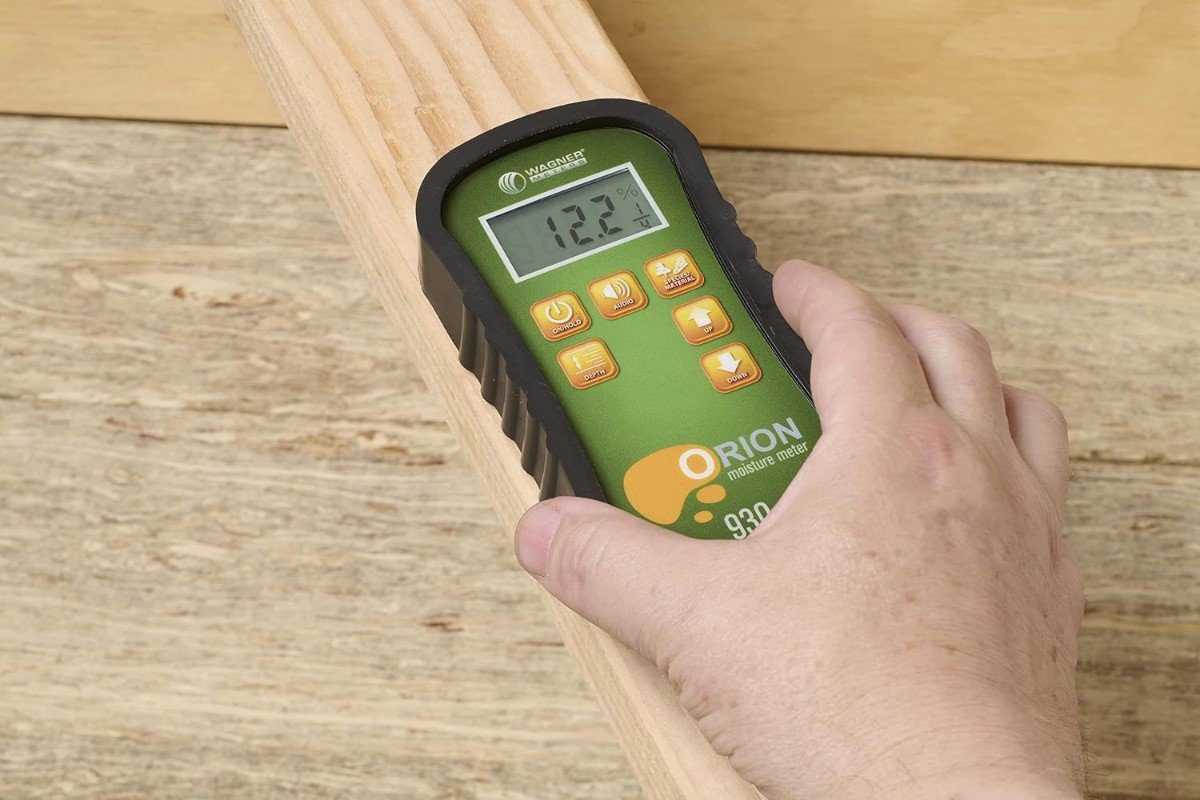
A board that looks dry can still have 30 percent moisture content inside. That gap is exactly why a moisture meter matters more once you're milling your own lumber than it does for someone buying kiln-dried boards at the yard. Fresh-cut lumber from a chainsaw mill or portable sawmill starts somewhere between 40 and over 100 percent moisture content. The figure depends on species. Building or finishing with it before it's dry enough is how you end up with cupped boards, popped nails, and joints that open up six months later.
We looked at five moisture meters that keep coming up for wood, ranging from a basic pin-type tester to a professional pinless unit built specifically for lumber. The right one depends less on brand and more on one question: are you checking rough-sawn, freshly milled boards, or wood that's already surfaced and closer to finished?
Our top picks at a glance
- General Tools MMD4E: Best overall
- Klein Tools ET140: Best for a trusted, do-it-all brand
- Wagner Meters Orion 930: Best for milled lumber specifically
- Lignomat Mini-Ligno E/D: Best pin meter for rough-sawn boards
- Mecurate Digital Pin Type: Best budget pick
How we picked
We compared pin versus pinless sensing, how each meter handles freshly cut or rough-sawn wood (not just finished lumber), reading depth, real Amazon review counts and ratings, and price. We checked each meter's current Amazon rating and review count ourselves.
Pin meters vs. pinless meters, and why it matters more for milled lumber
A pin meter pushes two small metal probes into the wood and reads the electrical resistance between them. It measures moisture at whatever depth the pins reach, and it needs a species setting to correct for the fact that different woods conduct electricity differently at the same moisture level.
A pinless meter uses an electromagnetic sensor pad pressed against the surface, with no holes at all. It reads a fixed depth, usually a quarter inch or three-quarters of an inch, below the surface without damaging the wood.
For finished lumber and woodworking projects, pinless wins because it doesn't leave marks. For freshly milled, rough-sawn boards straight off a sawmill, it's not that simple. Wet, rough surfaces can throw off a pinless reading, since surface moisture or condensation can make a board read 10 to 20 percent higher than what's going on deeper inside. That's the reason a pin meter, or a pinless meter built for dual-depth lumber reading specifically, is worth the extra thought if you're checking your own fresh-cut boards rather than lumber that's already surfaced and acclimated.
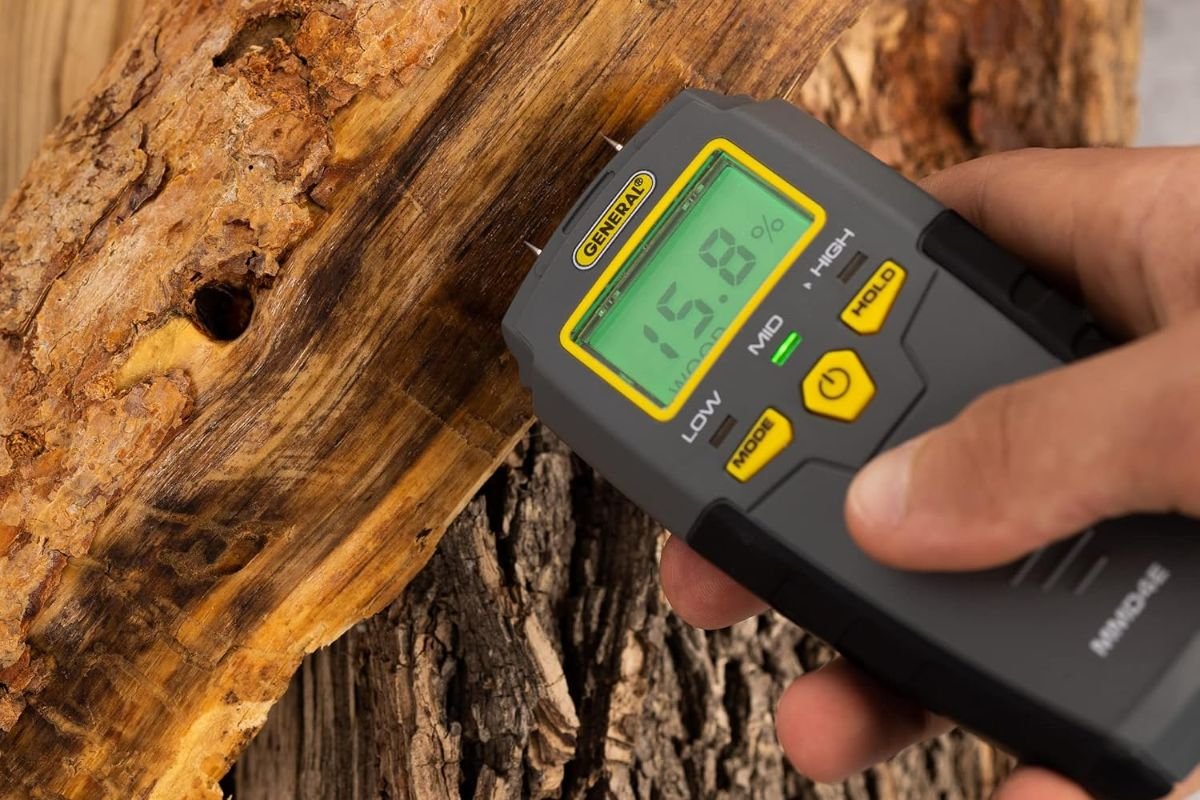
1. General Tools MMD4E: Best overall
Type: Pinless | Rating: 4.5 stars, 15,200+ ratings
The MMD4E is the moisture meter most people end up buying, and the review count backs that up. It's pinless, so it won't mark up a board, and it covers wood, drywall, and a handful of other materials with simple mode switching. It's built more for general home and shop use than for sawmill-specific work, which is exactly why it's the right starting point if you're mostly checking lumber after it's already been surfaced or has sat stacked and stickered for a while.
The tradeoff is depth. Like most budget pinless meters, it reads close to the surface, so on a thick rough-sawn board, it's telling you about the outside of the board, not necessarily the core.
- Thousands of owner reviews
- Pinless and non-marking
- Easy to use
- Reasonably priced for a name-brand tool
- Shallow reading depth
- Not built with fresh-cut rough lumber specifically in mind
2. Klein Tools ET140: Best for a trusted, do-it-all brand
Type: Pinless | Rating: 4.5 stars, 6,200+ ratings
Klein Tools built its name on electrical tools, and the ET140 carries that same durability into a moisture meter. It reads up to three-quarters of an inch below the surface, non-destructively, and switches between wood, drywall, and masonry settings. If you already trust Klein for other tools in the shop, this is the natural pick, and its deeper read gives it a slight edge for anything thicker than typical furniture stock.
It's still a general-purpose pinless meter rather than one designed specifically for lumber drying, so the same caution about wet, rough-sawn surfaces applies.
- Deeper 3/4 inch read than most budget pinless meters
- Well-known and durable brand
- Multi-material
- Same surface-moisture sensitivity as any pinless meter on rough, wet wood
3. Wagner Meters Orion 930: Best for milled lumber specifically
Type: Pinless, dual depth | Rating: 4.6 stars, 76 ratings
Wagner Meters has built moisture meters for the lumber industry for more than 50 years, and the Orion 930 is the one designed around the exact problem a sawmill owner runs into: a board's surface dries faster than its core. The 930 reads at both a quarter inch and three-quarters of an inch, so you can check whether the outside of a stack is drying evenly with the inside, not just get one number and guess.
It's also virtually unaffected by the temperature of the wood or the room, which matters if you're checking lumber that just came off the mill and is still warm from cutting. The included On-Demand Calibrator lets you verify accuracy yourself in under a minute rather than shipping the meter back to the factory. This is the meter to buy if lumber drying is a real, ongoing part of what you do, not an occasional check.
It's a real investment, and it's more than you need if you're only milling the occasional board for a weekend project.
- Purpose-built for lumber
- Dual-depth reading catches surface-versus-core drying gaps
- On-site calibration
- Well known in the lumber industry
- Expensive relative to every other option here
- More capability than an occasional hobbyist needs
4. Lignomat Mini-Ligno E/D: Best pin meter for rough-sawn boards
Type: Pin, dual pin length | Rating: 4.6 stars, 232 ratings
Lignomat is a moisture-meter specialist, not a general tool brand that added a moisture meter to its lineup, and the Mini-Ligno E/D shows it. It ships with both short and long pins, so you can take a quick surface reading or push the longer pins in for a deeper check on a thick rough-sawn board. That flexibility is exactly what a pin meter needs to be useful on milled lumber, not just finished stock.
Because it's a pin meter, it isn't thrown off by surface condensation or a wet, rough face the way a budget pinless unit can be. The two wood-group settings cover softwoods to dense hardwoods, and it measures a wide 6 to 45 percent range, comfortably spanning fresh-cut lumber down to properly dried stock.
- Long and short pins for real flexibility on rough-sawn boards
- Not thrown off by surface wetness the way pinless meters can be
- Wide measuring range
- Built by a company that only makes moisture meters
- Leaves small pinholes
- Pricier than a basic pin meter
5. Mecurate Digital Pin Type: Best budget pick
Type: Pin | Rating: 4.5 stars, 1,100+ ratings
If you just want a straightforward pin meter to spot-check boards before you build with them, the Mecurate covers the basics without the price tag of the Lignomat or the Wagner. It has two measuring modes and eight wood calibration settings, with a large backlit display and three colored indicators that give you an at-a-glance read on whether a board is dry, borderline, or too wet.
It won't match the accuracy or durability of pricier pin meters, and the pins are shorter, so it's better suited to typical lumber thickness than very thick slabs.
- Low price
- A true pin-type meter (works on rough wet wood)
- Color-coded readout
- Decent review count for the price point
- Shorter pins than the Lignomat
- Build quality is what you'd expect at this price
How dry does lumber need to be?
Freshly milled lumber typically starts in the 40 to 80+ percent moisture content range depending on species, sometimes higher for green softwood. For most building and furniture use, you're aiming for 6 to 8 percent for indoor furniture and cabinetry, and closer to 12 to 15 percent for framing or outdoor structures, depending on your local climate's equilibrium moisture content. Air drying (letting lumber dry slowly outdoors in a stacked pile) alone typically gets a board down to about 12 to 20 percent, which is fine for many construction uses but usually not dry enough for fine furniture without extra kiln drying.
The only way to know where a specific board stands, rather than guessing based on how long it's been stacked, is to check it.
Common mistakes people make with wood moisture meters
Checking only the surface of a thick board and assuming the core matches. This is the single biggest reason a dual-depth or pin meter matters more for milled lumber than for a thin finished board, where surface and core moisture are close enough not to matter.
Skipping the species setting. Different wood species conduct electricity differently at the same moisture level, so a meter left on the wrong species setting can be off by several percentage points, enough to matter when you're deciding if a board is ready to build with.
Testing a board right after it's cut, still warm from the saw, and reading that as final. Freshly cut lumber needs to be checked over time as it dries, not just once at the start.
Best moisture meters for wood, side by side
To dry boards faster than air drying, see our DIY lumber kiln guide. To slow cracking at the log ends while wood dries, see end grain sealer for logs.
Frequently asked questions
Do I really need a moisture meter if I'm just milling lumber for myself?
If you're building anything with the wood, yes. A board that feels dry can still be well above safe building moisture content, and that mismatch is what causes warping, cracking, and loose joints later. A basic pin meter is inexpensive enough that there's little reason to skip it.
Should I get a pin meter or a pinless meter for lumber I've just milled?
For rough-sawn, freshly cut boards, a pin meter or a dual-depth pinless meter built for lumber (like the Wagner Orion 930) is the safer choice. Basic pinless meters can misread wet, rough surfaces by a wide margin.
What moisture content is safe to build with?
Roughly 6 to 8 percent for indoor furniture and cabinetry, and 12 to 15 percent for outdoor or framing use, though the exact target depends on your local climate. Checking with a meter is the only way to know for sure rather than estimating from drying time alone.
Does wood species affect the reading?
Yes. Pin meters need a species-specific correction because different woods conduct electricity differently at the same moisture level, and pinless meters use density settings for the same reason. Always set the meter to the correct species or wood group before trusting the number.
Are the cheap pin-type meters accurate enough to trust?
For a basic pass-or-fail check before building, yes, a budget pin meter like the Mecurate is accurate enough. The pricier options earn their cost through depth flexibility (longer pins, dual-depth pinless sensing) and durability over years of shop use, not raw accuracy on a single reading.
Which one to buy
If you're mostly checking lumber that's already surfaced or been drying a while, the General Tools MMD4E or Klein Tools ET140 cover that well. If lumber drying is a real, recurring part of running a sawmill, the Wagner Orion 930's dual-depth reading is worth the price because it answers the actual question that matters: is the inside of this stack drying as fast as the outside? For rough-sawn boards on a budget, the Lignomat Mini-Ligno E/D's long and short pins get you real flexibility without Wagner pricing. The Mecurate is a perfectly reasonable way to start if you just want a straightforward yes-or-no answer before you build with a board.
Still working through the drying process itself? Our guide to air drying lumber after milling covers stacking, sticker spacing, and end sealing so you know what the meter should be telling you.