
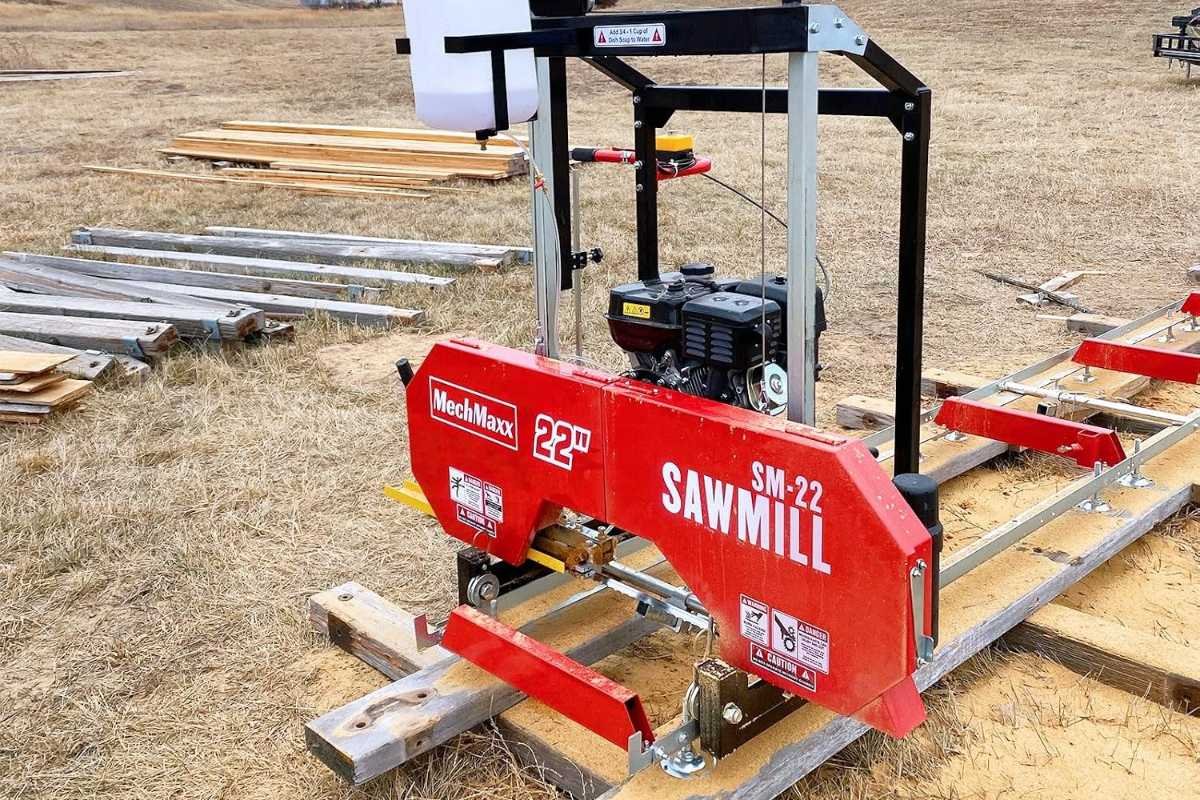
The best portable sawmill for beginners is not the biggest one you can afford. If this is your first sawmill, that's the opposite of what most spec-sheet comparisons push you toward, but a smaller mill is cheaper to learn on, easier to set up alone, and still cuts real lumber. Here's what to weigh before you buy your first mill, and the specific mill we'd point a beginner to.
Table of Contents
Why the Best Portable Sawmill for Beginners Is a Smaller One, Not a Compromise
Every buying guide leads with the biggest log diameter and the most horsepower, because those numbers look impressive on paper. For a first mill, they're the wrong things to optimize. You don't yet know whether you'll mill twice a year or every weekend, whether you'll work alone or with help, or whether milling becomes a hobby you love or one you try once and park in the garage. A smaller mill answers all three questions for less money and less regret.
There's a real mechanical reason too. A bigger engine and a longer track add weight, and weight is what makes a mill hard to set up solo. A compact mill is something one person can uncrate, assemble, and level without recruiting help, which matters more than it sounds on your first few cuts.
What you're giving up, stated plainly
None of this is free. A smaller mill has a lower ceiling, and you should know exactly where that ceiling is before you buy.
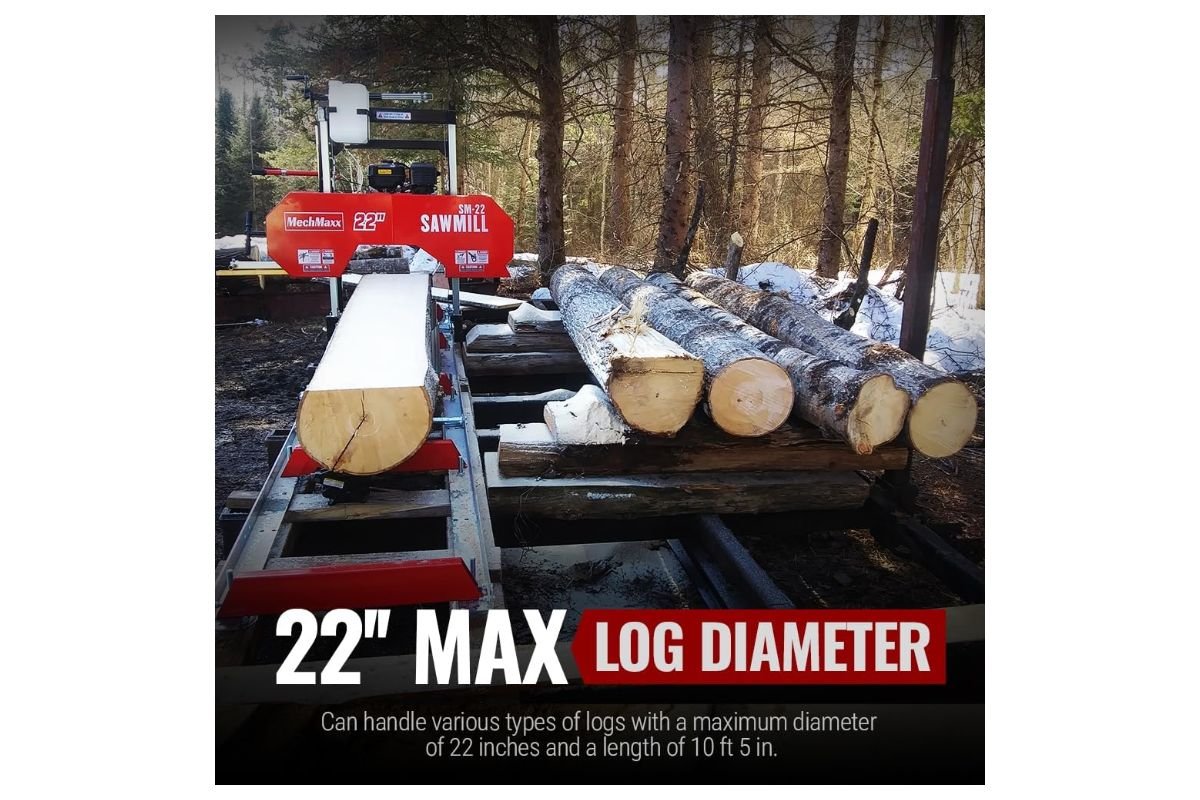
Log diameter. A compact mill in this class tops out around 22 inches. That covers most storm-damaged trees, firewood-length rounds, and the kind of mid-size hardwood a homeowner or small hobbyist deals with. It does not cover a big old oak or a wide walnut you're hoping to turn into slab furniture.
Board width and thickness. Expect a maximum board width in the 18-inch range and a maximum thickness around 6 inches. Fine for framing lumber, siding, and furniture stock. Not enough if you're planning full-width slab tables from the start.
Track length. A shorter track, often in the 13-foot range, handles firewood rounds and shorter cants (a log squared off on two or more sides) comfortably but won't take a full-length sawlog. If you're planning to mill logs longer than that from day one, you'll outgrow a compact mill's track faster than its engine.
If any of those limits rule out the kind of milling you want to do, don't force it. Go straight to a full-size mill instead. Our best portable sawmill overall pick covers what a 32-inch, 20-foot track mill can handle and what it costs.
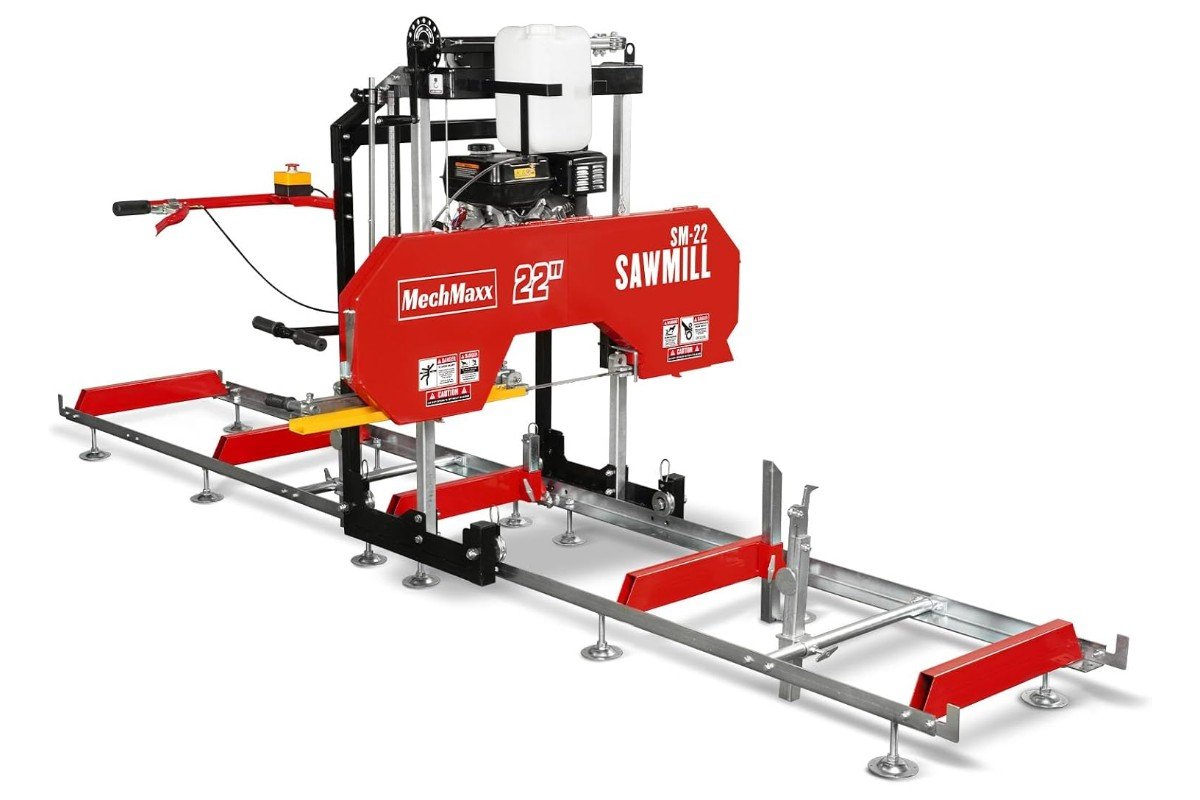
Our pick: MechMaxx 22-Inch Portable Sawmill (SM-22)
We looked at every compact, currently buyable bandsaw mill on Amazon rather than a brand you'd have to call a dealer for, and the MechMaxx SM-22 is the smallest, cheapest real option with a track record behind it. It has 4.6 stars across 48 ratings on Amazon.
The specs match the beginner brief. A 274cc, 8.1HP recoil-start gas engine (no battery, no electric-start complexity to learn), 22-inch max log diameter, 18-inch max board width, 6-inch max board thickness, and a 13-foot track. Cutting speed is controlled by pushing the handle, so you speed up or slow down by feel rather than fighting a fixed setting, which is easier to learn than a mill that runs at only one speed.
One note on the reviews: MechMaxx sells the SM-22, SM-26, and SM-32 as size variants of the same listing, so the 48 ratings span all three sizes, not the 22-inch model alone.
That's worth knowing rather than assuming every one of those 48 reviewers bought exactly this size. What we can say directly: one reviewer titled their review "Great starter mill" and described repainting a house and building cabinets with it after a couple of months of use, which is close to exactly the use case this article is written for. Reviewers across the size range consistently mention easy setup and good value for the price, without the pattern of assembly and engine complaints that shows up on the larger SM-32 listing.
It's several hundred dollars under the smallest BILT HARD model and roughly half the price of MechMaxx's own 32-inch flagship. Check the current price on Amazon.
What a beginner needs on top of the mill
The mill is only part of the setup cost. Budget for blades (a compact mill still wears through them on dirty or knotty logs, same as any bandsaw mill), eye and ear protection, and a flat, reasonably firm patch of ground to set the track on. You don't need a shed or a permanent pad for a first mill. You do need somewhere level enough that the track isn't fighting gravity on top of everything else you're learning.
Skip the accessories that get bundled into "starter kits" on other sites: moisture meters, specialty sharpening jigs, and extra bed extensions aren't things a first-time owner needs before the first log goes through. Learn on what the mill ships with, then decide what's missing.
When to skip the beginner mill entirely
If you already know you're milling logs over 22 inches, or you're setting up to sell lumber rather than use it yourself, a beginner mill is a detour, not a starting point. You'll spend money on a mill you outgrow in a season and then spend more money on the mill you needed. In that case, go straight to a full-size 32-inch mill and skip this tier.
Which one to buy
The best portable sawmill for beginners doesn't need to be the biggest one on the page. The MechMaxx SM-22 costs less, sets up easier, and still turns real logs into real lumber, as long as you're working with logs under 22 inches and boards under 18 inches wide. Know that ceiling going in, and it's a good place to start.
Quick answers
What is the best portable sawmill for a beginner?
A compact mill in the 22 inch class, like the MechMaxx SM-22, is a better first buy than a full-size mill. It costs less, is easier to set up alone, and still handles most storm-damaged trees and mid-size hardwood logs a first-time owner deals with.
Is a smaller sawmill harder to use than a bigger one?
No, it's generally easier. A smaller mill is lighter to assemble and level without help, and a recoil-start gas engine has less to learn than an electric-start or larger-displacement model.
What size logs can a beginner sawmill handle?
A compact mill like the SM-22 tops out around a 22 inch log diameter and an 18 inch board width. That covers most homeowner and hobbyist milling, but not large hardwoods or full-width slab work.
Should a beginner just buy a full-size sawmill instead?
If you already know you're working with logs over 22 inches or planning to sell lumber, yes, a full-size mill is the better starting point. A compact mill is meant for smaller-scale milling, not as a required first step for everyone.