
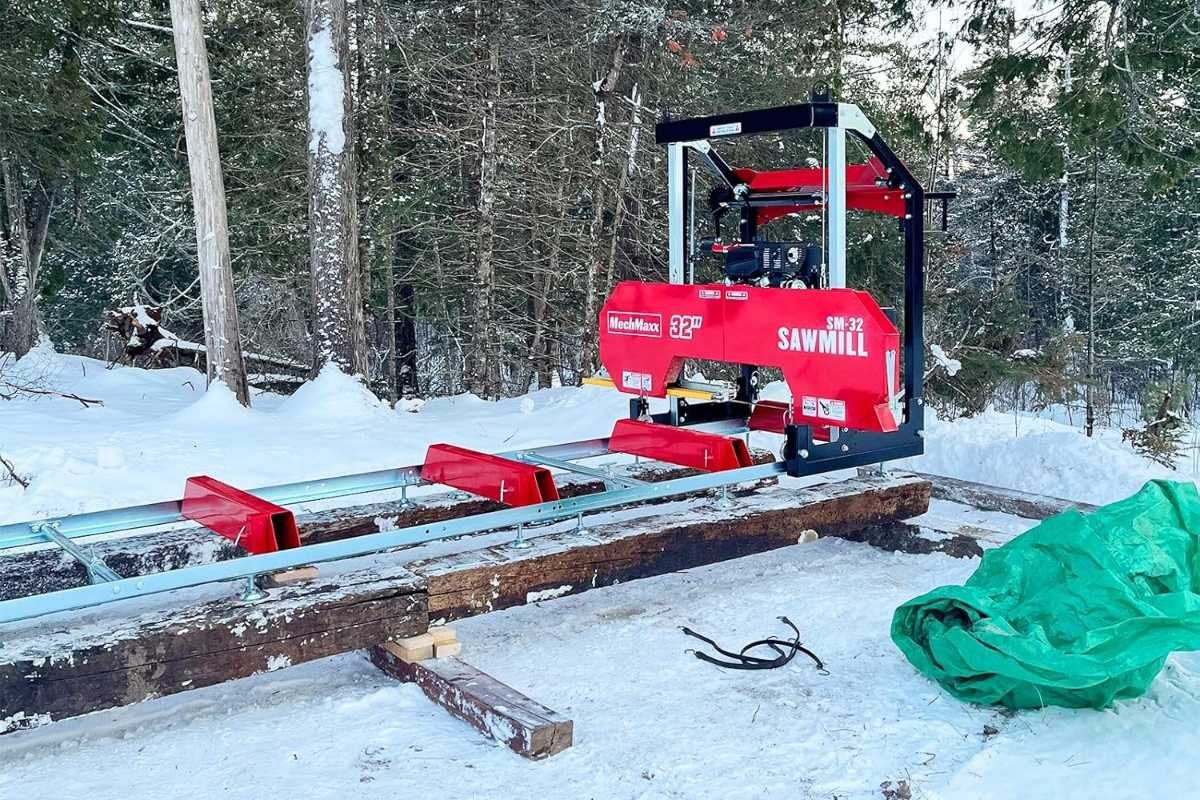
Search for the best portable sawmill, and the first results are Wood-Mizer, Norwood, and Woodland Mills, three real, respected manufacturers that don't sell through Amazon at all. You have to call a dealer, request a quote, or wait for a demo. If you just want a real price, real owner feedback, and to buy today, that search leaves you stuck. Here's what matters when you're choosing a bandsaw mill, and the one we'd point to if you're buying today rather than requesting a brochure.
Want to compare every model at once? Our portable sawmill spec table lines up log diameter, width of cut, log length, engine and weight for 45 band mills and 15 chainsaw mills.
Table of Contents
What Determines the Best Portable Sawmill, Not Just Specs on Paper
Spec sheets on this equipment are dense, and not every number matters equally when you're picking the best portable sawmill. Four numbers do most of the real work.
Engine power. A bandsaw mill's engine needs to keep the blade moving at a steady speed through a full-width cut, not just spin freely. Most mills in this price tier run 9 to 15HP gas engines. Anything under 9HP struggles on hardwood or wide boards. You'll notice it bogging down mid-cut instead of cutting cleanly.
Log diameter and board width. These aren't the same number, and manufacturers sometimes mix them up. Log diameter is the biggest log the mill can physically clear. Board width is the widest cut you can make, which is smaller because the blade sits inside the frame's opening. A mill rated for a 32-inch log might only cut a 26-inch board.
Track length. This sets your maximum log length, not your cutting speed. A 20-foot track handles a full sawlog. A 13-foot track is fine for firewood-length rounds or shorter cants (a log squared off on two or more sides), but it's a real limitation if you're planning to mill full logs for lumber.
Weight and setup time. A sawmill in this class runs 600 to 950 pounds. That's not something you casually move between job sites. If portability matters for your use case, check whether the frame breaks down for transport or is meant to stay in one spot.
Manual versus hydraulic, and why it barely matters at this price
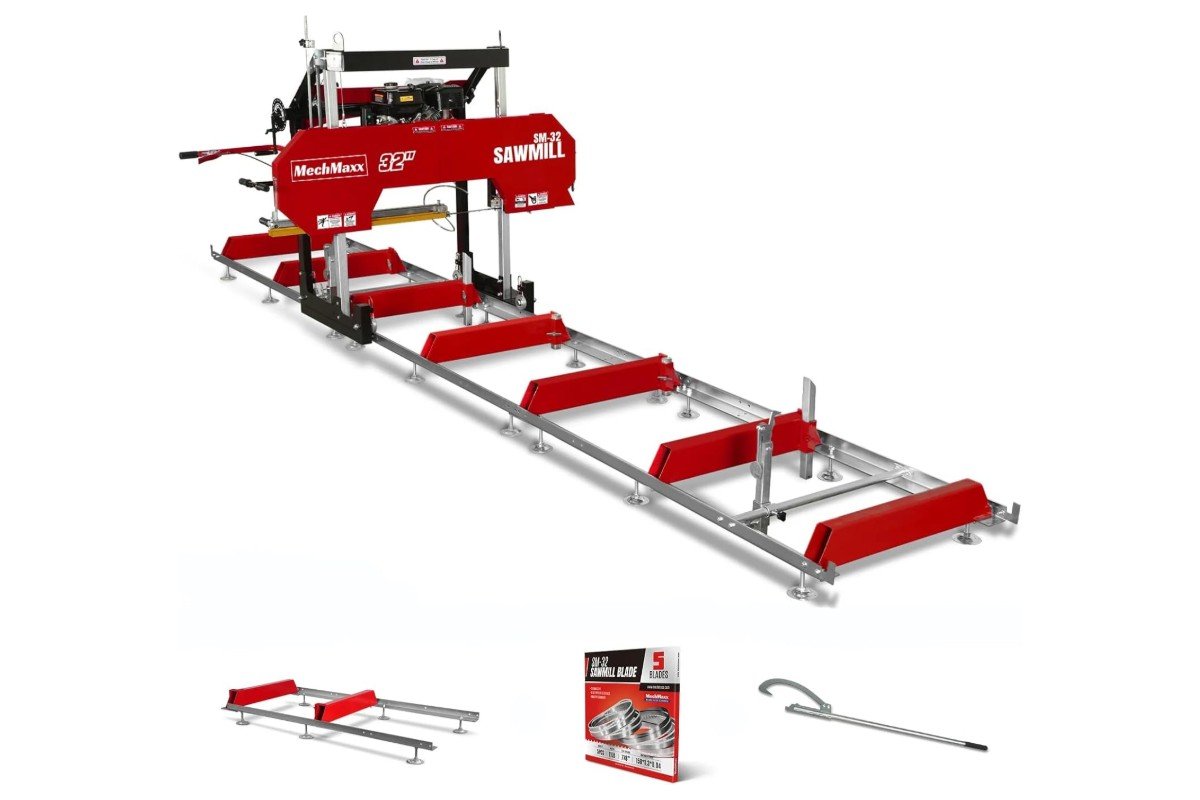
Higher-end mills offer hydraulic log loading and turning, useful if you're processing enough volume that manually rolling logs onto the bed eats into your day. Every mill in this price range is manual. You set the log on the bed, clamp it, and turn it by hand between passes. For a hobbyist or a small operation milling a few logs a weekend, that's not a real limitation. It's how this class of equipment works, and hydraulics don't show up until you're well into commercial territory anyway.
Blades, and what they cost you over time
The engine and frame are a one-time cost. Blades aren't. A bandsaw blade dulls faster on knotty or dirty logs, and a pack of 10 replacement blades for the MechMaxx SM-32 is a real recurring cost, a modest amount per blade. Budget for that as an ongoing cost, not a footnote, especially if you're milling logs that have been sitting on the ground and picking up grit and embedded debris. Keeping the blade properly tensioned and lubricated (most mills in this tier use a manual water-lube valve) does more to extend blade life than any other single habit.
Our pick: MechMaxx 32-Inch Portable Sawmill (SM-32)
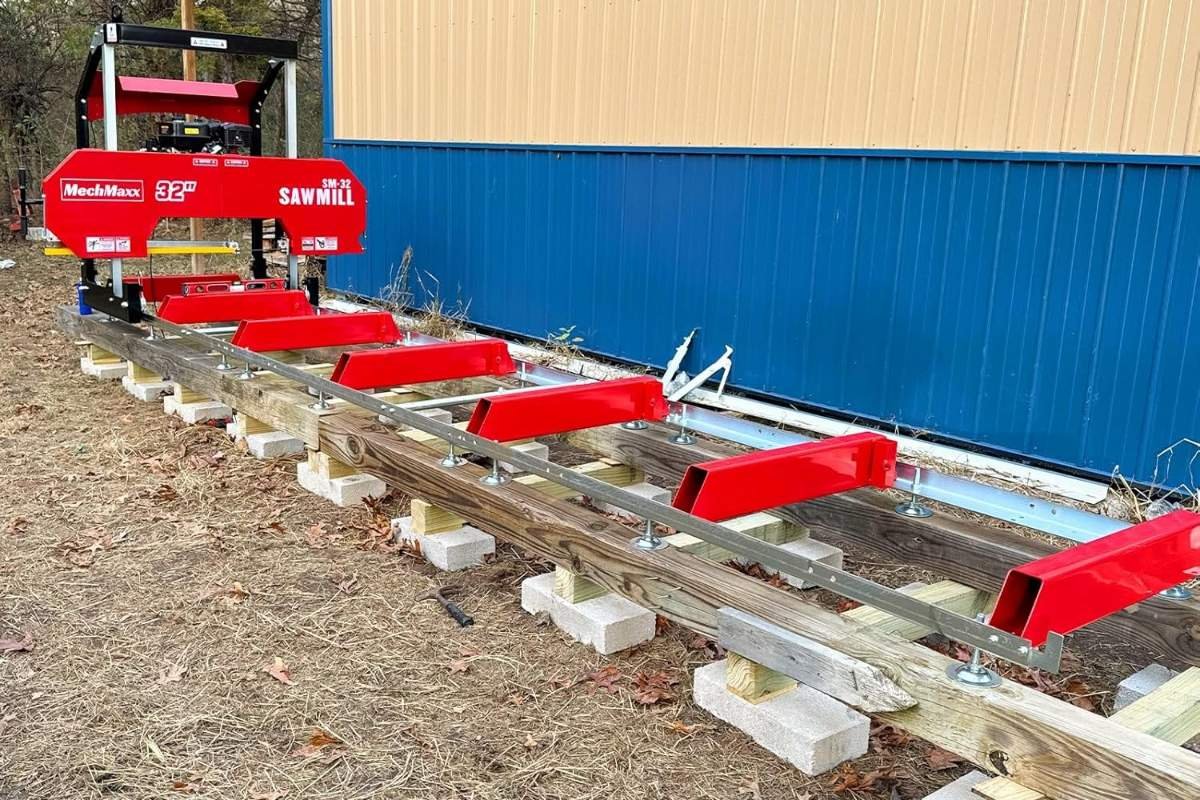
We looked at real, currently available, Amazon-purchasable bandsaw mills rather than manufacturer-direct brands you can't order online today, and among them, the MechMaxx SM-32 is the best portable sawmill by owner feedback: 4.4 stars across 37 ratings on Amazon.
The specs back up the price. A 420cc, 15HP electric-start gas engine, 32-inch max log diameter, 26.5-inch max board width, 7-inch max board thickness, and a 20-foot track that handles a full-length sawlog rather than just short cants. It ships with 5 blades and a log hook included, and carries a 2-year after-sales support window from MechMaxx plus a 1-year engine warranty, worth knowing given this is import-tier equipment rather than a US-built brand with a local dealer network.
Real owner reviews back up both the strengths and the caveats. Multiple reviewers specifically praised MechMaxx's customer service, replacing missing blades and shipping a replacement part at no cost when one review flagged a rusted component.
Assembly comes up repeatedly too, and the reviews are mixed rather than uniformly easy. Several owners called it straightforward, one described it as "an Erector Set" and got through it in two days, another rated the unit five stars while separately noting assembly wasn't easy, and the mill weighs "A TON." One review reported an engine failure (broken manifold studs) that MechMaxx refunded in full but never shipped a replacement part.
Go in knowing that. This isn't a plug-and-play tool, and the engine quality control isn't flawless at this price tier.
That's for the 32-inch model with a 20-foot track. MechMaxx also sells the same frame in smaller and larger sizes. A 26-inch model costs less depending on track length, and a 36-inch "MAX" model with a bigger 750cc engine costs considerably more. The 32-inch model is the middle ground, big enough for real sawlogs, not so large that you're paying for capacity most hobbyist and small-operation buyers won't use. Check current price on Amazon.
What you'll spend
Here's the realistic price range across the import-tier brands that sell on Amazon today: a smaller 22- to 26-inch model with a shorter track costs the least, up through a 36-inch model with the largest engine on offer at the top. BILT HARD is the other real name in this tier. Their 26-inch model runs a comparable price with a 420cc engine and similar specs to MechMaxx's mid-tier offering, worth cross-shopping if you want a second data point before committing.
One note across this whole price tier: review counts are thin compared to what you'd see on a cheap tool. A piece of equipment at this price point sells to fewer people, so a listing with 37 or 9 ratings isn't a red flag the way it would be on a cheaper product. It's just the realistic scale of this market.
Where the big-name brands fit in
The manufacturer-direct brands build real, well-regarded equipment, and if milling is going to be your income rather than an occasional project, their dealer networks, financing options, and hydraulic upgrade paths are worth the extra step of getting a real quote.
They're not on Amazon because that's not how they sell. Direct-to-dealer with a local demo is standard for equipment at this level, and their support infrastructure reflects that. For a hobbyist, a small builder, or anyone milling their own logs rather than running a commercial operation, the import-tier mills covered here get real logs turned into real lumber for a fraction of the entry cost. The tradeoffs about fit and finish laid out above.
Which one to buy
If you want the best portable sawmill you can see a real price on today, without waiting on a quote, the MechMaxx SM-32 is the one with the track record to back it up. It has a true 32-inch capacity, a 20-foot track for full sawlogs, and enough owner feedback to know both what it does well and where assembly can go wrong. Budget at least a full day for setup, and don't skip the pre-cut bolt check the reviews keep mentioning.
Quick answers
Why don't Wood-Mizer, Norwood, or Woodland Mills show up on Amazon?
Those brands sell direct through dealer networks rather than online retail, which is standard for equipment at this price and support level. You'll need to request a quote or find a local dealer to buy one, not order through a cart.
How much does a portable sawmill cost?
Import-tier brands that sell on Amazon run from a modest amount for a smaller model up to considerably more for the largest engine-and-track combination. Manufacturer-direct brands like Wood-Mizer start higher and require a dealer quote rather than a listed price.
Is an import-tier sawmill like MechMaxx reliable?
Real owner reviews are mixed but mostly positive, with strong marks for customer service and some reports of assembly difficulty or an occasional engine issue. It doesn't have the same support infrastructure as a US-built brand with a local dealer. Budget for that tradeoff at this price point.
What size portable sawmill do I need?
Match the track length to your longest logs and the board width to what you plan to cut, not the log diameter rating alone. A 20-foot track and 26 to 32-inch board width cover most hobbyist and small-operation milling without paying for capacity you won't use.