
Lumber statistics tend to fall into two camps: market numbers that go stale fast, and drying rules of thumb with no source behind them. Price headlines from 2021 still circulate, and so does the idea that lumber air dries at one year per inch. This page collects the lumber, sawmill and wood drying numbers that trace back to a primary source.
Every figure below links to where it came from: the Bureau of Labor Statistics price indexes, USDA Forest Service research and its Forest Products Laboratory, university extension guides, and the American Softwood Lumber Standard. After that come four things people say about lumber and drying that the sources don't support.
Quick take: softwood lumber prices in August 2026 were about half their May 2021 peak, but still well above 2019. U.S. urban trees could yield about 7.2 billion board feet (a lumber volume unit: 12 by 12 by 1 inch) of lumber a year. Green 1 inch red oak takes roughly 70 to 200 days to air dry (letting lumber dry slowly outdoors in a stacked pile) to 20% moisture, and air drying alone rarely gets below 14 to 19%. Interior woodwork should be around 8%.
Table of Contents
Lumber statistics at a glance
Each row is explained further down, including what period each number covers.
Lumber price statistics
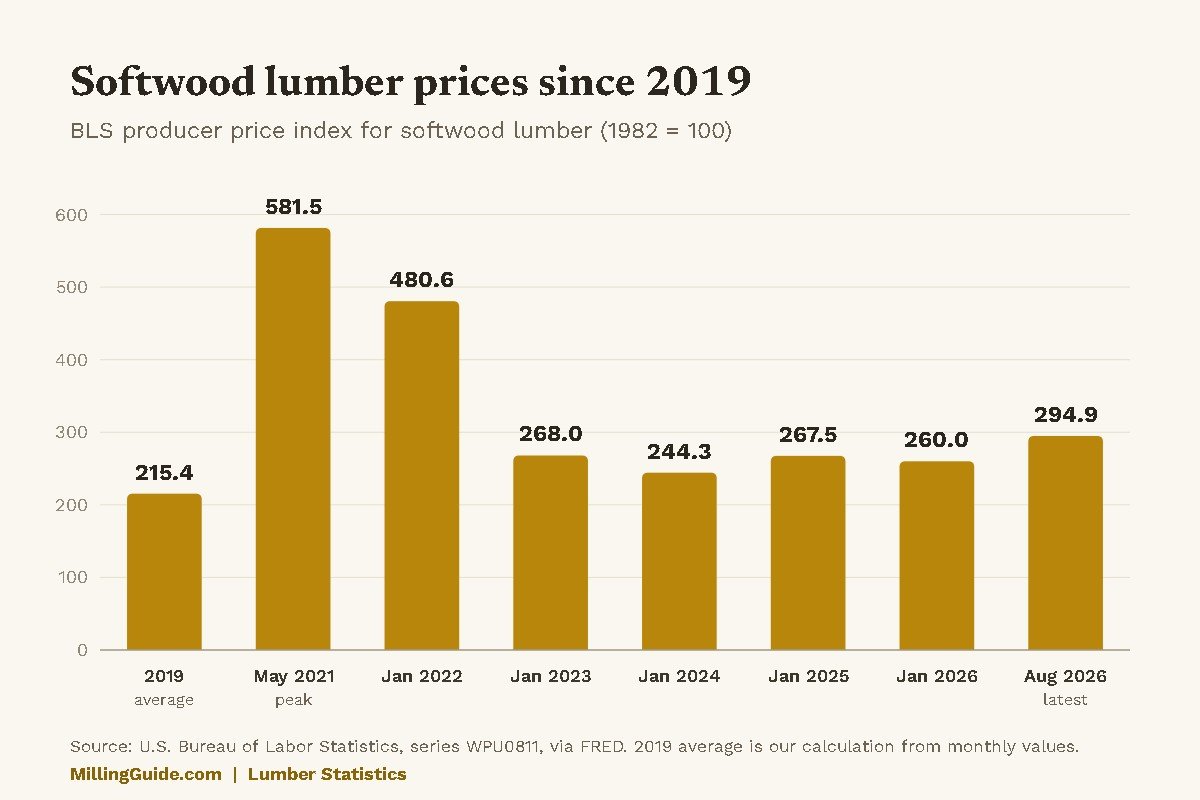
The cleanest public lumber statistics on price come from the Bureau of Labor Statistics producer price index, which tracks what mills get paid. The softwood lumber index (1982 = 100) stood at 294.899 in August 2026. At its May 2021 peak it hit 581.5, so today's level is about 49% lower. It's still about 37% above its 2019 average of 215.4. Those percentages are our own calculations from the published index values.
Hardwood lumber never had the same spike. The hardwood index was 279.1 in May 2021, peaked at 301.2 in October 2021, and was 286.5 in August 2026. For anyone milling their own hardwood, that means the retail price of the boards you're replacing hasn't dropped the way framing lumber has. Our board foot calculator helps you put a number on a log before you mill it.
Lumber production, imports and sawmill statistics
The most recent free, official lumber statistics on production come from the USDA Forest Service's annual market review for the United Nations. It put U.S. softwood lumber production at about 64.04 million cubic meters in 2022, against apparent consumption of 97.85 million cubic meters. The gap was filled by imports, and 82.7% of softwood lumber imports came from Canada.
Imports have fallen since. The National Association of Home Builders estimates the U.S. imported 12.7 billion board feet of softwood lumber in 2025, the lowest annual total since 2014, with about 80% coming from Canada. Sawmill and wood preservation employment fell to about 85,400 workers in the third quarter of 2025, the lowest level since early 2013.
Urban wood statistics
Some of the most surprising lumber statistics are about wood that never reaches a sawmill. A USDA Forest Service study by Nowak, Greenfield and Ash estimated that U.S. urban tree mortality, assuming 2% of urban trees die each year, produces about 46 million tonnes of merchantable wood annually. That's enough for about 7.2 billion board feet of lumber or 16 million cords of firewood.
The study put the potential value at $89 million to $786 million a year, depending on whether the wood becomes chips or lumber. That spread is the case for milling urban logs: the same tree is worth several times more as boards than as mulch.
Wood drying and moisture statistics
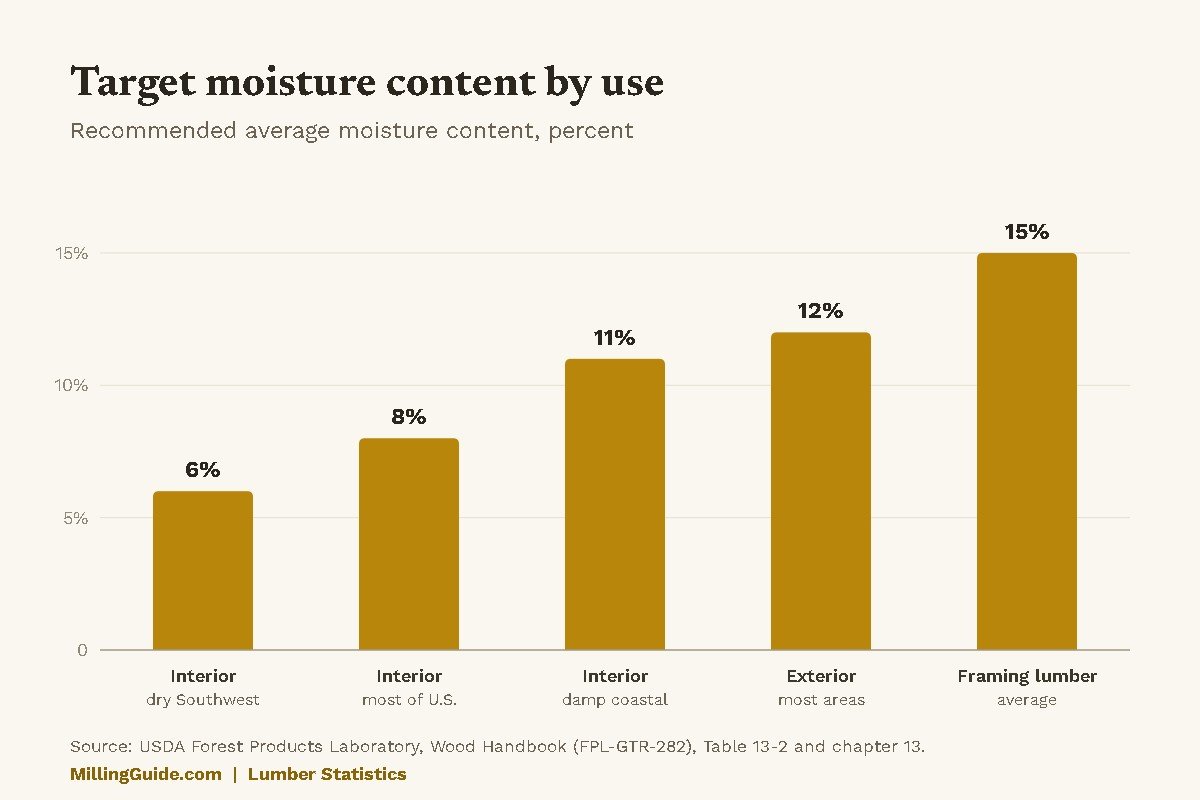
The USDA Forest Products Laboratory's Wood Handbook is the standard reference for wood moisture. It recommends an average of 8% moisture content (how much water is in the wood, as a percent of its dry weight) for interior woodwork in most of the U.S., with individual pieces between 6 and 10%. In the dry Southwest the target is 6%, in damp warm coastal areas 11%, and for exterior wood about 12%.
Wood only starts to shrink below the fiber saturation point, which the Handbook puts at about 30% moisture content. Shrinkage isn't even in every direction. Tangential shrinkage, along the growth rings, is roughly twice radial shrinkage. Northern red oak, for example, shrinks 4.0% radially and 8.6% tangentially from green to ovendry, while lengthwise shrinkage is only 0.1 to 0.2% for most species. That's why flatsawn boards cup and quartersawn boards stay flatter.
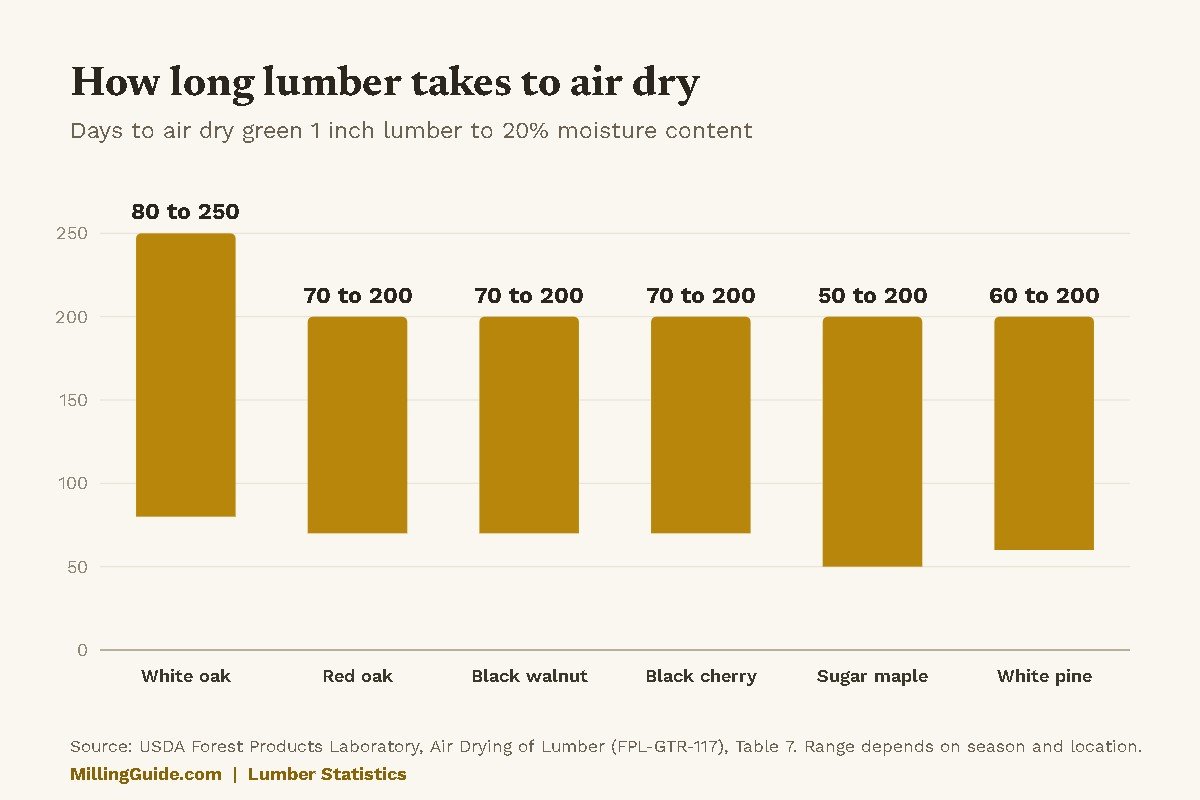
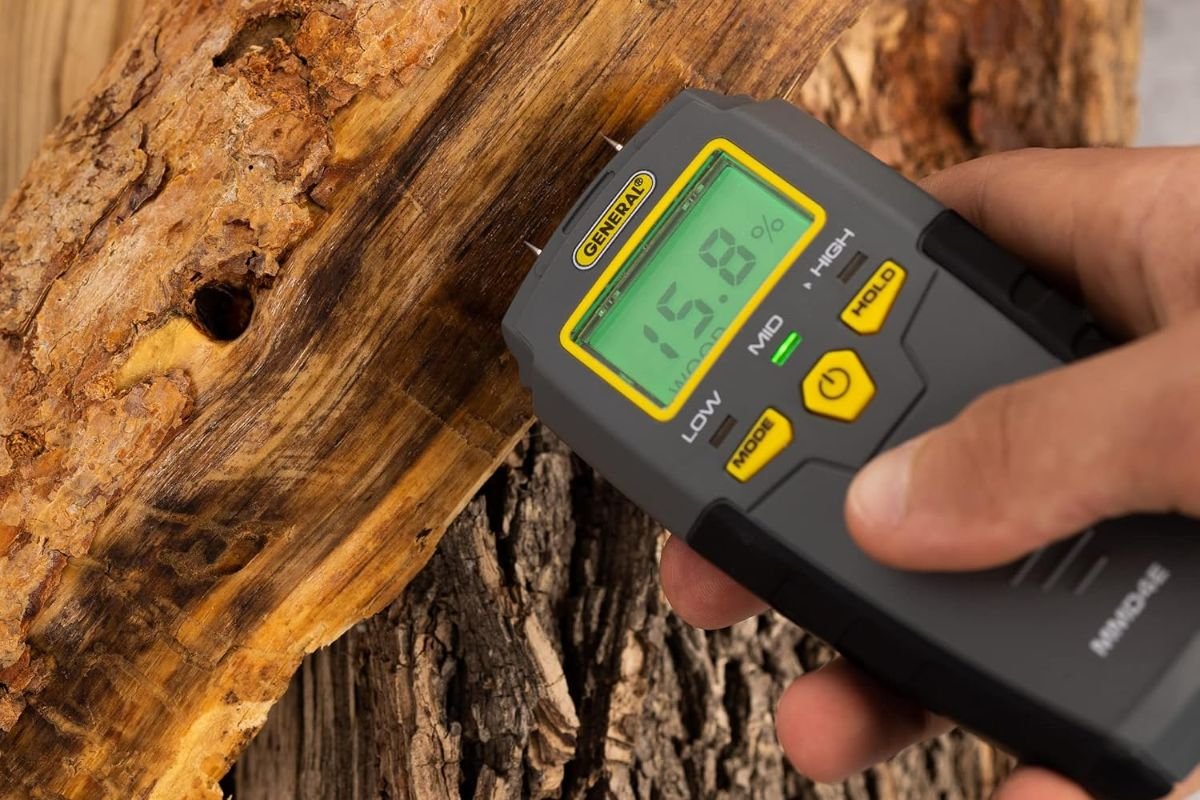
Air drying takes longer than most people expect. The Forest Products Laboratory's air drying guide gives 70 to 200 days to take green 1 inch northern red oak to 20% moisture content, and 80 to 250 days for white oak. The time depends on when the stack goes out and where. The University of Missouri Extension notes that air drying alone can bring lumber down to about 14 to 19%, and that 2 inch lumber may take two to four times longer than 1 inch. Our guide to air drying lumber covers stacking and stickering (stacking boards with thin spacers between them so air can flow), and a moisture meter tells you when you're there.
Four lumber myths the sources don't support
These lumber statistics and rules of thumb come up in sawmill forums, lumberyard talk and how-to videos. Here's what the primary sources say.
Myth 1: Air dry lumber one year per inch of thickness
None of the drying sources we checked uses that rule. The Forest Products Laboratory's own table gives 70 to 200 days for 1 inch red oak to reach 20%. The Wood Handbook ranges from 15 to 30 days for light species like pine and soft maple up to 200 to 300 days for slow species like oak in northern locations. Drying time also doesn't scale evenly with thickness: 2 inch lumber can take two to four times as long as 1 inch. Species, season and airflow matter far more than a calendar.
Myth 2: Kiln dried means 6 to 8% moisture
Only for furniture-grade hardwood. The American Softwood Lumber Standard defines dry lumber as 19% moisture content or less, and the Wood Handbook says softwood framing lumber is usually dried to an average of 15%, not over 19%. A kiln dried 2x4 from the lumberyard can be much wetter than the 6 to 8% you want for cabinets and furniture.
Myth 3: Lumber prices are still at their 2021 highs
Softwood lumber prices, measured by the BLS producer price index, are about half their May 2021 peak. They are still roughly a third above 2019 levels, so lumber isn't cheap, but the 2021 spike is long over.
Myth 4: Urban trees are only good for firewood or mulch
The USDA Forest Service estimate of about 7.2 billion board feet a year from urban tree mortality says otherwise. Plenty of urban logs have nails, fence wire or rot, and not every tree is worth milling, but the potential value of that wood as lumber is several times its value as chips.
How we checked these lumber statistics
For each figure we went to the primary source: the BLS price series as published on FRED, the USDA Forest Service market review and urban wood study, the Forest Products Laboratory's Wood Handbook and air drying guide, a university extension guide, and the American Softwood Lumber Standard. We note the period each number covers and label our own calculations. Production figures are the latest free official numbers, which run to 2022. We couldn't find a reliable public count of U.S. sawmills, so we left it out.
Last checked: September 28, 2026. We'll update the price figures as BLS publishes new months.
Using these statistics
You're welcome to use any figure or chart on this page in an article, report or class. Please link to the primary source for the number and to this page as the place you found it. Suggested citation: MillingGuide, "Lumber Statistics: 16 Verified Numbers and 4 Myths," millingguide.com/lumber-statistics/, September 2026.
Lumber statistics FAQ
Are lumber prices going down?
Softwood lumber prices are about 49% below their May 2021 peak but still about 37% above their 2019 average, based on the BLS producer price index in August 2026.
How long does it take to air dry lumber?
For green 1 inch red oak, about 70 to 200 days to reach 20% moisture content, according to the Forest Products Laboratory. Thicker lumber takes much longer.
What moisture content should lumber be for furniture?
About 8% on average for interior use in most of the U.S., with pieces between 6 and 10%, per the Wood Handbook. Use about 6% in the dry Southwest and 11% in damp coastal areas.
How much lumber could urban trees produce?
About 7.2 billion board feet a year, based on a USDA Forest Service estimate of wood from urban tree mortality.
What is the actual size of a 2x4?
A dry 2x4 is 1-1/2 by 3-1/2 inches under the American Softwood Lumber Standard.