
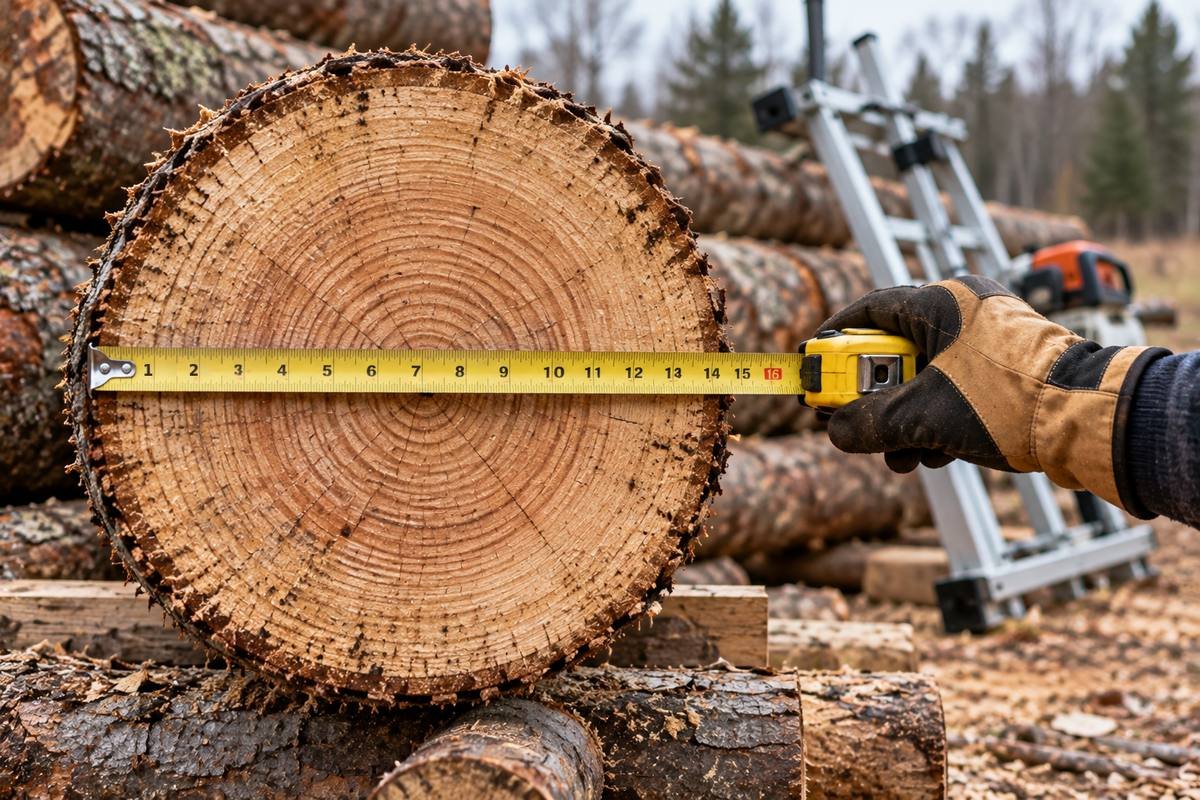
If you're pricing lumber, quoting a milling job, or figuring out whether a log is worth cutting, everything comes down to one unit: the board foot. Get that number wrong and you'll either overpay for wood or underquote a job. Use the board foot calculator below to get it right, then read on for the log rules and formulas behind the numbers.
Table of Contents
Board Foot Calculator
Enter the thickness, width, and length of a board (or a full pack) to get the board footage. Use this calculator if you're pricing dimensional lumber, a slab, or a stack you've already milled.
What Is a Board Foot?
A board foot is a unit of lumber volume, not length. One board foot equals a piece of wood 12 inches long, 12 inches wide, and 1 inch thick, or 144 cubic inches. That's it. A 2x4 isn't automatically "one foot" of anything. A 1-foot length of a 2x4 is two-thirds of a board foot, because it's only 3.5 inches wide by 1.5 inches thick (using actual, not nominal, dimensions).
This confuses people constantly when they're new to buying or selling lumber by the board foot instead of by the linear foot or the individual board. Hardwood lumber, slabs, and most sawmill output get priced and measured in board feet because it accounts for thickness, and thickness varies a lot between a 4/4 board and an 8/4 slab in a way linear footage completely ignores.
The Board Foot Formula
The formula behind the calculator above is straightforward:
Length goes in as feet because that's how lumber is almost always sold and measured. Thickness and width stay in inches because that's how a board's cross-section is described. Divide by 12, not 144, since only one of the three measurements (length) is already in feet instead of inches. If you'd rather work entirely in inches, divide by 144 instead and convert the length to inches, too. Both give you the same answer.
One thing worth saying plainly: use actual dimensions, not nominal ones, if you're pricing rough-sawn or hand-milled lumber. A board straight off a bandsaw mill that's cut to "1 inch" is usually closer to a true 1 inch, unlike a dressed 2x4 at the lumberyard, which is 1.5x3.5 inches after planing. Measure what you've got.
Log Board Foot Calculator
Before you mill a log, you'll want a rough estimate of how much lumber it'll yield. That's a different calculation from the one above, because you're estimating usable lumber from a round log, not measuring a board you already have. Enter the small-end diameter (measured inside the bark) and the log length below.
Estimates only. Real sawmill yield depends on log taper, defects, and how the sawyer chooses to cut. The International 1/4" figure uses the standard formula for the closest of the 4, 8, 12, 16, or 20 foot length classes.
Calculator by MillingGuide.com
Doyle vs. Scribner vs. International 1/4": Why Log Rules Disagree
Many first-time sawyers don't expect this: there isn't one universal way to estimate board feet in a log. There are three log rules in common use in the US, and they don't agree with each other, sometimes by a wide margin on smaller logs.
The Doyle rule is the oldest and still the most widely used, especially in the eastern and southern US and among hardwood buyers. It's also the least accurate on small-diameter logs, since it was built around a fixed 4-inch slab-and-sawdust deduction that doesn't scale down well. The International 1/4-inch rule is generally considered the most accurate of the three, since it was derived from real sawmill output data with a 1/4-inch saw kerf (the slot a blade or chain cuts) assumption. But it's less commonly used in everyday buying and selling. Scribner sits in between and is common in the Pacific Northwest.
The table below, sourced from the University of Tennessee Extension publication on log scales and log rules, shows how far apart the three rules can land on the same 16-foot log:
| Diameter (in.) | Doyle | Scribner | International 1/4" |
|---|---|---|---|
| 6 | 4 bd. ft. | 18 bd. ft. | 20 bd. ft. |
| 10 | 36 bd. ft. | 50 bd. ft. | 65 bd. ft. |
| 16 | 144 bd. ft. | 159 bd. ft. | 180 bd. ft. |
| 20 | 256 bd. ft. | 280 bd. ft. | 290 bd. ft. |
| 30 | 676 bd. ft. | 657 bd. ft. | 675 bd. ft. |
Notice how close the three rules get on the 30-inch log but how far apart they are on the 6-inch and 10-inch logs. Doyle isn't wrong. It's built on an assumption that stops making sense once the log gets small. If you're buying logs by the board foot from a mill or a landowner, ask which rule they're using before you compare a quote against your own numbers. A "cheap" price quoted in Doyle feet and an "expensive" price quoted in International feet might be the same deal.
Quick Reference: Board Feet by Common Lumber Size
For the sizes you'll run into most often, here's what one 8-foot board comes out to, using actual (not nominal) dimensions:
| Nominal size | Actual size | Board feet (8 ft. length) |
|---|---|---|
| 1x6 | 0.75 x 5.5 in. | 2.75 bd. ft. |
| 2x4 | 1.5 x 3.5 in. | 3.5 bd. ft. |
| 2x6 | 1.5 x 5.5 in. | 5.5 bd. ft. |
| 2x8 | 1.5 x 7.25 in. | 7.25 bd. ft. |
| 1-inch rough-sawn, 8 in. wide | true 1 x 8 in. | 5.33 bd. ft. |
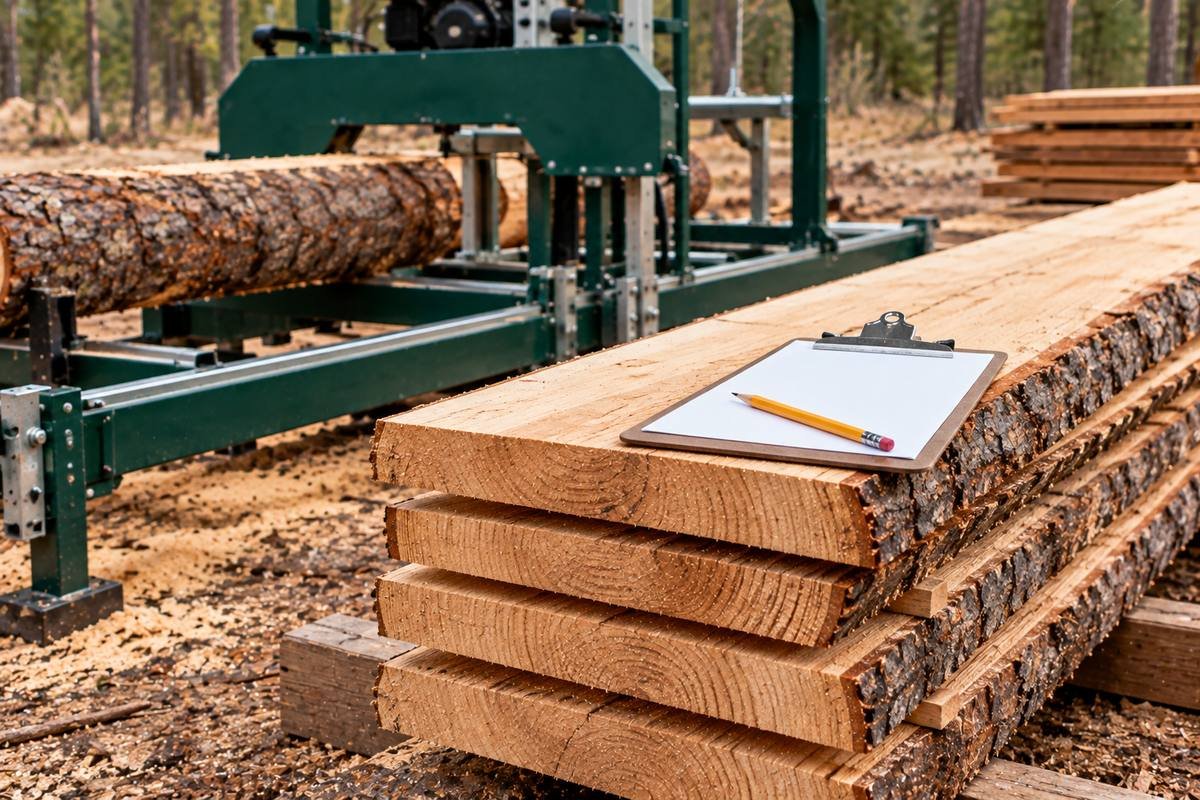
That last row matters if you're used to lumberyard nominal sizing. Rough-sawn lumber straight off a portable sawmill is usually left at its true dimension, not planed down, so a "1 inch" board you mill yourself holds more actual wood, and more board feet, than a "1 inch" board bought pre-dressed at a home center.
How Many Board Feet Do You Need?
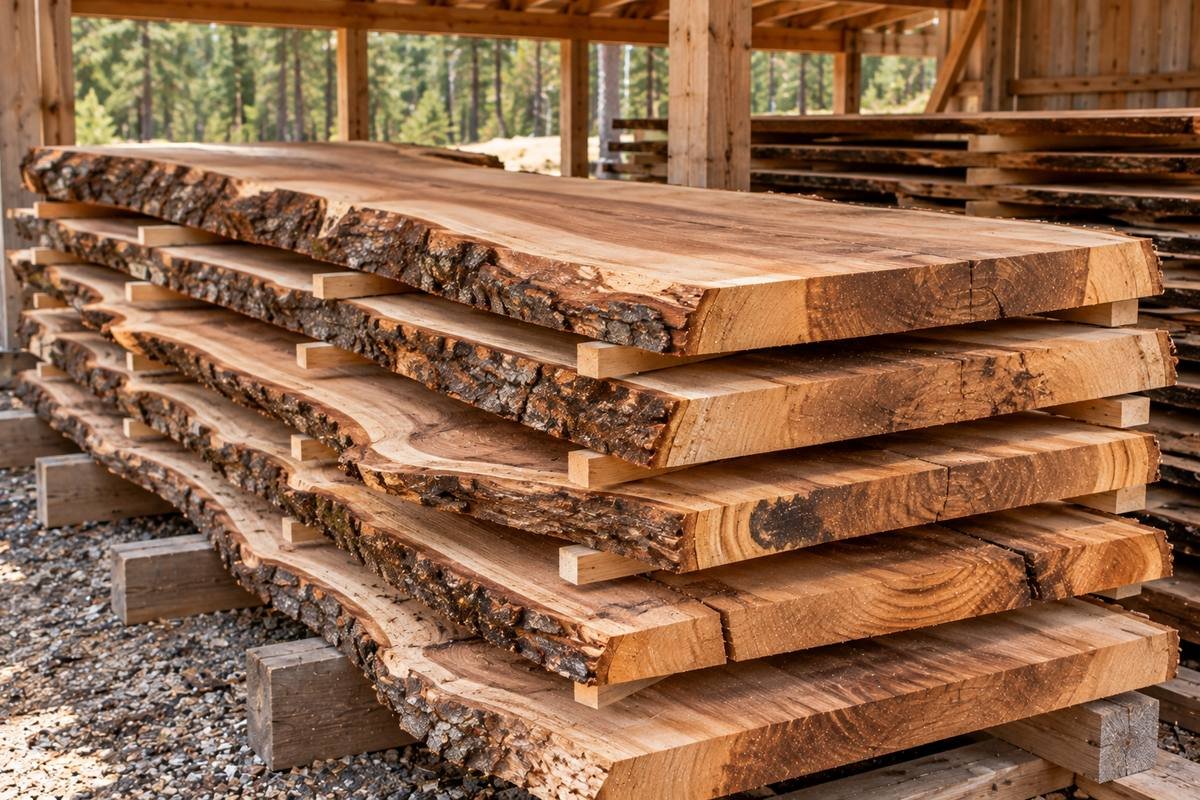
A board foot calculator is most useful before you ever start a project. Add up the board feet for every piece in your cut list, then add a waste factor. Use 10 to 15 percent for straight, defect-free lumber you're buying already dried and surfaced. Use 20 to 30 percent if you're milling your own logs, since you'll lose material to bark, taper, and any checking (small cracks that open as wood dries) or rot you find once you start cutting.
If the math is telling you that a single log or a small haul of logs won't get you there, that's usually the moment to think about whether milling makes sense at all versus buying finished lumber outright. Our portable sawmill price and cost guide breaks down what owning a mill costs across every price tier, and our new vs. used buying guide covers what you give up going the cheaper route. If you've already got logs and are deciding whether a mill is worth buying at all for the volume you're working with, start with our full sawmill buying guide.
Bookmark this page. Board feet come up every time you price lumber, quote a milling job, or decide whether a log is worth the fuel to haul it home.
How do you calculate board feet?
Multiply thickness in inches by width in inches by length in feet, then divide by 12. That gives you board feet for a single board. Multiply by the number of boards for a full stack.
How many board feet are in a 2x4?
An 8-foot 2x4 comes out to 3.5 board feet using actual dimensions (1.5 x 3.5 inches). A 1-foot length of the same board is about two-thirds of a board foot.
Which log rule should I use, Doyle or International 1/4 inch?
Doyle is the most common in everyday buying and selling, especially in the eastern and southern US, but it underestimates yield on small-diameter logs. International 1/4 inch is generally considered the most accurate. Ask which rule a mill or buyer is using before comparing quotes.
Why do board foot estimates for the same log differ so much?
Because Doyle, Scribner, and International 1/4 inch are three different formulas built on different assumptions about saw kerf and slab waste. They converge on large logs but can differ by 30 percent or more on small ones.