
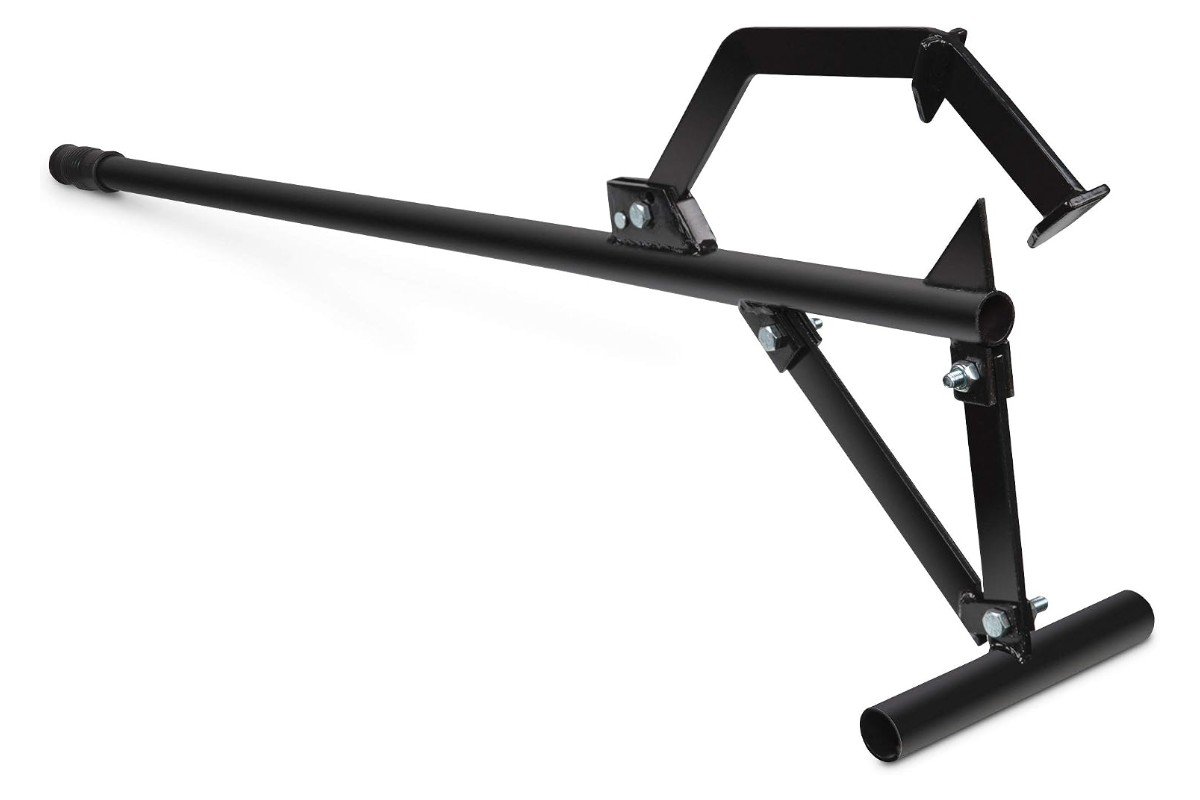
Turning a log on the mill bed is a different job than moving it through the woods. A cant hook or peavey is built to roll and drag a log across the ground. A log turner has one specific task: rotating a log that is already resting on the bed or the track, so the next cut lands where you want it, without you fighting a few hundred pounds of wood by hand. Getting the log to the mill in the first place is a different job, and a log arch is the usual tool for it.
This guide covers what turning a log at the mill involves, the manual and hydraulic tools built for it, real products worth buying at each tier, and how to do it without hurting yourself or the mill. The picks below span the full range from a homeowner's occasional log to a mill running all day.
Table of Contents
What Turning a Log at the Mill Means
Once a log is loaded onto the mill bed or track, the first cut usually opens a flat face. To get the second and third cuts right, you often need to rotate the log 90 or 180 degrees so the next flat face lines up the way you planned. Or you may want a taper, a bow, or a bad section faces the direction that wastes the least lumber. That rotation, done on a log that can weigh anywhere from a few hundred pounds to well over a ton, is what a log turner is built for.
This is a different tool category from a cant hook or peavey. Those are built to roll a log across open ground, drag it, or walk it a short distance, and MillingGuide's own guide to cant hooks versus peaveys covers that job in detail. A log turner's job starts after the log is already on the mill, where the challenge is precision, not ground friction: getting the log to stop rotating exactly where you want it, with little room for error.
Manual Options: Timberjacks and Log Jacks
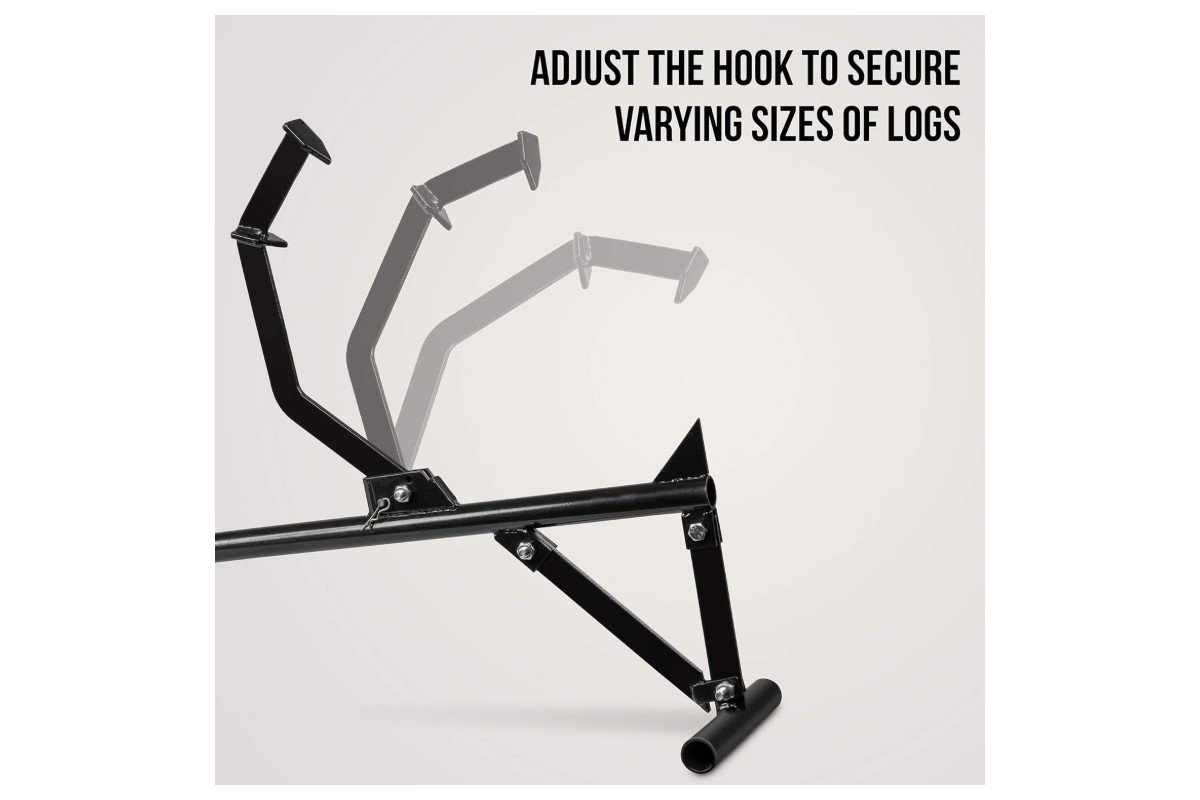
A timberjack, sometimes sold as a log jack or log lifter, is a long-handled tool with a hook or duckbill jaw at one end and a stand at the other. You hook the jaw under the log, use the handle as a lever, and the stand takes the weight as you lift and rotate. Most manual timberjacks handle logs from about 3 to 20 inches in diameter, depending on the model, and lift the log a few inches to over a foot off the bed, enough clearance to swing it around by hand.
The tradeoff is straightforward: a timberjack is inexpensive, needs no power source, and works anywhere, but it only handles smaller logs. Past a certain diameter, the leverage that makes the tool work also makes it dangerous to use alone, which is why every manufacturer's own instructions call for a second person spotting.
Getting the Log to the Mill in the First Place
Turning a log is only half the problem. Getting it onto the bed to begin with is its own decision, and the right method depends entirely on what equipment you already have.
- Fork loader or tractor. Lower the log gently, keeping the forks below the top of the bunks, and raise the log supports first so the log can't roll off as it's set down.
- Grapple. Works well for smaller logs within the loader's rated capacity. Keep the log in view at all times and avoid dropping it hard enough to damage the rails or bunks.
- Winch and ramp. Common on elevated mills. Secure the cable around the log, start the winch slowly while watching that the log is rolling straight, then engage the log clamps before releasing tension on the cable.
- Platform loading. Some sawyers build a staging platform level with the mill bed and use gravity and moveable ramps to walk logs across, avoiding a lift entirely.
Whichever method you use, the same rule applies across all of them: know where the log is at all times, keep clear sightlines, and never exceed the equipment's rated weight capacity to force a log that's too big.
Hydraulic Turner Kits: How They Work
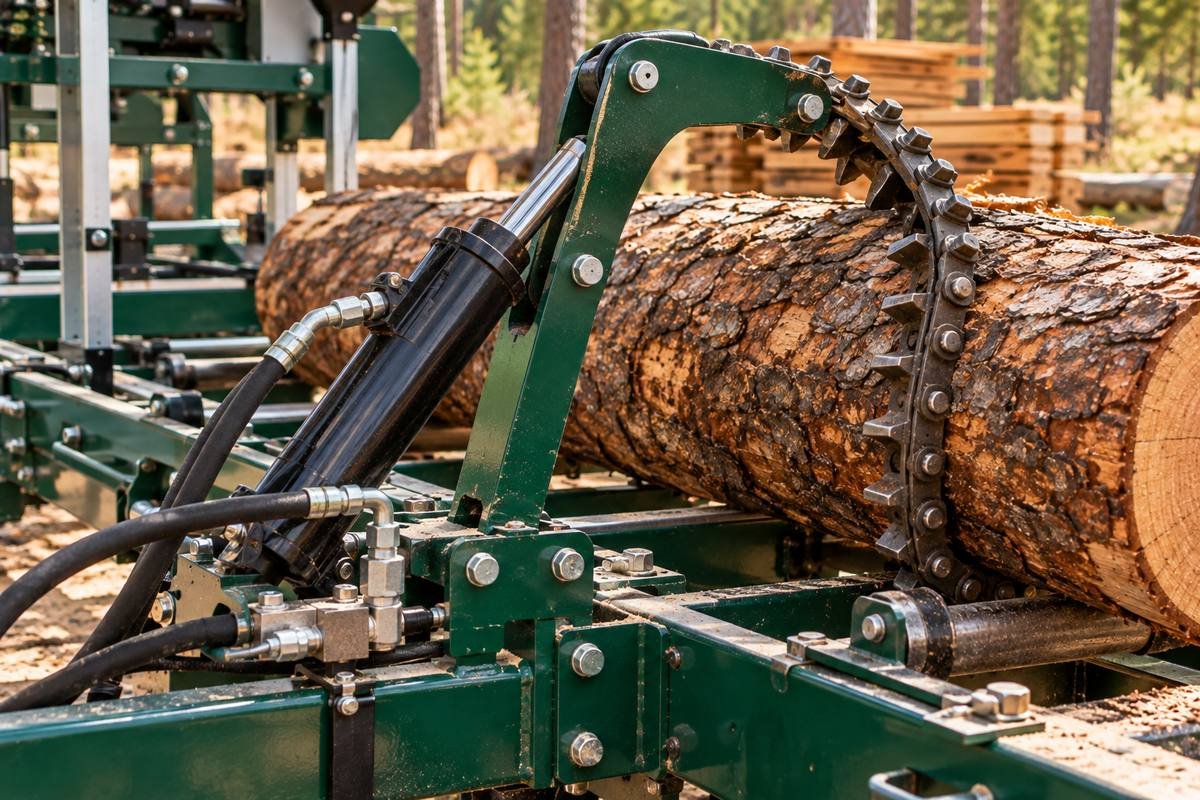
A hydraulic log turner mounts directly to the mill and does the rotation for you at the pull of a lever. The mechanism typically splits the job into two separate components. A hydraulic cylinder that raises the log off the bed, and a hydraulic motor that spins it, often in either direction. That lets you set the exact rotation you need rather than swinging a log all the way around. A deep-toothed chain or clamp grips the bark for traction so the log turns instead of just spinning the chain against it.
These kits are built for specific mill models rather than universal fit, and most require a hydraulic pump system and a compatible log clamp to function safely. Norwood's own documentation for its hydraulic turner warns that running the turner without its matching clamp will damage the mill's manual clamping system, which is worth knowing before assuming any hydraulic turner bolts onto any mill.
Log Turners Worth Buying
Two manual picks and two mill-mounted hydraulic kits, covering the realistic range from a homeowner with a few logs a year to a mill that turns dozens of logs a day.
Right Hand Timberjack Triple Thick Log Lifter
An alloy steel timberjack that lifts logs from 3 to 15 inches in diameter up to 15 inches off the ground, with an adjustable duckbill hook and a reinforcing bar connecting the hook to the handle so it doesn't bend under load. It's the most straightforward pick here: no assembly beyond attaching the handle, no power source, and a stand designed to keep the chain out of the dirt while you cut.
- Reinforcing bar keeps the hook from bending under repeated heavy use.
- Two-piece handle makes it easy to store in a truck or shed.
- Tops out at 15 inches, so it won't handle a full-size mill log.
- Some owners report the threaded handle joint loosening with heavy repeated use, fixable with thread locker.
LogOX 3-in-1 Forestry Multitool
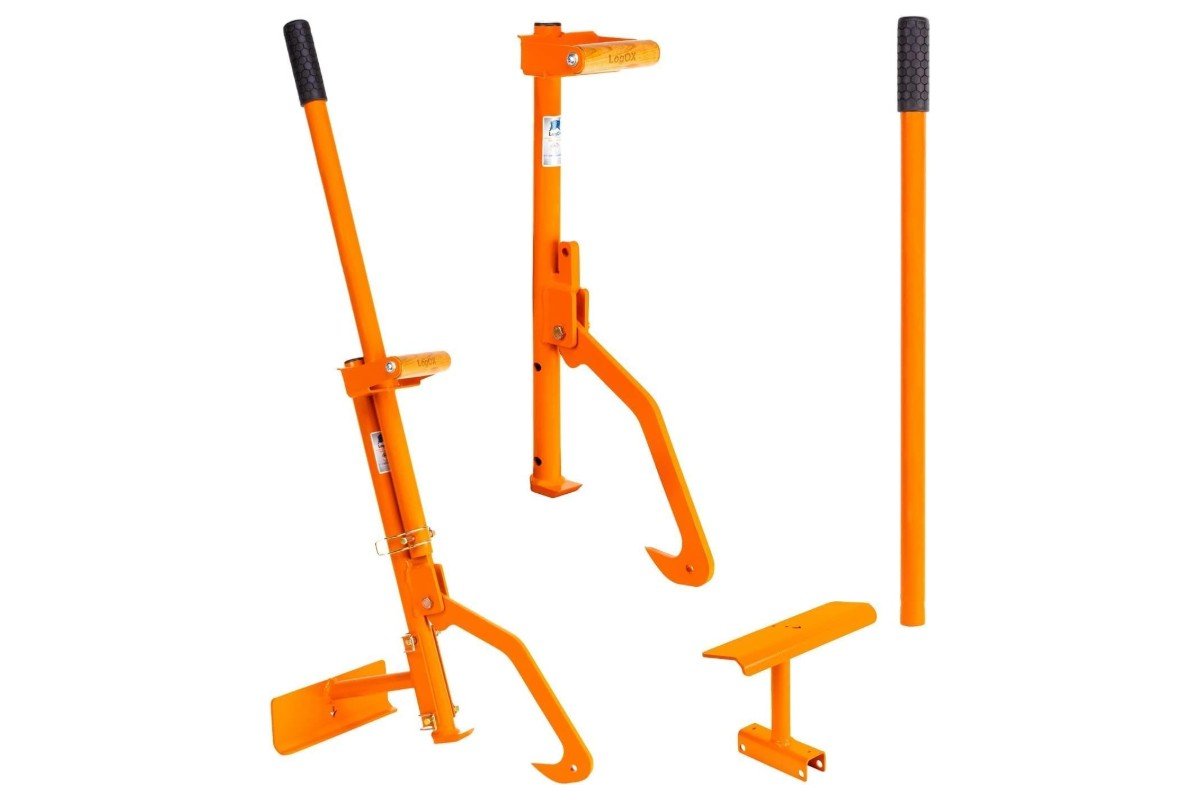
A patented, US-made combination tool that folds a log hauler, a cant hook, and a timberjack into one implement. For someone who doesn't want three separate tools taking up wall space, this covers rolling, dragging, and lifting a log with a single tool, and it carries the strongest review base of any manual option in this category.
- Three tools in one, so you're not buying and storing separate implements.
- Made in the USA and patented, with a large, strongly positive review base.
- Costs noticeably more than a single-purpose timberjack.
- A combination tool is a compromise on each individual function compared to a dedicated tool.
Wood-Mizer Hydraulic Log Loading/Turning Kit
Wood-Mizer's factory kit pairs a loading arm with a hydraulic turner, sold together or separately, for LT35 and LT40 manual sawmills built from 1992 onward with an external alternator. This is the upgrade path for someone who already owns one of those mills and is tired of moving logs into position by hand, rather than a standalone accessory that bolts onto any mill.
- Factory-engineered for a specific mill line, so the fit is confirmed, not a guess.
- Loading arm and turner can be bought separately if you only need one function.
- Only fits LT35 and LT40 mills from 1992 onward with an external alternator.
- A significant investment, closer to the cost of a used mill than an accessory.
Norwood Hydraulic Log Turner
Norwood's turner uses a separate hydraulic cylinder for lift and a hydraulic motor for rotation, with dual-direction turning and a deep-toothed chain that grips rough bark rather than slipping against it. It's compatible with Norwood's HD38, HD36V2, HD36, and LM34 mills, but it needs a matching hydraulic pump and log clamp system to run, and Norwood's own manual warns that skipping the matching clamp can damage the mill's manual clamps.
- Dual-direction rotation lets you set the exact turn instead of spinning the log all the way around.
- Deep-toothed chain is built specifically to grip bark, not just smooth wood.
- Requires a separate hydraulic pump and matching log clamp to function at all.
- Only fits four specific Norwood mill models, so check compatibility before buying.
Which One You Need
If you're milling a handful of logs a year on a chainsaw mill or a small manual bandsaw mill, a timberjack pays for itself fast and costs a fraction of anything hydraulic. If you're already leaning on a cant hook for every turn and it's straining your back, the combination tool is worth the extra cost for the convenience of carrying one implement instead of three. A hydraulic kit only makes sense once you own a compatible mill and are turning enough logs, or big enough logs, that turning them by hand is slowing down your whole day, not just a minor inconvenience.
How to Turn a Log Safely
Whatever tool you're using, keep your footing solid and your body to the side of the log's path, never behind or in front of where it could roll. OSHA's logging eTool (OSHA is the federal workplace safety agency) emphasizes that most manual-handling injuries in this kind of work come from the log itself, not the tool, once it starts moving faster or further than expected. A log that looks stable can shift the moment weight comes off one side of it, so treat every turn as if the log might roll toward you until it's fully settled.
Work with a second person whenever the log is heavy enough that you can't stop its motion by hand, and never put any part of your body under a log that's only supported by a lever or a hydraulic arm. If a hydraulic turner stalls partway through a rotation, release the pressure and reset rather than forcing it, since a stalled turn under load is exactly the situation the clamp compatibility warnings above are meant to prevent.
Frequently Asked Questions
What is the difference between a log turner and a cant hook?
A cant hook or peavey is built to roll and drag a log across open ground. A log turner is built to rotate a log that's already resting on the mill bed or track, with the precision to stop the rotation exactly where you need it for the next cut.
Can I turn a log on my mill without a hydraulic turner?
Yes, for logs within a manual timberjack's rated diameter, usually up to around 15 to 20 inches depending on the model. Beyond that size or weight, a hydraulic turner or a second person with proper leverage becomes necessary for safety.
Will a hydraulic log turner fit any sawmill?
No. Hydraulic turner kits are built for specific mill models and usually require a matching hydraulic pump and log clamp system to operate safely. Check your mill's exact model against the manufacturer's compatibility list before buying.
How big of a log can a manual timberjack handle?
Most manual timberjacks are rated for logs from about 3 to 20 inches in diameter, with the exact range varying by model. Past that range, the same leverage that makes the tool work also makes it unsafe to use without additional equipment or a second person.
Do I need a spotter to turn a log?
For anything beyond a light, small-diameter log, yes. Manufacturer instructions for manual timberjacks consistently call for a second person, and OSHA's manual-handling guidance for logging work treats an unpredictable log roll as one of the most common causes of injury in this kind of task.
For the tool built to roll and drag logs before they reach the mill, see MillingGuide's guide to cant hooks versus peaveys. If you're outfitting a chainsaw mill more broadly, the chainsaw mill accessories guide covers the other gear worth having on hand.