
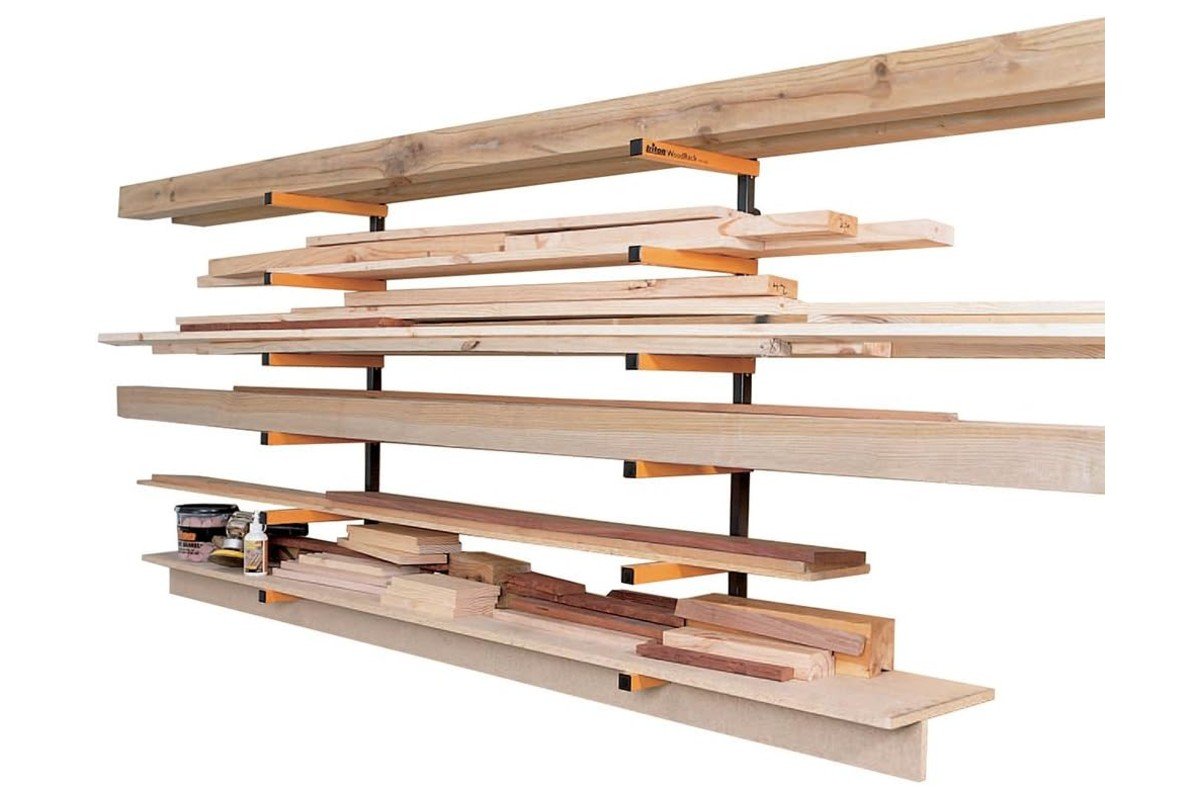
Fresh off the mill, a stack of green lumber is heavier, wetter, and less predictable than anything you buy at a lumberyard. Lean it against a wall or pile it on the shop floor and it cups, twists, and picks up moisture unevenly as it dries. The best lumber storage rack for milled lumber fixes that by holding boards flat, off the ground, and with air moving around every piece. That holds whether you are stacking rough-sawn slabs straight from a chainsaw mill or boards that already went through a full air-drying cycle.
This guide covers what separates a rack built for milled lumber from a generic garage shelving unit. It also covers the three basic rack types and which one fits your shop, how to size one to your own stack, a few real products worth buying, and how to load one without bowing your boards or your wall.
Table of Contents
Why Milled Lumber Needs a Real Rack, Not a Corner of the Shop
Most lumber rack articles are written for someone buying pre-dried dimensional lumber from a home center and storing it flat until a project starts. That is not the problem a sawmill owner has. Wood straight off a chainsaw mill or a portable bandmill (a sawmill that cuts with a long, thin loop of blade) can weigh far more than the same board once it is dry, and it is still moving as it loses moisture. Penn State Extension's green weight tables put white oak at around 64 pounds per cubic foot green against about 42 pounds dry, a jump of roughly 50 percent. A rack sized for a stack of finished 2x4s can sag or bend under a stack of green slabs the same size.
- Airflow on every face. A rack that holds boards apart, not stacked flat against each other, lets air reach both faces and dries lumber evenly instead of leaving the bottom of the pile damp.
- Real weight capacity for wet wood. Check the rack's rated load against green weight, not dry weight, especially for anything over 8 feet long.
- Straight, flat storage. A board that leans or sags while it dries will hold that shape. A rack that supports the full length keeps a board flat instead of setting a permanent bow.
- Room for irregular widths. Live edge slabs and rough-sawn boards rarely match the neat, uniform widths a garage shelving rack is designed around.
If you already air dry your own lumber, the rack is the other half of that process. Our guide to air drying lumber after milling covers stickering (stacking boards with thin spacers between them so air can flow) and stack technique. This one covers what to store the stack on.
Wall Mount, Cantilever, or DIY: Which Type Fits Your Shop
Three basic approaches cover almost every home shop and small sawmill setup.
- Wall-mounted arms. Bolted directly to studs, these are the fastest way to get lumber off the floor in a shop with wall space to spare. Good for boards up to about 8 feet and moderate total weight. Not a fit for long slabs that overhang badly or for a wall that is not solidly framed.
- Freestanding cantilever racks. Arms extend from a floor-mounted upright rather than a wall, so length and weight capacity are limited mostly by the frame itself rather than your wall's stud spacing. This is the better choice for long slabs, heavy green stock, or a detached shed where you would rather not drill into a shared wall.
- DIY modular builds. A rack welded or clamped together from pipe and modular fittings, sized to your own longest slab and your own shop's footprint. Slower to set up than buying a rack off the shelf, but it is the only option that scales past what any factory-built rack is rated for.
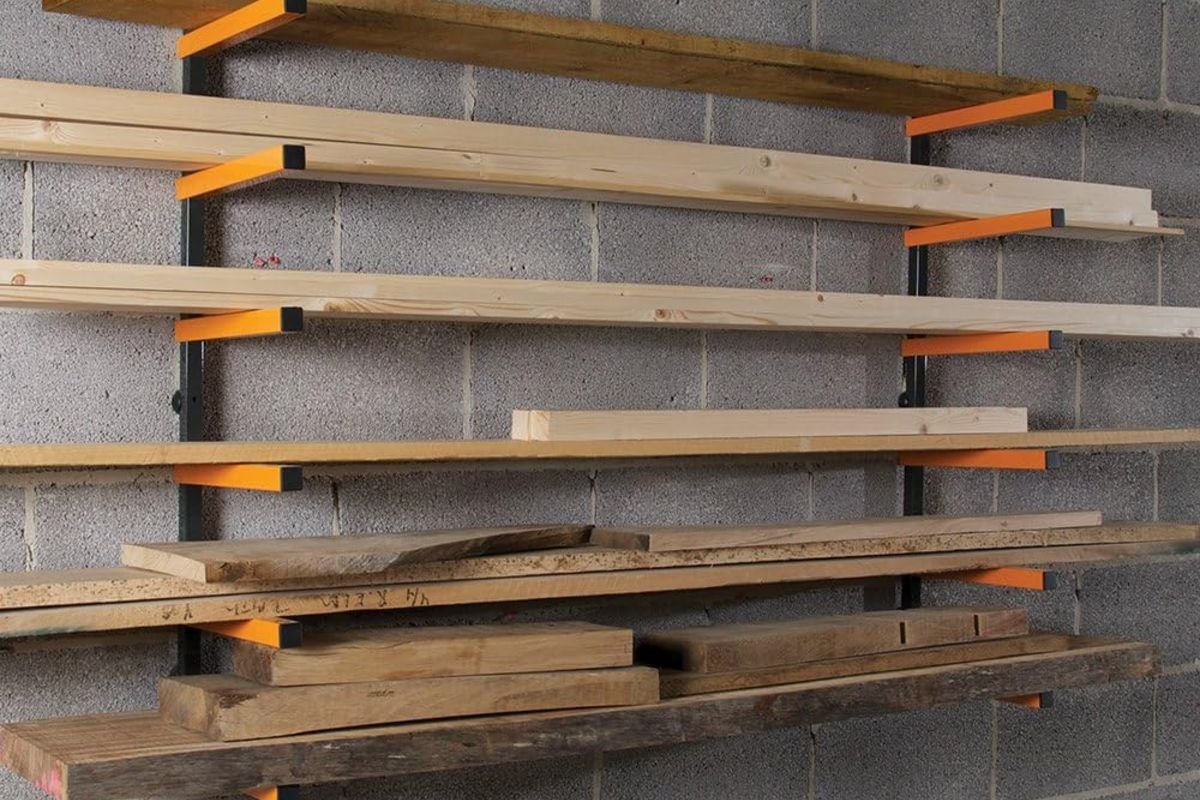
Most people end up with two of these rather than one. A wall rack for shorter offcuts and project stock, plus a freestanding or DIY rack for the long green slabs coming straight off the mill.
Sizing a Rack to Your Stack
Three numbers matter more than the brand on the box when sizing a rack for your shop.
- Rated load per arm, not just total. A rack rated for 800 pounds across five arms is not rated for 800 pounds on one arm. Spread weight across as many support points as the board length allows.
- Arm reach versus your longest board. An arm that only reaches 16 inches off the wall will not properly support a wide slab. Unsupported overhang is where boards bow.
- Indoor versus outdoor rating. If the rack lives under a lean-to or in an open shed, check that the finish is rated for outdoor exposure. A rack that rusts through in a season is not cheaper than one built for it.
Weigh a green board before you assume a rack can hold your stack. A rough estimate: a wet 8-foot 2-by-10 in a dense hardwood can run 40 to 50 pounds on its own. Stack six of those on one arm and you are well past what most wall brackets are rated for.
Lumber Storage Racks Worth Buying
Four options, from off-the-shelf wall racks to a DIY modular build for stock that does not fit a factory rack.
Delta 16 in. x 41 in. Heavy Duty Wall Rack (HDRS3000)
A five-tier wall-mounted rack built from hammered gunmetal steel with a powder coat finish, rated to hold 800 pounds total across its adjustable arms. The arms move to fit different board thicknesses, and the mounting hardware is included for a stud-mounted install. This is the straightforward choice for a shop with a solid wall to spare and a stack that stays under moderate total weight.
- 800 pound total capacity across five tiers
- Adjustable arms fit boards of different thickness
- Steel construction with a powder coat finish
- Fixed to the wall, so it needs solid framing behind it
- 41 inch height needs real wall clearance
Triton WoodRack Storage System (WRA001)
Six levels of steel tube racking rated at 50 kilograms, about 110 pounds, per level, built from powder-coated steel tubing and rated for indoor or outdoor use on a workshop wall, shed, or fence. The narrower footprint suits a small shop where floor space is tighter than wall space. It arrives as two uprights and twelve racks rather than pre-assembled arms, so plan on an hour of assembly.
- Rated for outdoor use as well as indoor shop walls
- Narrow footprint fits a small shop wall
- Six levels for sorting boards by species or length
- 110 pounds per level limits how much green stock one shelf can hold
- Ships unassembled
Folding Wall Mounted Rack Sets (720 Pound Class)
Several brands sell a near-identical folding wall bracket design, sold in multi-packs of arm pairs, typically six levels and a combined rating around 720 pounds. The arms fold flat against the wall when not loaded, which matters in a shop where floor and wall space both stay tight. These are the budget option, and the build quality varies by brand, so check current reviews before ordering rather than assuming every listing performs the same.
- Folds flat against the wall when empty
- Lowest price per pound of rated capacity in this list
- Build quality varies noticeably between brands selling the same design
- Folding hinge point is the first thing to fail under repeated overloading
Kee Klamp Modular Fittings (DIY Freestanding Rack)
Kee Klamp fittings are weld-free, slip-on pipe connectors originally built for railings and industrial structures. They show up regularly in shop-built lumber rack projects because they let you size a freestanding cantilever rack to your own longest slab instead of whatever a factory rack happens to offer. Buy standard pipe locally, connect it with these fittings, and build a rack rated for exactly the length and weight your mill produces. This is the option worth considering once your longest slabs or your total green weight outgrows every off-the-shelf rack on this list.
- Sized to your own longest slab, not a fixed factory length
- Weld free assembly, no welding equipment or skill required
- Reconfigurable if your shop layout or stock size changes later
- You are responsible for your own load calculations, not a rated factory spec
- Costs more upfront than a single off the shelf wall rack once pipe is added
Loading and Stacking Lumber Safely
Even a good rack fails if it is loaded wrong. A few habits keep boards straight and the rack itself sound.
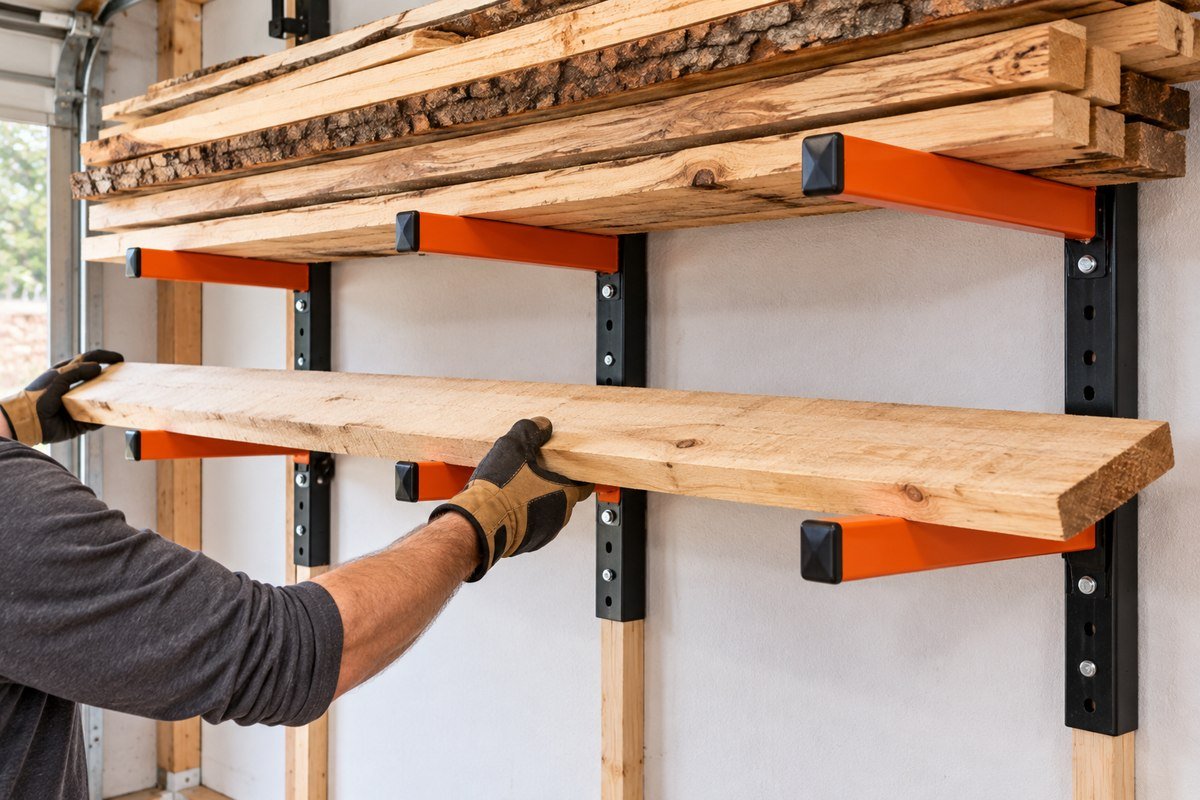
- Check the rack is anchored before loading it. A wall rack bolted into drywall alone will not hold green lumber. Confirm every mounting point lands on a stud or a rated anchor.
- Load heavy, long boards on the lower arms first. Keeping the heaviest weight low on the rack and low to the ground reduces strain on the mounting points and lowers the center of gravity on a freestanding rack.
- Support the full length, not just the ends. A board resting only on its two end arms will sag in the unsupported middle as it dries. Add a center support for anything over about 6 feet.
- Leave space between boards for airflow. Stacking green boards tight against each other defeats the purpose of getting them off the floor in the first place.
- Recheck load and level after the first few weeks. Green lumber loses weight fast as it starts to dry, and a rack that looked fine on day one can shift as the stack settles. A quick recheck catches a leaning stack before it becomes a real problem.
Frequently Asked Questions
What is the best lumber storage rack for milled lumber?
The best lumber storage rack for most home shops is a wall-mounted rack rated for at least 800 pounds, such as the Delta HDRS3000, which handles freshly milled boards up to about 8 feet. Longer slabs or heavier green stock generally need a freestanding cantilever rack or a DIY build sized to the actual length and weight coming off the mill.
How much weight can a lumber rack hold before it fails?
Check the rated load per arm or per level, not just the total for the whole rack. A rack rated for 800 pounds across five levels is not rated for 800 pounds on a single level. A board's green weight can run well above its dry weight, so size the rack to wet lumber, not finished lumber.
Can you store green lumber on a regular garage shelving rack?
A regular garage shelving rack is usually built and rated for boxes and dry goods, not the concentrated point loads of long green boards. It can also lack the airflow a drying stack needs. A rack built or rated specifically for lumber is the safer choice for anything fresh off a mill.
Should a lumber rack be indoors or outdoors?
Either works if the rack is rated for it. An indoor rack in a shop or garage is the simplest setup. An outdoor rack under a roof or lean-to needs a weatherproof finish, since a rack that rusts through in a season ends up costing more than one built for outdoor exposure from the start.
How do you build a DIY lumber rack for long slabs?
Weld-free modular pipe fittings, such as Kee Klamp connectors, let you build a freestanding cantilever rack from standard pipe sized to your own longest slab and total stack weight. This is the option to consider once slabs or total load outgrow what an off-the-shelf rack is rated for.
Which One to Buy
The best lumber storage rack for your shop comes down to how long your slabs run and how much green weight you are putting on it. A wall mounted rack handles most home shop needs, a freestanding cantilever rack takes over once boards get long or heavy, and a DIY modular build is the only option once your stock outgrows every off the shelf choice. Whichever type you pick, size it to wet weight, not dry weight, and leave air space around every board.