
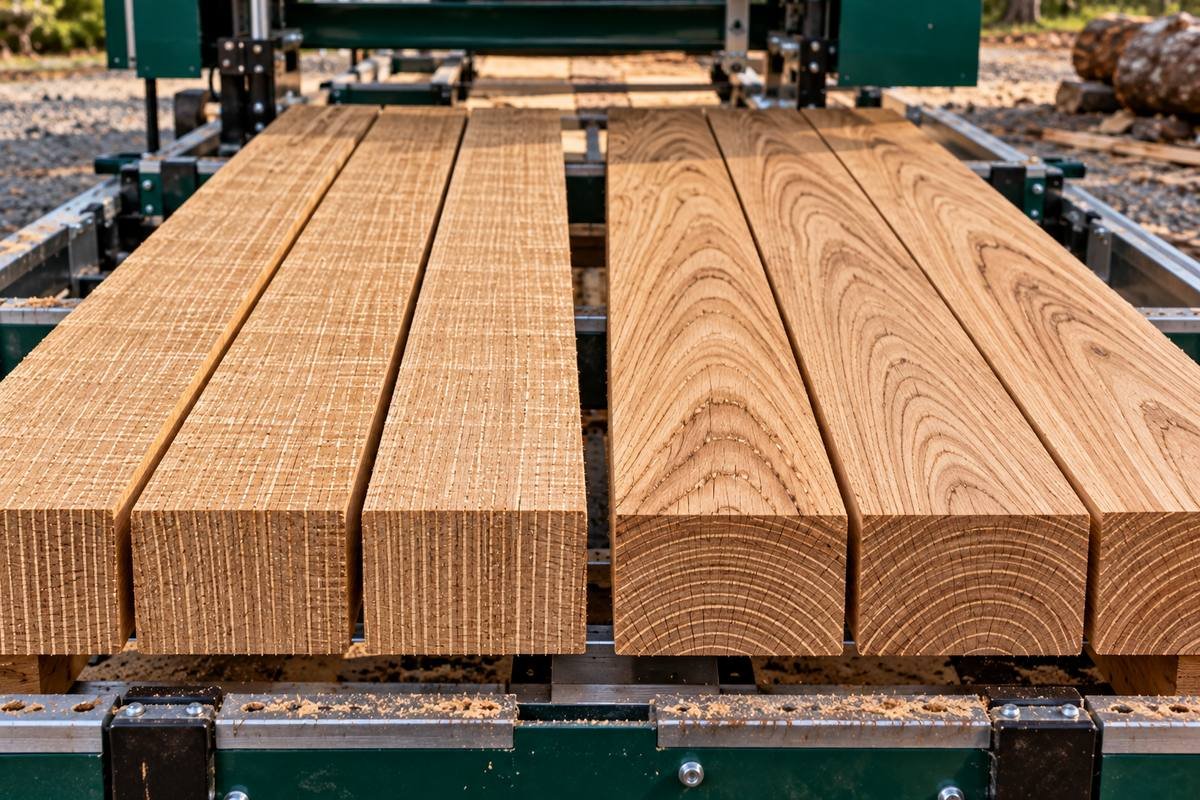
Quarter sawn vs plain sawn comes down to one thing: the angle the growth rings make with the face of the board. Plain sawn boards have rings lying nearly flat, so they show cathedral arches and move a lot across their width. Quarter sawn boards have rings standing near vertical, so they show straight stripes (and ray fleck in oak) and move about half as much. Rift sawn sits in between, with rings at roughly 30 to 60 degrees and the straightest grain on every face.
Most guides to quarter sawn vs plain sawn are written for someone buying boards. This one is written for the person running the mill. You'll get the definitions, but also the movement numbers from the USDA Wood Handbook, a simple rule for finding quarter sawn grain inside any log. It also gives three ways to saw it on a portable band mill (a sawmill that cuts with a long, thin loop of blade) or a chainsaw mill, including how to hold a wedge-shaped quarter of a log steady on a flat bed.
Table of Contents
Quarter sawn vs plain sawn vs rift sawn at a glance
| Plain sawn | Quarter sawn | Rift sawn | |
|---|---|---|---|
| Ring angle to the face | About 0 to 30 degrees | About 60 to 90 degrees | About 30 to 60 degrees |
| Face figure | Cathedral arches, wild grain | Straight stripes, ray fleck in oak and sycamore | Tight straight lines, little or no fleck |
| Width movement | Highest (tangential) | About half of plain sawn (radial) | Between the two |
| Cupping | Cups as it dries (the bark side goes concave) | Stays flat | Stays flat |
| Yield from the log | Highest | Lower (Wood-Mizer puts it at about 20% less) | Lowest |
| Board width | Widest | Limited by the log radius | Narrow |
| Sawing effort | Least turning | More turning and handling | Most handling and waste |
| Best uses | Tabletops, general stock, anything wide | Furniture, flooring, Craftsman work, guitar tops | Table legs, face frames, trim |
The angle ranges above are the common ones, and they're used by the American Hardwood Export Council for rift-sawn. Not everyone draws the lines in the same place. Wood-Mizer's own guide calls 80 to 90 degrees quarter sawn and 45 to 80 degrees rift, so a board one seller calls quartered can be rift to another. When you sell lumber, say what angle you mean.
How each cut is defined
Look at the end of any board, and you'll see the growth rings as curved lines. Hold a square against the wide face and judge the angle those lines make with it. That's the whole test, and it works the same whether the board came off a commercial mill or your own.
Plain sawn (flat sawn)
On a plain sawn board, the rings run roughly parallel to the wide face. The face cuts across the rings at a shallow angle, which is what draws the arches and ovals you see on a pine shelf or a red oak cabinet door. According to the American Hardwood Export Council (AHEC), at least 95 percent of hardwood lumber sawn commercially in the U.S. is plain sawn because it yields the most and widest boards from each log.
Quarter sawn
On a quarter-sawn board, the rings stand close to perpendicular to the face. The face runs along a radius of the log, so it shows the rings edge-on as straight lines. In species with big medullary rays (white oak most of all) the face also slices along those rays and shows the silvery flakes called ray fleck. That's the look Gustav Stickley built Craftsman furniture around.
Rift sawn
A rift-sawn board has its rings at a diagonal, roughly 30 to 60 degrees. It shows tight, straight grain on the faces and edges alike, which is why it's prized for table legs seen from all four sides. The fleck mostly disappears because the face no longer runs along the rays.
Quarter sawn vs plain sawn movement: the numbers
Wood shrinks and swells about twice as much along the growth rings (tangential) as it does across them (radial). A plain-sawn board's width runs mostly tangential, and a quarter-sawn board's width runs mostly radial. So the movement difference between quarter sawn and plain sawn is the difference between those two shrinkage rates.
The USDA Forest Products Lab Wood Handbook gives a dimensional change coefficient for each direction. Multiply the coefficient by the board width and the change in moisture content to get the movement. The table below runs that math for a 10-inch-wide board going from 6% to 12% moisture content, which is about the swing between a heated house in winter and a humid summer.
| Species | Plain sawn movement | Quarter sawn movement | Plain sawn moves this many times more |
|---|---|---|---|
| White oak | 0.22 in | 0.11 in | 2.0x |
| Red oak | 0.22 in | 0.09 in | 2.3x |
| Sugar maple | 0.21 in | 0.10 in | 2.1x |
| Sycamore | 0.18 in | 0.10 in | 1.7x |
| Black walnut | 0.16 in | 0.11 in | 1.4x |
| Black cherry | 0.15 in | 0.08 in | 2.0x |
Two things jump out. Red oak gains the most from quartering, since its plain-sawn boards move well over twice as much. Walnut gains the least, which is one reason walnut is usually sawn for width and figure instead. If you're cutting white or red oak for flooring, tabletops with breadboard ends, or doors, quartering pays you back in boards that stay flat.
The Handbook says the coefficient method is reliable between 6% and 14% moisture content. Outside that range, from green down to dry, use the full shrinkage figures instead. White oak shrinks 10.5% tangentially and 5.6% radially from green to oven dry, so a 10-inch quarter-sawn white oak board loses about half an inch less width from green to dry than a plain-sawn one does.
Where quarter sawn grain hides in every log
You don't need to quarter a log to get quarter sawn boards. If you live-saw a log straight through, the boards near the pith already have quarter-sawn grain across most of their width. The question is how far from the pith that holds.
Treating the rings as circles around the pith, the math is simple. Take any board and measure how far its face sits from the pith, and call that distance D. On that face, the grain is:
- Plain sawn within 0.58 x D of the pith line, measured sideways across the board.
- Rift sawn from 0.58 x D out to 1.73 x D.
- Quarter sawn from 1.73 x D out to the bark.
Those two multipliers are just tan 30 and tan 60. Here's what they mean on a 20-inch log (inside bark), live sawn:
| Board face distance from pith | Face width (bark to bark) | Plain-sawn strip in the middle | Rift sawn zones (both sides) | Quarter sawn zones (both sides) | Share quarter sawn |
|---|---|---|---|---|---|
| 1/2 in | 20.0 in | 0.6 in | 1.2 in | 18.2 in | 91% |
| 1 in | 19.9 in | 1.2 in | 2.3 in | 16.4 in | 83% |
| 2 in | 19.6 in | 2.3 in | 4.6 in | 12.7 in | 65% |
| 3 in | 19.1 in | 3.5 in | 6.9 in | 8.7 in | 46% |
| 4 in | 18.3 in | 4.6 in | 9.2 in | 4.5 in | 24% |
| 6 in | 16.0 in | 6.9 in | 9.1 in | 0 in | 0% |
On your own mill, this is the useful part. The three or four boards nearest the pith in a 20-inch log are mostly quarter sawn already. Rip out the center strip with the pith, and each one gives you two quarter-sawn boards. Past about 3 inches from the pith, a live-sawn board is mostly plain and rift-sawn with quartered edges.
Real logs are never perfectly round, and the pith wanders, so treat the table as a guide. Read the end grain on every board before you decide where to rip it.
Method 1: live saw and rip the center boards
This is the easiest way to get quarter sawn lumber, and it works on any mill, from a chainsaw mill to a hydraulic band mill. You saw the log exactly as you would for plain-sawn lumber, then sort.
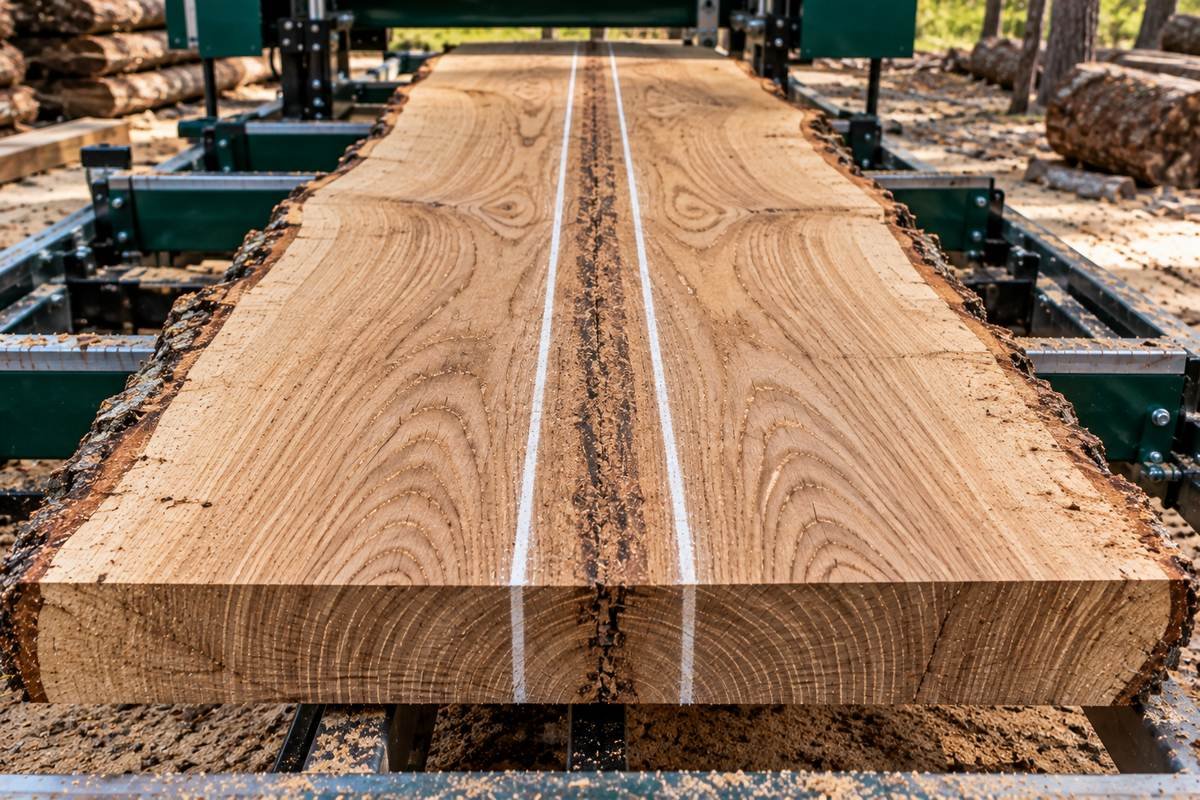
- Take a thin slab off the top to open the log, then saw through and through without turning it. Keep the cuts parallel to the first face.
- Stack the boards in order so you know which ones came from the center.
- On each of the three or four center boards, find the pith on the end grain and snap a line along it.
- Rip out a strip about 1 to 2 inches wide with the pith in it. The pith cracks as it dries, so it was going in the firewood pile anyway.
- Edge the bark off the two halves. Those are your quarter-sawn boards, with the most vertical grain along the ripped edge.
For most small mills, this is the best approach: you get both from the same log. The upside is speed and yield. Nothing extra gets turned, and the outer boards still come out as wide plain-sawn stock. The downside is width. A quarter-sawn board can't be wider than the distance from the pith to the bark, minus half the pith strip, so a 20-inch log gives you boards about 9 inches wide at most before edging. A 12-inch log gives about 5.
Method 2: quarter the log and alternate faces
This is the traditional method, and the one to use when you want the most true quarter-sawn boards and the strongest ray fleck from a good oak log. It takes more handling. A cant hook and some wedges are no longer optional.
- Saw the log in half through the pith. On a band mill, dog the log and make one horizontal cut at pith height.
- Stand one half with its flat face against the backstops and saw through it again at pith height. That splits it into two quarters. Repeat for the other half.
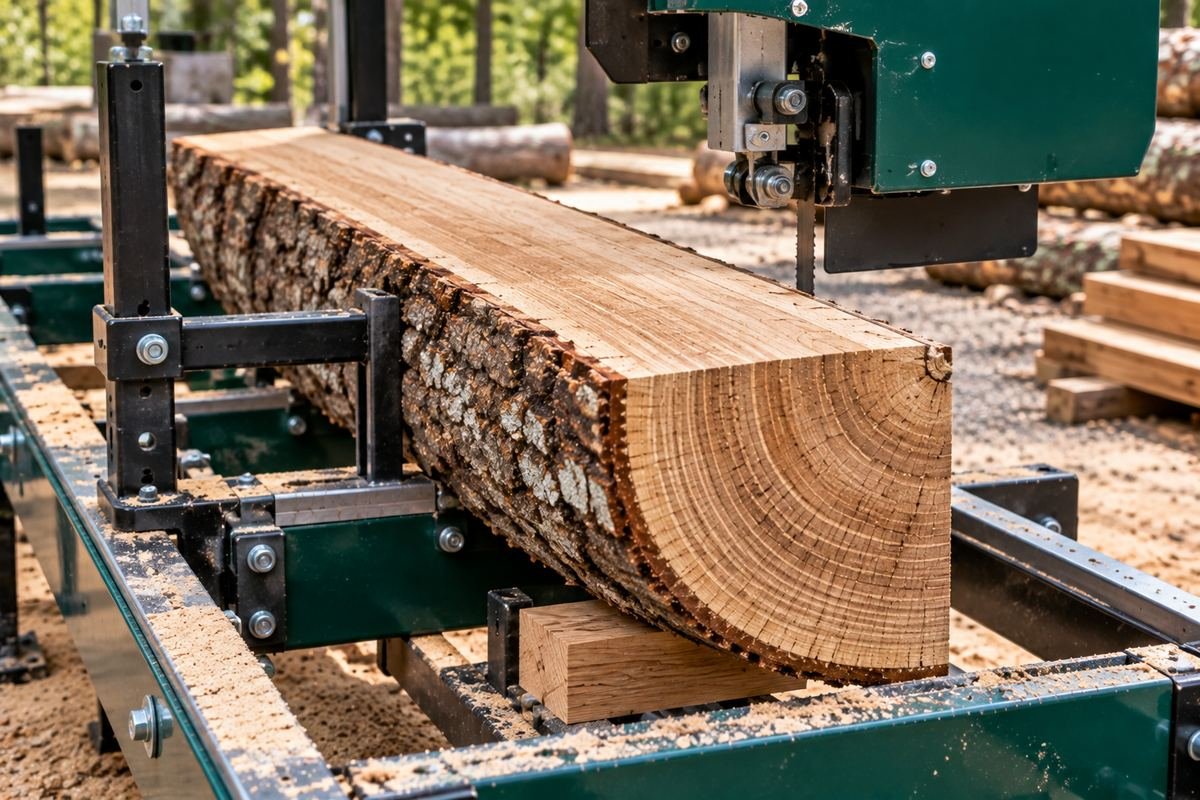
- Set a quarter so one split face is flat on top, and the other split face is against the backstops, with the bark arc resting on the bed. Shim under the bark with a wedge until the top face is level, then clamp or dog it tight.
- Take one board off the top face.
- Roll the quarter 90 degrees so the other split face is on top, and the freshly sawn face is against the backstops. Level it again and take a board.
- Keep alternating. Each board comes off a face that runs close to the log's radius, so its rings stay near vertical.
Stop when what's left is too narrow to be useful and flat saw it or rip it for rift stock. Expect a lot of narrow boards with tapered edges to clean up. A log turner or hydraulic clamp makes flipping much easier on bigger quarters, and a fresh, sharp blade matters more here than usual, since white oak's rays are hard on a dull band.
On a chainsaw mill, quartering is harder because the mill rides on the top face of the work. Sawyers either split the log with wedges along the pith and mill each quarter from a guide board screwed to it, or stick with Method 1.
Method 3: sawing rift sawn stock on purpose
Rift-sawn stock lives in the bands between the plain-sawn center of a board and its quarter-sawn edges. Look back at the table: on a board 3 inches off the pith, about 6.9 inches of the face is rift. You can rip those bands out of live-sawn boards, or saw a heavy cant (a thick center plank holding the pith), turn it 90 degrees, and saw boards across it. Boards cut that way come out narrow, with rift and quartered grain on both faces and edges.
For table legs, saw the leg blanks with the rings running corner to corner at about 45 degrees on the end grain. All four faces then show the same straight grain. It's the most wasteful way to saw a log, which is why rift-sawn white oak legs cost what they do at the lumberyard.
Picking a log worth quartering
| What to check | What you want |
|---|---|
| Species | White oak is the classic, with big ray fleck. Red oak, sycamore (sold quartered as lacewood) and beech also show fleck. Cherry and maple show subtle fleck. Walnut gains little stability from quartering. |
| Diameter | Quarter sawn board width tops out at the log radius minus the pith strip. For boards wider than about 6 inches, start with a log over 14 inches inside the bark. |
| Bark | Sawyers on WoodWeb point out that straight bark means the rays run straight from the bark to the pith. A twisted or spiral-barked log gives fleck that wanders and boards that twist. |
| Pith | Centered. An off-center pith, common in leaning trees, means tension wood and a lopsided ring pattern. Saw that log plain. |
| Clear length | Quartering costs time per board foot, so spend it on a clear butt log, not a knotty top log. |
Scale the log before you decide. The Doyle log scale badly underestimates what small logs yield, and the board foot calculator will tell you what the finished boards are worth in volume.
When plain sawn is still the right call
Quartering doesn't always win. Plain sawn gives you the most lumber, the widest boards, and the most dramatic figure. Wood-Mizer puts the yield penalty for quartering at about 20% and says quarter sawn lumber takes about 15% longer to dry. On a log that's knotty, small, or walnut, that trade usually isn't worth it.
Plain sawn boards also dry flat enough if you treat them right. Sticker them evenly, weigh the stack, and keep the boards stacked until they're dry. Our air drying lumber guide covers the stacking that keeps plain-sawn boards from cupping (a board bending across its width as it dries) badly.
Drying quarter sawn lumber after you saw it
Quarter sawn boards cup far less, but they still check at the ends. Seal the ends the day you saw them with a wax emulsion like Anchorseal (see our end grain sealer comparison). Oak dries slowly, so stack it out of direct sun and give it air on all sides.
One thing surprises people. A quarter-sawn board shrinks less in width but more in thickness, because its thickness now runs tangentially. Don't saw quarter-sawn oak thin. The usual 1-1/8 inches green for 4/4 lumber leaves room for that shrinkage and for planing. Check it with a moisture meter before you start building. If you're drying in a DIY kiln, go gentle on oak early in the schedule. It's prone to surface checks and honeycombing when it's dried too fast.
Quarter sawn vs plain sawn: telling them apart in a lumber pile
Settling quarter sawn vs plain sawn on a finished board takes about five seconds. Check the end grain first. Rings standing up like a stack of plates are quarter sawn. Rings lying down like a smile are plain sawn. Diagonal rings are rift.
Then check the face. Quarter-sawn oak shows ray fleck across the face, and its edges show cathedral arches, the reverse of a plain-sawn board. A board can be quarter sawn on one edge and plain sawn in the middle, exactly as the table above predicts for boards sawn near the pith. Grade and price it by what most of the face shows.
Frequently asked questions
Is quarter sawn better than plain sawn?
Quarter sawn is more stable, moving about half as much in width and staying flat, and it shows ray fleck in oak. Plain sawn gives more and wider boards from each log and costs less. The quarter sawn vs plain sawn trade is stability against yield, so use quarter sawn for furniture, flooring and doors, and plain sawn for wide panels and general stock.
What is the difference between quarter sawn and rift sawn?
The ring angle. Quarter sawn boards have rings at about 60 to 90 degrees to the face and show ray fleck in oak. Rift-sawn boards have rings at about 30 to 60 degrees and show straight grain on all four sides with little or no fleck.
Can you quarter saw on a chainsaw mill?
Yes. The simplest way is to live-saw the log and rip the pith out of the center boards, leaving two quarter-sawn boards from each. True quartering is harder on a chainsaw mill because the mill rides on the top face, so most sawyers split the log along the pith and mill each piece from a guide board.
How big does a log need to be to quarter saw?
Any log gives some quarter-sawn boards from near the pith, but the width of those boards is limited by the log radius. For quarter-sawn boards wider than about 6 inches, start with a log over 14 inches in diameter inside the bark.
Why is quarter sawn lumber more expensive?
It takes more turning and handling to saw, it yields less lumber from each log (Wood-Mizer puts it at about 20% less), and it takes longer to dry. Rift sawn costs even more because it wastes the most of the log.
Summary
The quarter sawn vs plain sawn choice starts at the mill, not the lumberyard. Live-saw your logs and rip the center boards, and you'll get quarter-sawn lumber from almost every log at no extra cost. Save true quartering for straight, clear white and red oak over 14 inches, where the stability and the ray fleck pay for the extra turning. Saw everything else plain, and dry it carefully.