
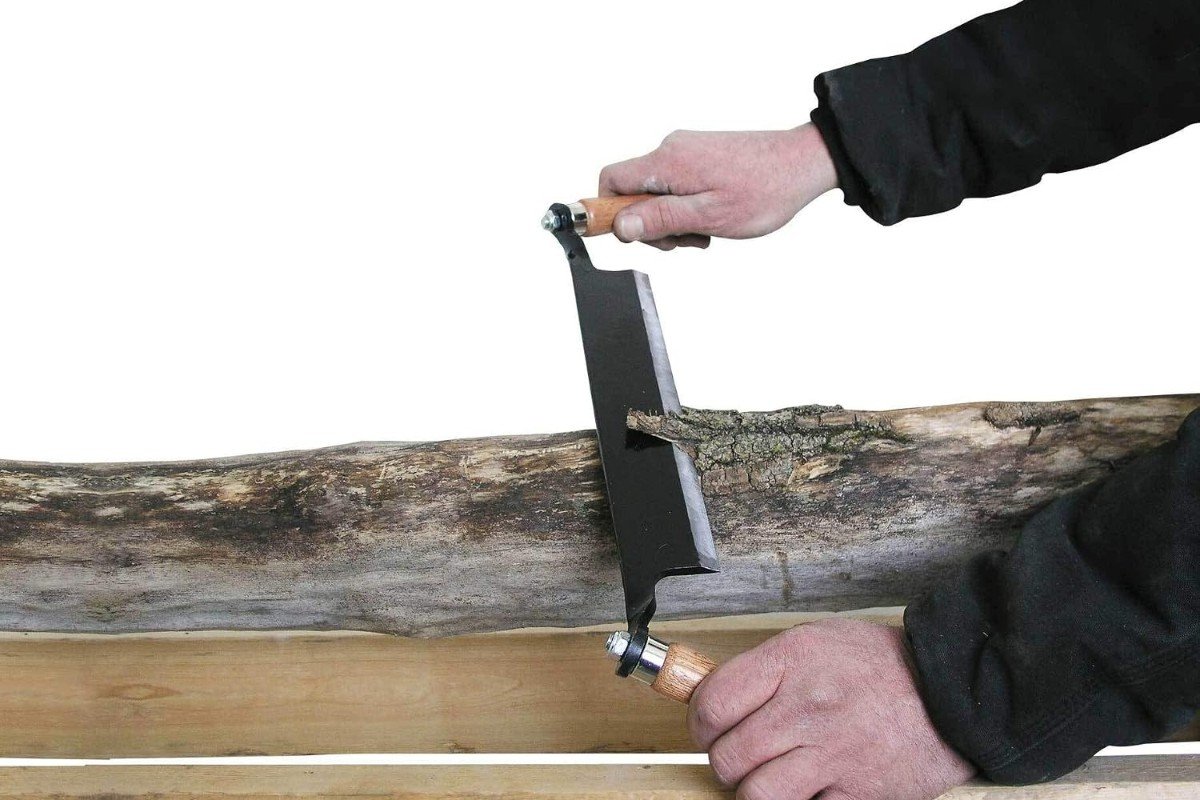
A drawknife is one of the oldest tools in a sawyer's kit, and still one of the most useful before the first cut. It is a long blade with a handle at each end. You pull it toward you along a log, and it lifts the bark off in long strips. For anyone running a portable sawmill or a chainsaw mill, that means less grit and fewer stones going through the blade.
This guide covers what a drawknife does, why bark is worth removing before you mill, when it comes off easiest, how to choose between straight and curved blades, five drawknives sold on Amazon, and how to use and sharpen one safely.
Table of Contents
What Is a Drawknife?
A drawknife, also written draw knife and often sold as a draw shave, is a blade with a handle at each end. You hold both handles and pull the blade toward your body. A drawknife has a blade that is long along the cutting edge but shallow from edge to back, with a bevel of about 25 degrees. It lists debarking, rough shaping, and making round blanks for a lathe among its main uses.
Unlike a spokeshave, a drawknife has no sole or mouth to limit the depth of cut. That makes it less precise, but much faster at taking off a lot of material. For bark, speed is what you want.
Why Take the Bark Off Before You Mill
Bark holds dirt. A log that was dragged, dropped or stacked on the ground picks up sand and small stones in the cracks of its bark, and those go straight into the blade on the first cut. On the WOODWEB knowledge base, technical advisor Gene Wengert puts it plainly: one important reason sawmills use a debarker is "to get rid of the sand and grit and small rocks that are in the bark." The same discussion lists longer blade life as a main benefit.
Big mills use machine debarkers. Small sawyers use simpler tools: a pressure washer, a wire brush, a shovel to knock off loose bark, or a drawknife. A drawknife is the slowest of these, but it takes the bark off completely, which none of the others do on tight bark.
It also helps keep logs clean before they reach the mill. Lifting one end of the log with a log arch keeps it from plowing through the dirt on the way out of the woods. And if you sell or build with live edge slabs, peeling the bark first leaves a clean edge that won't flake off later. Our guide to flattening a wood slab after milling covers the next step.
When Bark Comes Off Easiest
Timing matters more than the tool. In spring, the layer under the bark grows fast and stays soft and slippery, so bark comes away with little effort. By autumn, that layer has dried, and the bark has tightened onto the log. Northern Woodlands describes both cases. With a spring-cut log, a bark spud and an axe can strip a large log in minutes. For logs whose bark has already tightened and dried out, it calls a drawknife the best option, but warns that the work will be very time-consuming.
The practical takeaway: peel spring-cut logs soon after felling, with a spud if you have one. For everything else, plan on a drawknife and allow the time. The American Trails tool guide makes the same split, using the spud on green logs and the drawknife to strip small logs and poles.
Straight or Curved, Long or Short: Choosing a Drawknife
Two choices determine which drawknife fits your work: blade shape and length.
| Blade | Best for | Trade-off |
|---|---|---|
| Straight, 8 to 10 inches | General debarking, live edge slabs, flat faces | Corners of the blade can dig into a round log |
| Curved, about 10 inches | Peeling round logs and posts | Less suited to flat surfaces |
| Straight, 13 inches | Large logs, long strokes | Heavier and harder to control on small work |
| Short, about 5 inches | Shaping, carving, small branches | Slow on big logs |
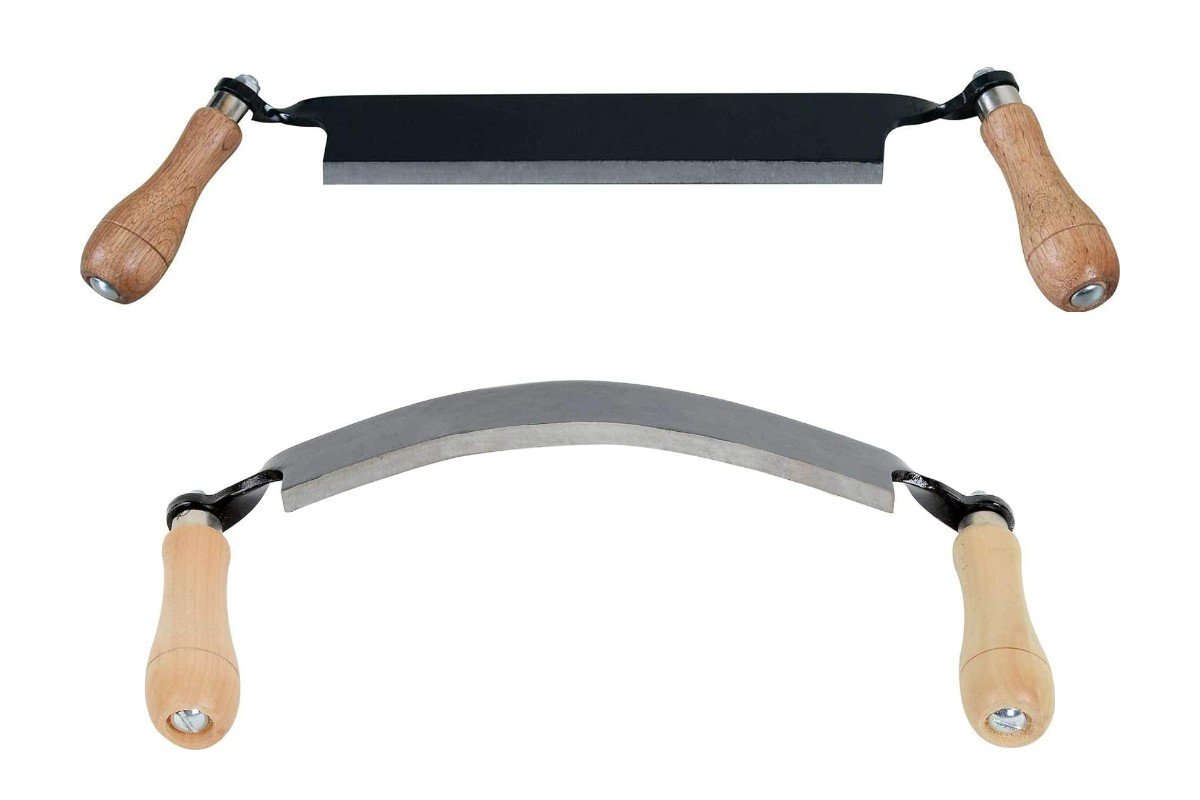
If your main goal is peeling sawlogs, start with a curved or 10-inch straight blade. Add a short drawknife later if you also shape handles, chair parts or spindles.
Drawknives Worth Buying
These five cover the main blade types at a range of prices. Ratings are from Amazon, checked in October 2026, along with what owners say most often in their reviews. Check the current listing for price and stock before you buy.
Timber Tuff TMB-10S 10 Inch Straight Draw Shave
Timber Tuff makes the best-known budget drawknives on Amazon. This 10-inch straight model has a 5 mm thick steel blade ground at a 30-degree angle, wood handles, and a blade cover. Timber Tuff rates the steel at HRC 30 on the Rockwell hardness scale, which is soft for a cutting tool. Soft steel is easy to sharpen but loses its edge faster. Owners rate it 4.4 out of 5 from about 1,400 ratings. Many call it good value and sturdy, but reviews on sharpness are mixed, and some owners report loose handles and a blade cover that doesn't stay on.
See the Timber Tuff TMB-10S on Amazon
Timber Tuff 10 Inch Curved Draw Shave
The curved version of the same tool, with the same 5 mm blade, 30-degree bevel, and HRC 30 steel. The curve follows the round surface of a log, so the whole edge stays in contact as you pull. That makes it the better Timber Tuff for peeling sawlogs and posts. Owners rate it 4.3 out of 5 from about 840 ratings. Several say the blade did not arrive sharp enough, so plan to sharpen it before first use.
See the Timber Tuff 10 Inch Curved Draw Shave on Amazon
Stubai 336003 Drawknife, 240 mm
Stubai is an Austrian toolmaker, and this is the step up from the budget models. The blade is forged steel with a 240 mm (about 9.5 inches) cutting length, a concave grind, and a plastic edge guard. Stubai lists peeling as its intended use. It has the highest rating of this group, 4.7 out of 5 from about 1,360 ratings. Owners describe a high-quality tool with a good edge, and the most common complaint is the price.
See the Stubai 336003 Drawknife on Amazon
Felled 13 Inch Straight Draw Shave
For big logs, a longer blade covers more bark with each stroke. The Felled draw shave has a 13-inch straight blade and wood handles, and is sold for removing bark from logs, posts, and firewood. Owners rate it 4.5 out of 5 from about 1,800 ratings. Most describe a sturdy tool that works well, but reviews on sharpness are mixed, and some owners say the steel is poor quality.
See the Felled 13 Inch Draw Shave on Amazon
Flexcut KN16 5 Inch Drawknife
This is a different kind of tool. The Flexcut has a 5-inch blade of 1095 high-carbon steel that flexes slightly, so it follows curved surfaces. It comes with ash handles and a leather sheath, and is made in the USA. It is too small to peel a large sawlog quickly, but it is the best of this group for shaping, carving, and cleaning bark off branches and small poles. Owners rate it 4.6 out of 5 from about 960 ratings. Many say it arrives very sharp, and one owner reports it stayed sharp after peeling 50 feet of cedar. A few found it smaller than expected or had handles come loose.
See the Flexcut KN16 Drawknife on Amazon
How to Use a Drawknife to Debark a Log
- Hold the log steady at about waist height. A pair of sawbucks works for long logs. A vise or a shaving horse, a bench that clamps the work with a foot lever, works for shorter pieces. A cant hook or peavey helps you roll a heavy log as you go.
- Stand with one foot forward and one back. Lean on the front foot as you start the cut, then shift your weight back as you pull. Use your legs and body, not just your arms.
- Hold the blade at a slight angle to the log, so it slices rather than chops. Take short strokes at first until you feel how deep it wants to cut.
- Choose bevel up or bevel down. Bevel up gives straighter cuts along the grain, and bevel down gives more control over depth on curved surfaces. For peeling a round log, most people find bevel down easier.
- Peel in strips along the length of the log, rolling it as you go. Leave the knots for last, and work around them from both sides.
- Clean the blade often. Sap builds up on the edge and makes it drag.
How to Sharpen a Drawknife
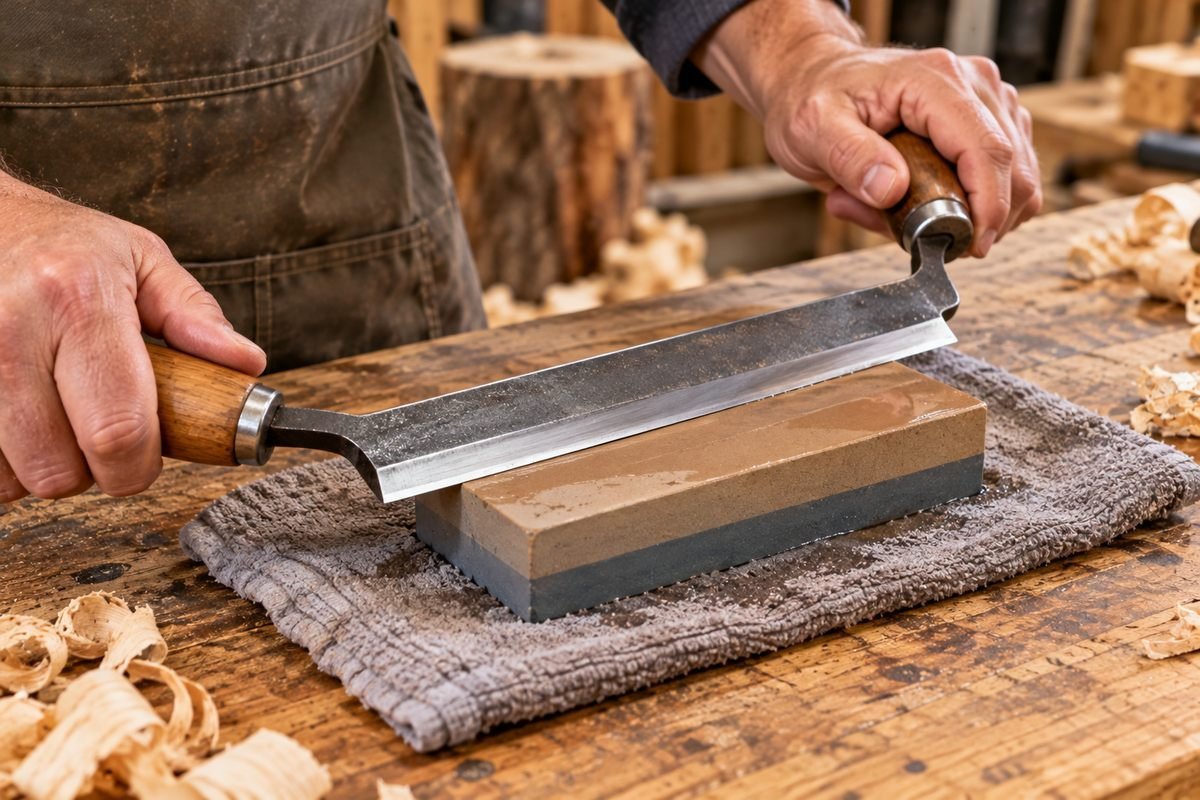
A sharp drawknife does most of the work for you. A dull one tears the bark and tires you out. Owner reviews show that many budget drawknives need sharpening before first use.
- Flatten the back of the blade first, the flat side opposite the bevel, on a coarse stone.
- Sharpen the bevel at its existing angle, usually 25 to 30 degrees. Work until you can feel a small burr along the whole back edge.
- Move to a finer stone and repeat, then remove the burr with a few light strokes on the back.
- Strop on leather if you have it, for a cleaner edge.
A combination whetstone covers both stages. The KING KW65 1000/6000 grit combination stone has a coarse side for shaping the edge and a fine side for finishing, comes on a plastic base, and has a 4.6 out of 5 rating from more than 7,500 Amazon ratings. Hold the stone and move it along the blade, rather than trying to move a long drawknife over a fixed stone. If you also run a chainsaw mill, our guide to sharpening a chainsaw mill chain covers that blade.
Drawknife Safety
- Keep both hands on the handles every time you pull. The blade travels toward your body, so never hold the work with one hand while pulling with the other.
- Keep the work clamped or supported so it cannot roll or slide while you pull.
- Wear gloves when you handle the blade, and put the blade cover back on whenever the tool is not in use.
- Watch the end of each stroke. Stop before the blade can reach your body.
- For the cutting side of the job, see our chainsaw mill safety guide.
Drawknife FAQ
What is a drawknife used for?
A drawknife removes bark and shapes wood. You hold a handle in each hand and pull the blade toward you along the log or board. Sawyers use it to peel bark before milling and to clean bark off live edge slabs.
Is a draw knife the same as a drawknife?
Yes. Drawknife, draw knife, and draw shave all name the same tool: a long blade with a handle at each end that you pull toward you.
Should I buy a straight or curved drawknife?
A straight blade suits flat work and live edge slabs. A curved blade follows the round surface of a log, so it suits debarking. If you only buy one for peeling logs before milling, the curved blade is easier to use on round stock.
Do drawknives come sharp?
Some do and some don't. Owner reviews of the Flexcut model say it arrives very sharp. Reviews of the larger budget draw shaves are mixed, and many owners sharpen them before first use.
Is a bark spud better than a drawknife?
For logs cut in spring, when the bark slips off easily, a bark spud is faster. Once the bark has tightened up later in the year, a drawknife works better, though the job takes much longer.
Which Drawknife to Buy
For peeling sawlogs on a budget, the Timber Tuff curved drawknife follows the log's round surface and costs the least, as long as you sharpen it first. For a tool that arrives ready and holds its edge longer, the Stubai is the better buy. For large logs, the 13-inch Felled covers more ground per stroke, and for shaping and small poles, the Flexcut is the most precise. Whichever you choose, a drawknife and a sharpening stone are a small cost next to the blades they protect, and clean logs will mill cleaner and keep your blades sharp longer. For the blades themselves, see our guide to the best portable sawmill blades.