
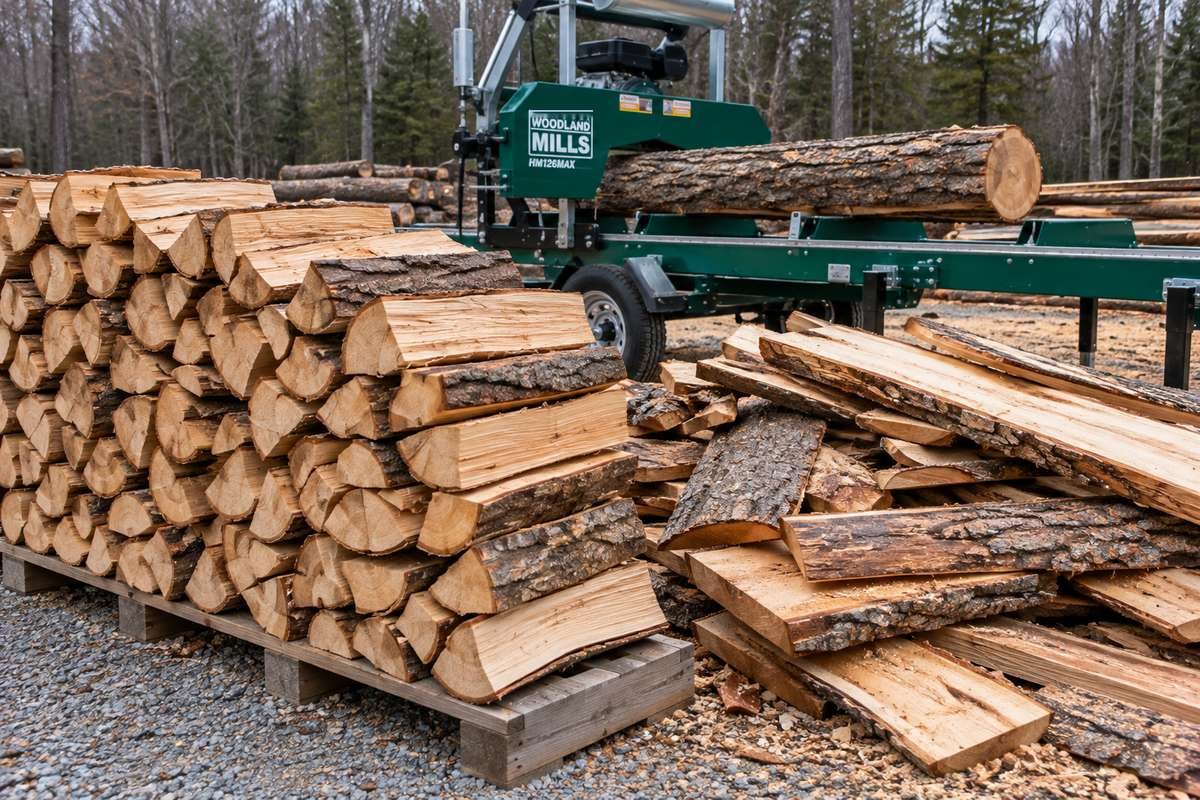
If you run a chainsaw mill or a portable sawmill, you already have a pile of firewood sitting next to your work area. Slab wood, edgings, short ends, and the occasional punky or curved log that never made good lumber add up fast, and most of it ends up in a burn pile instead of a bank account. Learning how to sell firewood turns that scrap pile into extra income, often with equipment you already own.
This guide covers how to season and prepare mill scraps for sale, how firewood is measured and priced, what labeling and weights-and-measures rules usually apply, where to find buyers, and which extra tools speed up the process. None of this requires buying a separate processor or a dedicated firewood operation. It builds on what a sawmill or chainsaw mill owner already has sitting in the yard.
Table of Contents
Why Sawmill Scraps Make a Solid Firewood Side Business
The question of how to sell firewood usually starts with realizing how much of it you already have. A typical chainsaw mill or small bandsaw mill wastes a surprising amount of volume. Slabbing off the first few cuts to square a log, trimming taper and wane (bark or a missing corner left on a board edge) from edges, and setting aside logs with rot, metal, or bad curve that will never yield clean boards all generate real cordwood. Most of it is already cut to a manageable length and split by the milling process itself, which is most of the labor a commercial firewood seller pays for.
The economics are different from someone buying standing timber specifically to process into firewood. The wood is a byproduct of work you were already doing, so the only added cost is seasoning time, occasional splitting, and whatever it takes to move it to a buyer. That is why selling firewood pays even at a small scale: a few cords a season from scrap alone can offset the cost of blades, chain, and fuel for the mill itself.
How to Season and Prepare Mill Scraps for Firewood
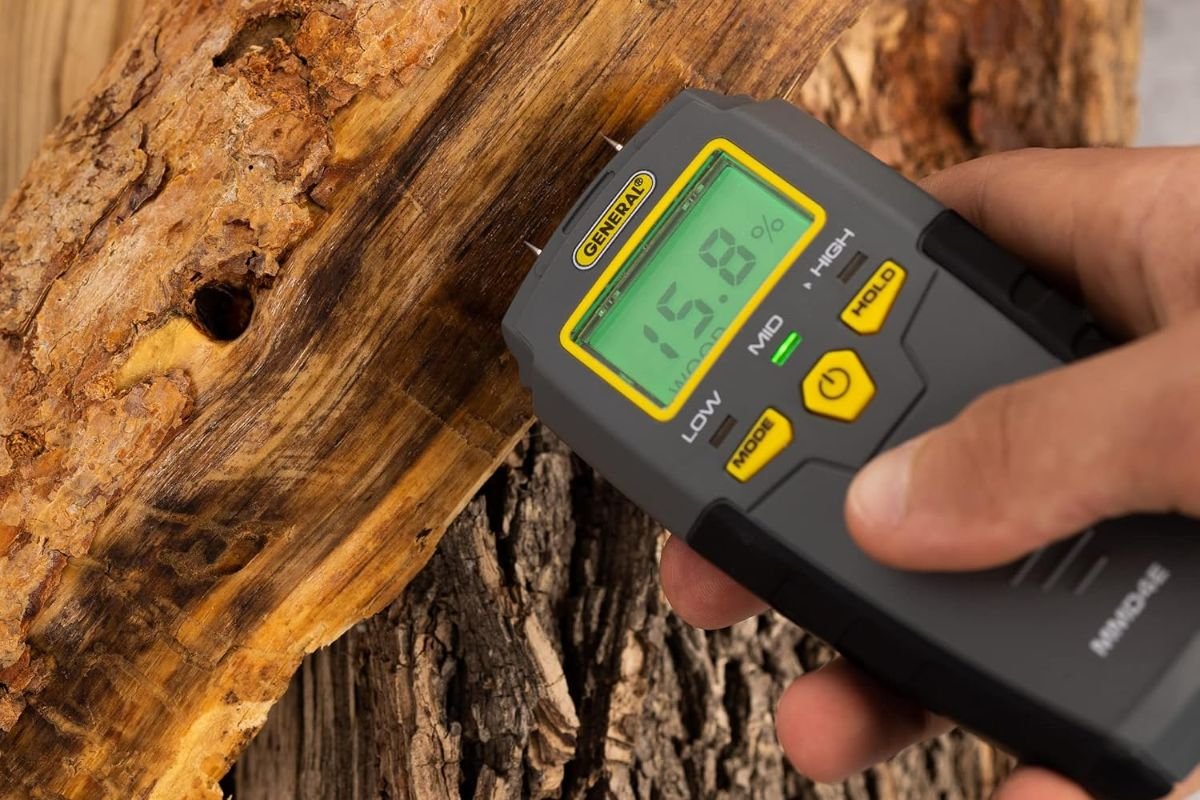
Seasoning is the step most firewood guides skip. Green wood straight off the mill can run anywhere from 30 to well over 100 percent moisture content (how much water is in the wood, as a percent of its dry weight). It depends on species, and buyers notice immediately if it isn't ready to burn. Properly seasoned firewood needs to drop to around 20 percent moisture or lower, which usually takes six months to a year of open-air stacking, longer for dense hardwoods like oak and shorter for softer species like pine or poplar. A cheap moisture meter pays for itself the first time it stops you from selling wet wood as seasoned.
- Cut to a standard length. 16 inches is the most common size for home wood stoves and fits most fireplaces, and cutting everything to one length also makes stacking and measuring easier.
- Split anything over about 6 inches across. Smaller splits season faster and are easier for customers to handle. Mill slabs with bark still attached often split cleanly along the grain.
- Stack off the ground, single row, bark side up. Pallets or 2x4 rails keep the bottom row from wicking moisture out of the soil, and a single row lets air move through the whole stack instead of just the outside.
- Cover the top only. A tarp or steel roof over just the top of the stack sheds rain while leaving the sides open for airflow, since wrapping the whole stack traps moisture and slows seasoning down.
- Keep species separated if you can. Hardwoods like oak, hickory, and maple burn longer and hotter than softwoods, and buyers who know the difference will ask.
How Firewood Is Measured and Priced
The first thing to get right is the unit of measure. The legal unit for firewood in most states is the cord, defined as a stack measuring 4 feet by 4 feet by 8 feet, or 128 cubic feet of ranked, well-stacked wood. Informal units like a "rick," "rank," "face cord," or "pickup load" are common in casual conversation but are not legal units of sale in most places and tend to undervalue what you are selling once a buyer runs the math. Quoting in cords, or clearly labeled fractions of a cord, protects you and keeps pricing comparable to what competitors are charging locally.
A reference published by the University of Missouri Extension notes that green wood loses roughly 10 to 12 percent of its heat value compared to properly seasoned wood. That is a useful number to cite when explaining why seasoned firewood commands a higher price than green. The same guide recommends giving buyers a bill of sale and keeping species claims accurate to within about 10 percent, since several states' weights and measures divisions treat misrepresenting species or quantity as a real violation, not just a customer-service issue.
Full cords typically sell to local buyers for a wide range depending on region and species, while bundled firewood aimed at campers and casual buyers sells by the bundle instead. A bundle of around 0.75 cubic feet, roughly 6 to 7 pieces, commonly sells for $6 to $12, with $8 to $10 being a comfortable middle ground that also prices cleanly against cash (three bundles for $20, for example). Selling both ways, cords to regular customers and bundles to campers or grocery-store foot traffic, covers more of the market from scrap volume that would otherwise just get burned in a pile.
Legal and Labeling Requirements
You also need to know the rules. These vary by state and county, so check your local weights and measures division before selling at any real volume, but a few requirements for selling firewood legally show up almost everywhere. Firewood generally has to be advertised and sold by the cord or a clearly labeled fraction of a cord, not vague terms like a load or a rank.
Many states also require a bill of sale or receipt showing the seller's name and address, the quantity in cords, and the species if that was part of the sales pitch. If you are delivering wood, your vehicle and trailer should meet normal road and weight requirements, and some counties require a basic vendor or peddler's permit for roadside or door-to-door sales even at small volume.
Where to Sell Your Firewood
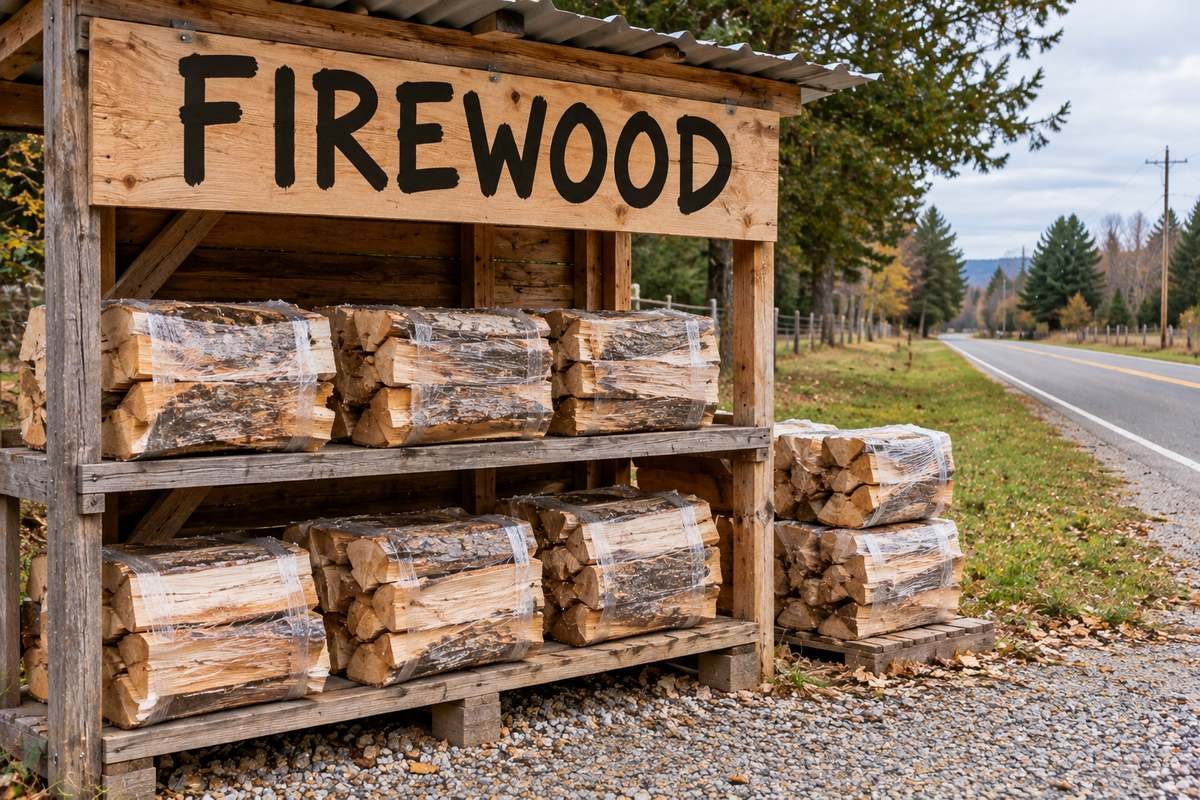
Most small sellers do best spreading sales across a few channels rather than relying on just one, so pick two or three channels and stick with them.
- Roadside stand. If your property gets any passing traffic, a simple stand with clear pricing and an honesty box works well for bundled wood aimed at campers and casual buyers.
- Facebook Marketplace and local classifieds. Still the highest-volume channel for most small sellers, so post with a clear photo of a measured stack and your price per cord or per bundle.
- Firewood-specific apps and directories. Services built specifically for connecting local firewood sellers with buyers are growing and cost little or nothing to list on, and they reach people already searching for firewood rather than browsing.
- Campgrounds and gas stations. Many will let you drop off bundled wood on consignment or buy it outright at a wholesale rate, which trades a lower per-bundle price for guaranteed, hands-off volume.
- Repeat local customers. Once you have sold a few cords, word of mouth among neighbors who heat with wood tends to become the steadiest channel, especially if you can deliver and stack.
Equipment That Makes Selling Firewood Easier
You do not need a dedicated firewood processor to sell firewood as a side business, especially at the scale most mill-scrap sellers work at. A few tools make a real difference in how much time each cord takes and how professional the final product looks, and they make it easier to sell a consistent product.
- Moisture meter. The fastest way to confirm wood is seasoned before you sell it as such. See our guide to choosing a moisture meter for wood for picks that work on firewood-sized pieces, not just milled lumber.
- A manual or hydraulic log splitter. Speeds up processing anything too large to split by hand and reduces the physical toll of a full season of firewood prep.
- Firewood racks or pallets. Keep stacks off the ground and organized by species or seasoning date, which also makes inventory easier to estimate at a glance.
- A trailer or truck bed liner. Delivery sells more wood than pickup-only listings do, and a dedicated hauling setup pays for itself quickly once you have regular customers.
- Netting or twine for bundles. Cheap, and it makes bundled wood look retail-ready for roadside stands and consignment spots, which matters more to casual buyers than the price per piece.
If you are already air-drying milled lumber on the same property, the same stacking principles apply to firewood. See our guide to air-drying lumber for the airflow and cover details that carry over directly.
Frequently Asked Questions
How much firewood can I realistically get from sawmill scraps?
It depends heavily on what you are milling and how much of each log ends up as slab, edging, or reject wood. But a steady weekend hobbyist mill can often generate half a cord to a full cord of scrap per month of regular use. Someone running a mill commercially or part-time for income can generate several cords a month, more than enough to justify treating the scrap as a real side business instead of a burn pile.
Can I sell firewood without a business license?
Selling firewood legally starts with your local rules, not federal ones. In most states, casual or occasional sales at a small scale do not require a formal business license, though some counties require a basic vendor or peddler permit for roadside stands or door-to-door delivery. Rules vary enough by state and county that it is worth a quick call to your local weights and measures office or county clerk before you start selling at real volume.
What is the difference between a cord, a face cord, and a rick?
A full cord is a legally defined volume: 128 cubic feet, or a stack 4 feet by 4 feet by 8 feet. A face cord or rick is an informal term for a stack the same height and length as a full cord but only as deep as the wood is cut, often 16 to 18 inches. That works out to roughly a third of a full cord depending on the length used. Selling or advertising in face cords or ricks without clearly stating the actual cubic footage can run afoul of weights and measures rules in several states.
Is it better to sell firewood by the cord or in small bundles?
Most successful small sellers do both. Full or partial cords sold to regular local customers who heat with wood bring in steadier, higher-volume income. Small bundles sold at a roadside stand or through campgrounds and gas stations reach casual buyers who would never order a whole cord but will pay a premium per piece for convenience.
How dry does firewood need to be before I sell it as seasoned?
Most buyers and most state guidance treat around 20 percent moisture content or lower as properly seasoned. Freshly milled scrap wood typically starts well above that, often 50 percent or more depending on species, and needs roughly six months to a year of proper open-air stacking to get there. A moisture meter is the only reliable way to confirm it before you sell wood as seasoned rather than guessing by weight or how it sounds when you knock two pieces together.
Summary
The short version of how to sell firewood from sawmill scraps is simple. If you already run a chainsaw mill or a portable sawmill, you already have most of what it takes to sell firewood on the side. You have raw material that costs you nothing extra, equipment to cut it to size, and a yard to season it in. The gap between a burn pile and a real side income is mostly just seasoning time, a consistent measuring standard, and a couple of sales channels you check regularly.
In short, start small. Season one stack properly, confirm it with a moisture meter, and sell it by the cord or in clearly sized bundles so pricing stays simple and defensible. Once that first batch moves, scaling up is mostly a matter of stacking more scrap instead of burning it, which is exactly the kind of margin improvement that costs nothing but time you were already spending at the mill.