
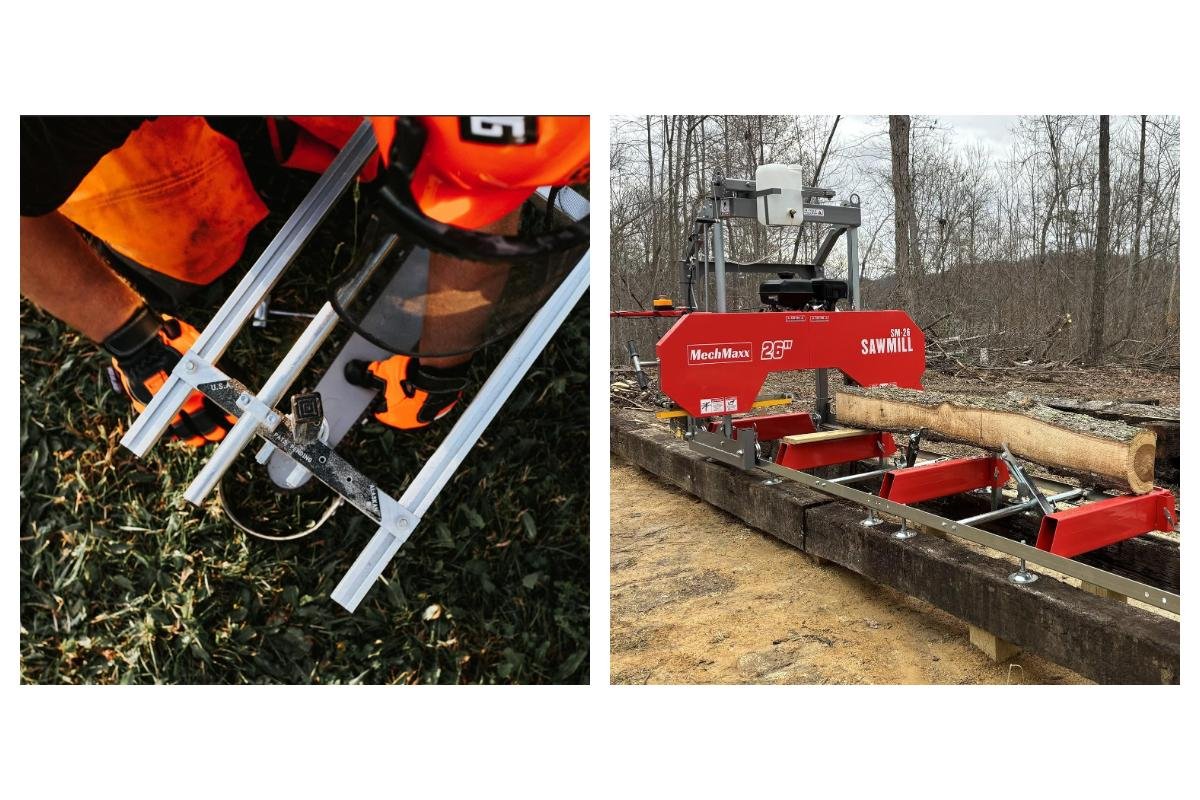
Chainsaw mill vs. bandsaw mill is a question worth asking once you've read our chainsaw mill attachment guide and want to know whether you should skip straight to a real sawmill. Both solve the same basic problem, turning a log into usable lumber, but they're built around completely different tradeoffs, and the gap between them is bigger than "one is cheaper." Here's what separates the two, and how to tell which one fits what you're trying to do.
Want to compare every model at once? Our portable sawmill spec table lines up log diameter, width of cut, log length, engine and weight for 45 band mills and 15 chainsaw mills.
Table of Contents
What a chainsaw mill is
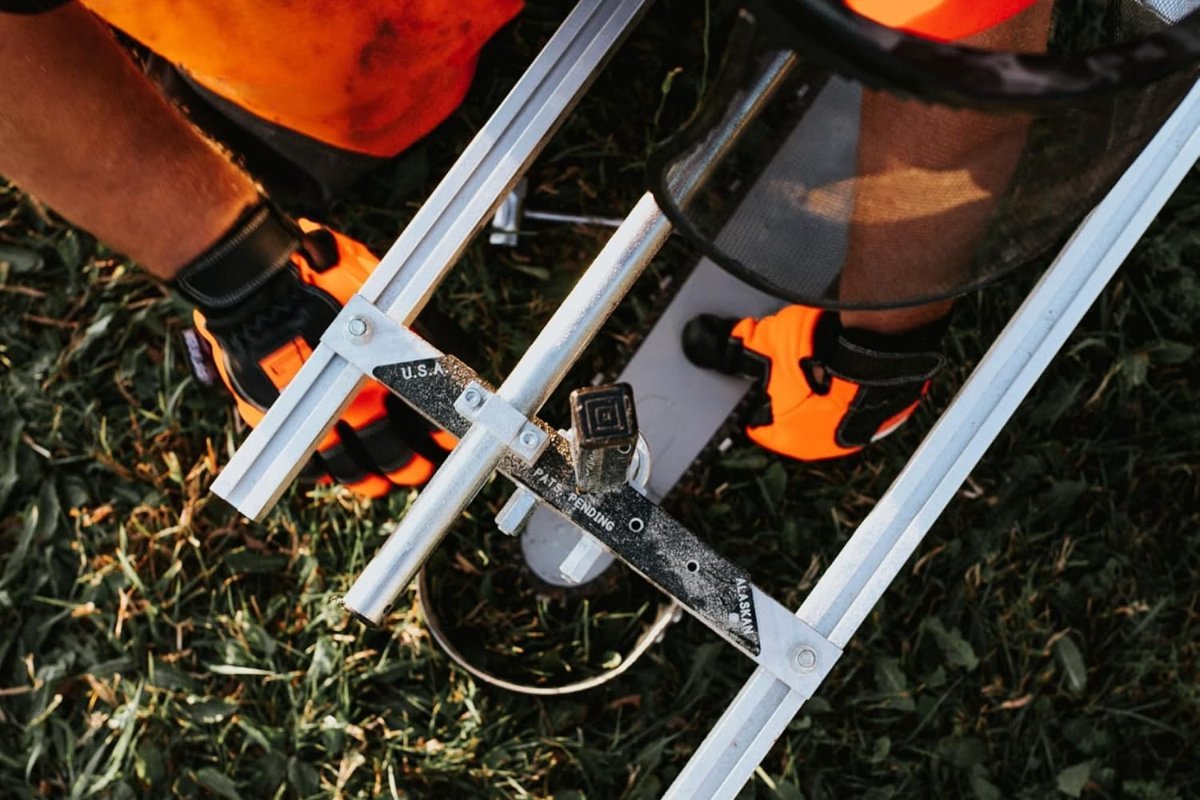
A chainsaw mill attachment turns a chainsaw you already own into a slabbing tool: a set of rails clamps onto your guide bar, rides along an aluminum rail laid across the log, and guides the chain in a straight, level cut. It's an attachment, not a standalone machine: you supply the saw and the muscle, and the mill keeps the cut true. We've already covered the category in detail: the overall pick, the Granberg Alaskan Mill specifically, the budget option, and the beginner-friendly Zozen mill.
What a bandsaw mill is
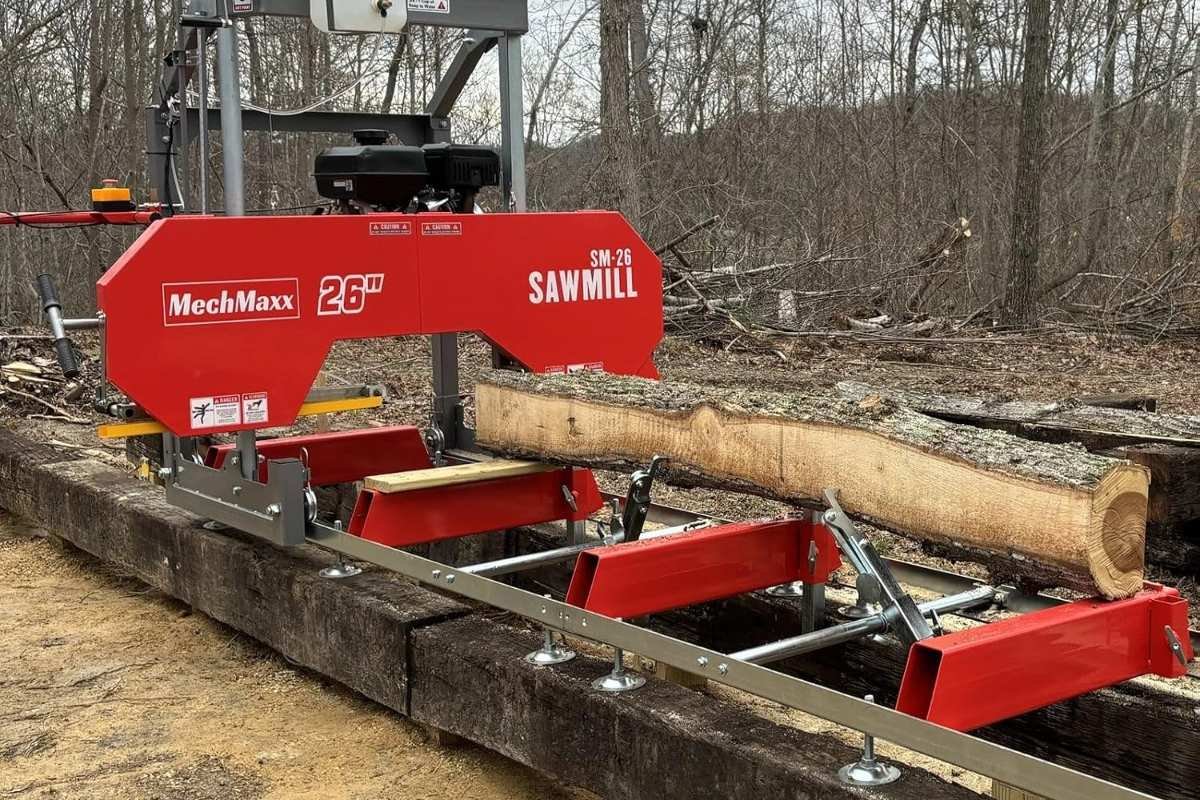
A bandsaw mill is a dedicated machine: a continuous, thin steel blade looped around two wheels, with the log fed through on a bed or carriage while the blade cuts. It's not an attachment for something else. It's purpose-built equipment, usually gas- or electric-powered, ranging from small manual-feed models a couple of people can move to large hydraulic units that stay mounted on a trailer. You're not supplying a saw you already own. You're buying the whole machine. Norwood is one of the most established bandsaw mill manufacturers, and its entry-level manual models are a common benchmark for what a new unit costs.
Chainsaw mill vs bandsaw mill: the real differences, point by point
Both tools cut logs into lumber. Almost everything else differs.
Cost
A chainsaw mill attachment costs relatively little on top of a chainsaw you likely already own. A bandsaw mill is a different kind of buy entirely. Wood-Mizer's LX25, an entry-level hobbyist model announced this year specifically to close that gap, starts in the thousands of dollars. Most established manual bandmills (a sawmill that cuts with a long, thin loop of blade) run well beyond that once you factor in a blade sharpener and setter. That adds meaningfully more on its own. There's no version of a bandsaw mill that costs less than the most expensive chainsaw mill attachment.
Portability
Chainsaw mills win outright here. The whole setup fits in a truck bed or the back of an SUV, which means you can take the mill to the log instead of hauling the log to the mill: useful if you're milling a tree that fell somewhere inconvenient. Bandsaw mills range from "two people can carry the frame" on the smallest manual units to permanently trailer-mounted on the larger ones. None of them go in a truck bed the way a chainsaw mill attachment does.
Cutting speed and capacity
A chainsaw mill is slow by design: figure roughly a foot of cut every 5 to 10 minutes on a large hardwood log with a mid-size saw, and every pass is manual, muscle-powered work. Bandsaw mills are built for throughput: a mid-size powered unit can cut an 8-foot slab in well under 10 minutes. If you're processing more than the occasional log, that speed difference adds up fast.
Lumber yield
A chainsaw's cutting chain is thick compared to a bandsaw blade, and that width becomes waste. Chainsaw milling typically turns something like 16% or more of a log into sawdust. A bandsaw mill's much thinner blade cuts that down to roughly 5%. Wood-Mizer's own figures put a dedicated bandsaw mill at producing up to 30% more usable lumber from the same log compared to a chainsaw mill. If you're milling for volume rather than the occasional project, that yield difference is real money lost with a chainsaw mill.
Maintenance
Chainsaw mills need what any chainsaw needs, just more often under the sustained load of milling: chain sharpening, bar oil, tensioning. Bandsaw mills need their own upkeep: blades need periodic sharpening and setting, which is a separate skill and, as above, often a separate piece of equipment. Neither is maintenance-free. They're just different maintenance.
Safety and physical effort
A chainsaw mill puts you standing over a running chainsaw for the entire cut, often for several minutes at a stretch on a large log, with the saw at a fixed angle and both hands occupied keeping the mill tracking straight. It's demanding work, and it's the kind of sustained, close-range chainsaw use that deserves real caution rather than the casual attitude some owners bring. A bandsaw mill removes you from that position. You're feeding the log and watching the cut, not holding a running chain against it, which is a real safety advantage on top of everything else, even though the blade itself still needs respect.
Noise and where you can use one
A chainsaw mill is exactly as loud as the chainsaw powering it, which means hearing protection and a location where a two-stroke engine running at full load for several minutes doesn't bother anyone. Bandsaw mills vary more: gas-powered units aren't quiet either, but many electric models run noticeably calmer, which matters if you're milling somewhere with neighbors close enough to care.
When a chainsaw mill is the right call
Choose a chainsaw mill attachment if you already own a chainsaw and want to try milling without a four-figure commitment, if you mill occasionally rather than as a regular workflow, if the logs you're cutting are scattered or hard to move to a fixed location, or if storage space is limited. The whole kit stores in a corner of a garage. It's also the sensible starting point if you're not yet sure milling is a hobby you'll stick with. Our beginner's guide covers this exact situation.
When a bandsaw mill is the right call
Choose a bandsaw mill if you're processing enough volume that the yield and speed difference pays for itself: a side business, a homestead producing its own lumber regularly, or land with enough downed timber that a chainsaw mill's pace becomes the bottleneck. It's also the better call if cut quality matters for the end use: a bandsaw's thinner kerf (the slot a blade or chain cuts) and more consistent feed generally produce a smoother, more dimensionally accurate board with less planing needed afterward.
The used-market option most people skip
Before ruling out a bandsaw mill on price alone, it's worth knowing the used market for them is active. Small sawmill operations and hobbyists upgrade or exit fairly often. A used manual bandmill can come in well under the price of a new entry-level unit. The tradeoff is the one you'd expect: no warranty, and you're relying on your own judgment (or a knowledgeable friend's) to assess blade guides, engine hours, and frame condition rather than a manufacturer's inspection.
It's not the first move for someone who isn't sure milling is for them yet. But it's a legitimate way to close the price gap for someone who already knows they want a bandsaw mill and just doesn't want to pay full retail for the privilege.
What people get wrong about the chainsaw mill vs bandsaw mill decision
The most common mistake isn't picking the wrong tool: it's treating this as a strictly better/worse comparison rather than a fit question. A bandsaw mill isn't an upgrade to a chainsaw mill the way a better chainsaw is an upgrade to a worse one. It's a different tool built around different assumptions about how much you're milling and how often.
Someone who mills a downed tree once a year doesn't get more value from a bandsaw mill's speed and yield advantages. Those advantages only pay off against volume, and without the volume, you've just paid far more for the same occasional board a chainsaw mill attachment already gave you.
The reverse mistake is just as real: someone running a real lumber operation off a chainsaw mill because "it works fine" is losing time and usable lumber with every cut.
Which one to buy
Chainsaw mill vs bandsaw mill comes down to volume, not quality: neither tool is a smaller or larger version of the other. They're built for different amounts of milling. A chainsaw mill attachment is the low-commitment way to find out if milling is for you, using a saw you probably already own, with real tradeoffs in speed, yield, and physical effort that come with that low commitment.
A bandsaw mill is what you buy once you already know the answer is yes, and the occasional Saturday project has turned into something closer to a regular need. If you're reading this because you're still deciding, that's usually a sign you're not past the chainsaw mill stage yet: and that's a fine place to start.
Quick answers
Is a chainsaw mill or bandsaw mill better for a beginner?
A chainsaw mill attachment, almost always. It costs a fraction as much, uses a saw most people already have, and lets you find out whether milling is worth the bigger investment before you make it.
How much lumber do you lose to sawdust with a chainsaw mill vs. a bandsaw mill?
Roughly 16% or more of the log with a chainsaw mill's wider kerf, versus around 5% with a bandsaw mill's thinner blade: a real difference if you're milling for volume rather than occasional projects.
Can a chainsaw mill cut as fast as a bandsaw mill?
No. A chainsaw mill runs roughly a foot of cut every 5 to 10 minutes on a large hardwood log. A mid-size powered bandsaw mill can cut an 8-foot slab in under 10 minutes. Bandsaw mills are built for throughput in a way chainsaw mills aren't.
What's the cheapest way to get into milling your own lumber?
A chainsaw mill attachment, if you already own a chainsaw: our budget option costs relatively little. Bandsaw mills start much higher, with even new entry-level hobbyist models running far more.