
Table of Contents
Why the Granberg Alaskan Mill gets its own page
The Granberg Alaskan Mill isn't just one option among several in the chainsaw mill attachment category: it's the one that essentially created it. Granberg has been building these mills for 60 years, and when other reviewers and forum threads talk about "the" chainsaw mill attachment, they usually mean this one, or one of the many attachments built to copy its basic design. If you're comparing the Granberg Alaskan Mill against cheaper alternatives, it helps to understand exactly what the extra cost is buying before deciding whether it's worth it for you.
This page goes deep on the Granberg Alaskan Mill specifically. For a head-to-head against the Zozen and VEVOR attachments, see our best chainsaw mill attachment comparison.
What's in the box
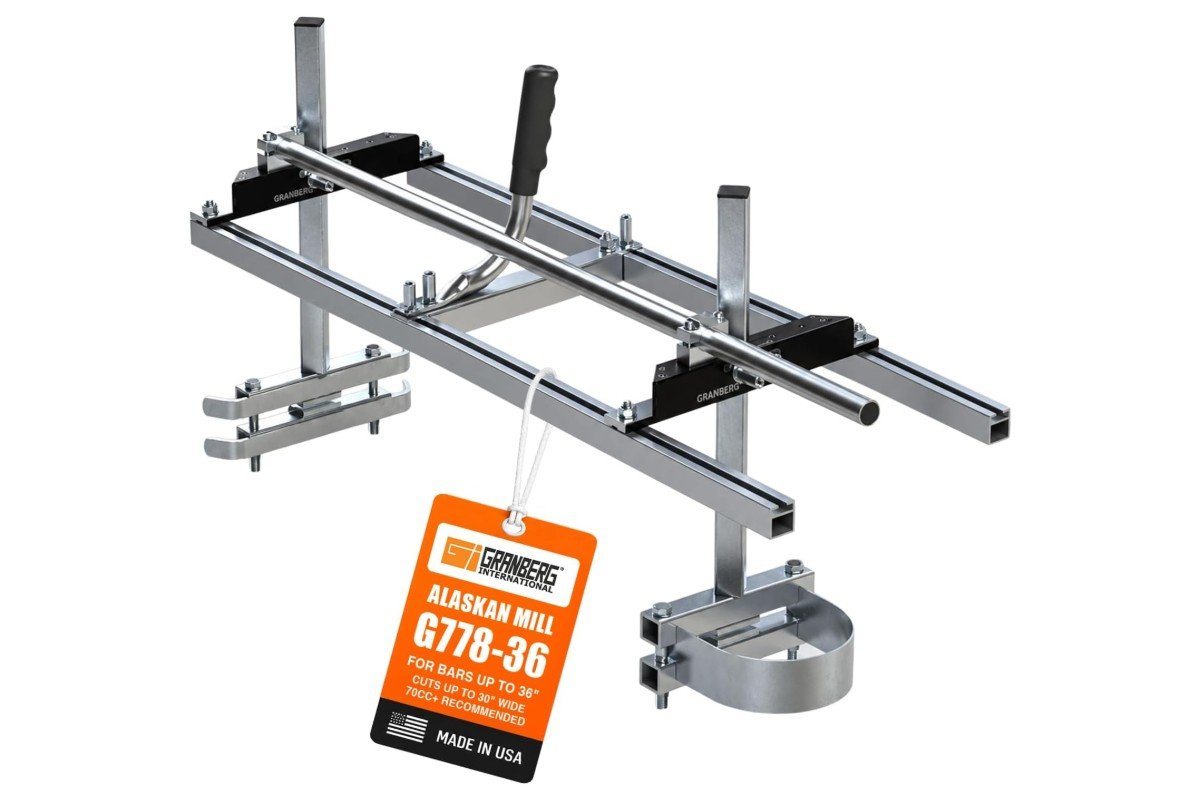
The Granberg Alaskan Mill ships as two pieces: the base mill unit and a handle/rail set sized to match your chainsaw's bar length, plus an instruction manual and the hardware to assemble it. The mill itself is built from tubular aircraft-grade aluminum extrusion with zinc-plated steel hardware, and the end brackets are CNC-machined (cut by computer-controlled machines) rather than die-cast. That detail matters more than it sounds, since it's what keeps the mill running true and cuts down on vibration during a long cut.
Nothing about assembly requires modifying or drilling into your chainsaw. The mill clamps onto the bar itself, so the saw goes back to normal use the moment you unclamp it.
How the depth adjustment works
The core of any chainsaw mill attachment is the depth-adjustment system that controls slab thickness, and it is where the Granberg Alaskan Mill stands out. The adjustment posts let you set a target thickness before the cut, and owners consistently report that the mill holds that setting through the full length of a pass. Slabs come out a consistent thickness end to end rather than tapering as saw vibration and operator fatigue creep in over a long cut. That consistency is the single biggest quality difference between a mill built to Granberg's tolerances and a budget attachment built to a lower one.
Which size to buy
Granberg sells the Alaskan Mill in several rail lengths, 24", 30", 36", 48", 56", 60", and 84", and the one you need is determined by your chainsaw's guide bar, not by the logs you plan to cut. As a rule of thumb, buy a mill rated for a rail a few inches longer than your bar. The rails need to extend past both ends of the bar for the mill to sit stable on the log. A saw running a 36" bar is the largest size Granberg recommends for the mill format most buyers land on, and it requires a chainsaw in the 70cc-or-larger class to have enough power to pull a full-width cut without bogging down.
Buying a longer rail than you need doesn't help: it just adds weight and cost for capacity your saw can't use. Match the rail to the bar you own.
The tradeoffs
The Granberg Alaskan Mill is not the easiest or lightest way to get started milling. At roughly 20 lbs before it's even mounted to a saw and bar, the combined rig is heavy enough that most owners find two-person operation far more comfortable than solo milling, especially on anything past a modest log diameter. It's also a manual, muscle-powered process: there's no motor pulling the saw through the cut, just you, and chainsaw milling burns through bar oil and chain life faster than normal cutting because of how much material a full-width slab removes.
None of that is a defect. It's what chainsaw milling is, on any attachment. The Granberg Alaskan Mill is simply built to hold up to it better than a lighter-duty attachment will over years of use.
Who the Granberg Alaskan Mill is for
This is the attachment for someone who already owns a suitable chainsaw and plans to mill regularly: clearing storm-damaged trees for lumber, milling their own timber-frame material, or turning firewood-bound logs into usable slabs on an ongoing basis. The price gap between this and a budget attachment isn't buying a better single cut. It's buying a mill built to still be square and true after the hundredth cut, not just the first one. If you're not sure yet whether chainsaw milling is something you'll stick with, our full comparison guide covers the lower-cost options worth starting with instead.
Setting up your first cut
The Granberg Alaskan Mill's depth-adjustment system only does its job once the first pass is already flat and level: it can't fix an uneven starting surface, it can only maintain whatever thickness you set from that first cut onward. A freshly felled log has bark, branch stubs, and taper working against you, so the first pass needs its own guide, not the mill itself.
The common approach: screw or clamp a straight board (a 2x4 or 2x6 works) along the top of the log, leveled with shims at each end, and run the first cut with that board as the reference rather than the log's natural surface. Once that first slab is off, the log's own cut face becomes level enough for the mill to ride directly on for every pass after. Skipping this step is the single most common reason a first-time Granberg owner ends up with a first slab that's thicker on one end than the other.
Chain and maintenance
A standard cross-cutting chain will work in a Granberg Alaskan Mill, but it's a poor match for the job. Milling holds the chain in contact with wood for the full length of a slab instead of brief bursts. A standard chain's steeper tooth angle (around 30 degrees, versus roughly 10 degrees on a ripping chain) bogs down and generates excess heat under that kind of sustained load. Budget for a ripping chain sized to your specific bar before your first cut, not after a frustrating first attempt with the chain you already own.
Expect to burn through bar oil noticeably faster than normal cutting, since a full-width slab removes far more material per pass than felling or bucking does. Keep the oil reservoir topped off and check it more often than habit would otherwise suggest, especially on a long cut.
Recommended accessories
Two additions consistently come up across Granberg owner discussions as worth having before the first cut rather than after:
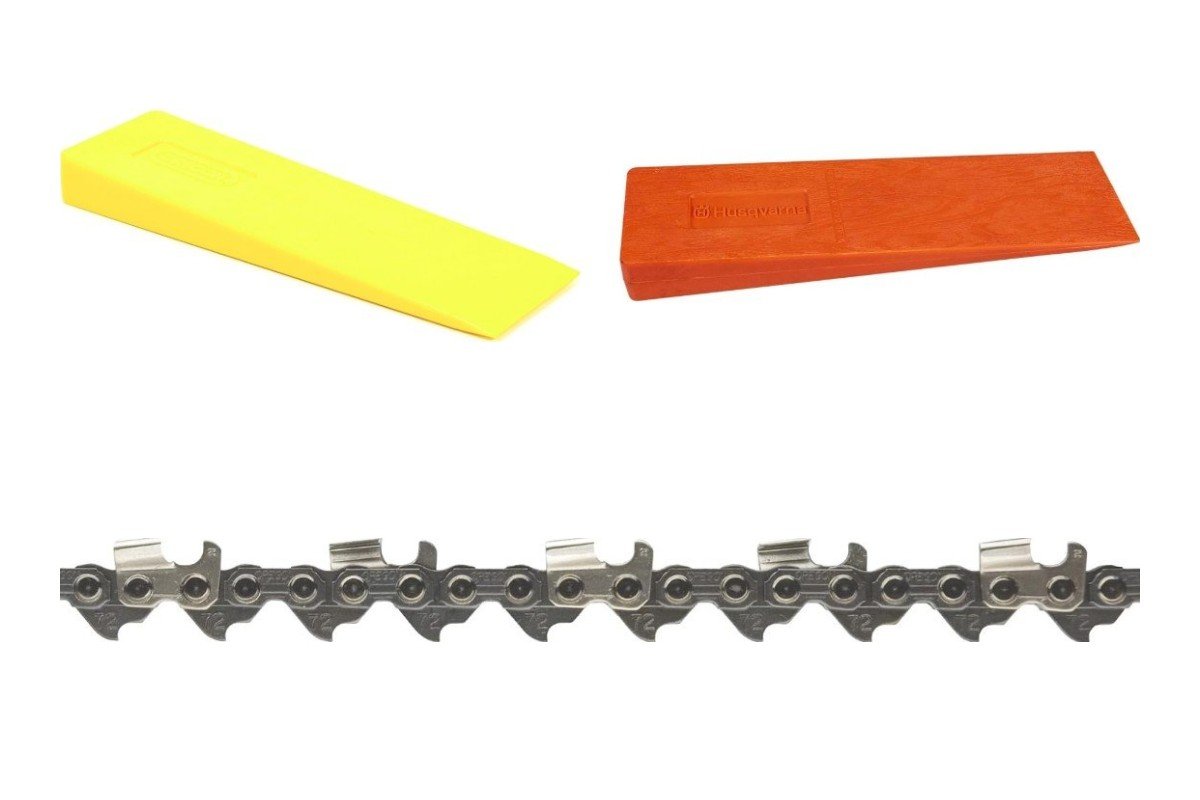
Felling wedges. The Granberg Alaskan Mill doesn't ship with these, and they matter for more than felling. Driving a wedge into the kerf (the slot a blade or chain cuts) behind the bar as you clear a long cut keeps the slab from settling and pinching the chain partway through. A mixed-size pack, like the UNCO 6-piece felling wedge set, covers most log diameters a home miller will run into.
A ripping chain sized to your bar. This isn't a single universal product: ripping chains are sold by bar length, gauge, and pitch, so the correct one depends entirely on the saw and bar you're running, not on which mill you bought. As one reference point, an 8TEN ripping chain in 20-inch/.050/3/8 spec fits a common configuration on saws like the Husqvarna 455 Rancher or Stihl MS 270. Check your own bar's markings against a chain's listed spec before buying, since the wrong gauge or pitch simply won't fit.
Granberg Alaskan Mill
Our Granberg Alaskan Mill review covers setup, chain choice, accessories, and why it's still the industry-standard chainsaw mill attachment in 2026.
Product SKU: B06XHLVY6Y
Product Brand: Granberg
4.7
Pros
- The original design the whole category copies, built by Granberg for 60 years
- Heavy-duty rails and hardware built to hold up to years of repeated use
Cons
- Heavy at roughly 20 lbs mounted, best run two-person on wider logs
- Manual, muscle-powered milling that burns through bar oil and chain life faster than normal cutting
Verdict
The Granberg Alaskan Mill has its reputation as the industry-standard chainsaw mill attachment because of decades of consistent build quality: it's the mill most other attachments are still measured against. For anyone planning to mill more than the occasional log, it's the one that's built to still be worth using years from now.
If you plan to mill long logs, see our guide to the chainsaw mill rail extension. For setup and your first cut, see how to use a chainsaw mill.
Quick answers
Does the Granberg Alaskan Mill come with felling wedges or a ripping chain?
No. The box includes the mill unit, the rail/handle set matched to your bar length, hardware, and a manual: wedges and a ripping chain are separate purchases most owners make before their first cut.
How do I make a level first cut with the Granberg Alaskan Mill?
Clamp or screw a straight board along the top of the log, leveled with shims, and run your first pass against that board rather than the log's natural surface. Every cut after that can ride on the log's own newly flattened face.
Can I use my regular chainsaw chain to mill with a Granberg Alaskan Mill?
It will physically fit, but a standard chain's steeper tooth angle isn't built for sustained contact and will bog down and overheat during a full-length slab cut. A ripping chain sized to your bar is the right tool for the job.
Do I need a specific chainsaw bar length for the Granberg Alaskan Mill?
You need a bar close to (a few inches under) the rail length you buy, since the rails have to extend past both ends of the bar to sit stable on the log. Granberg sells the mill in matched rail lengths from 24 to 84 inches specifically so this pairing is straightforward.