
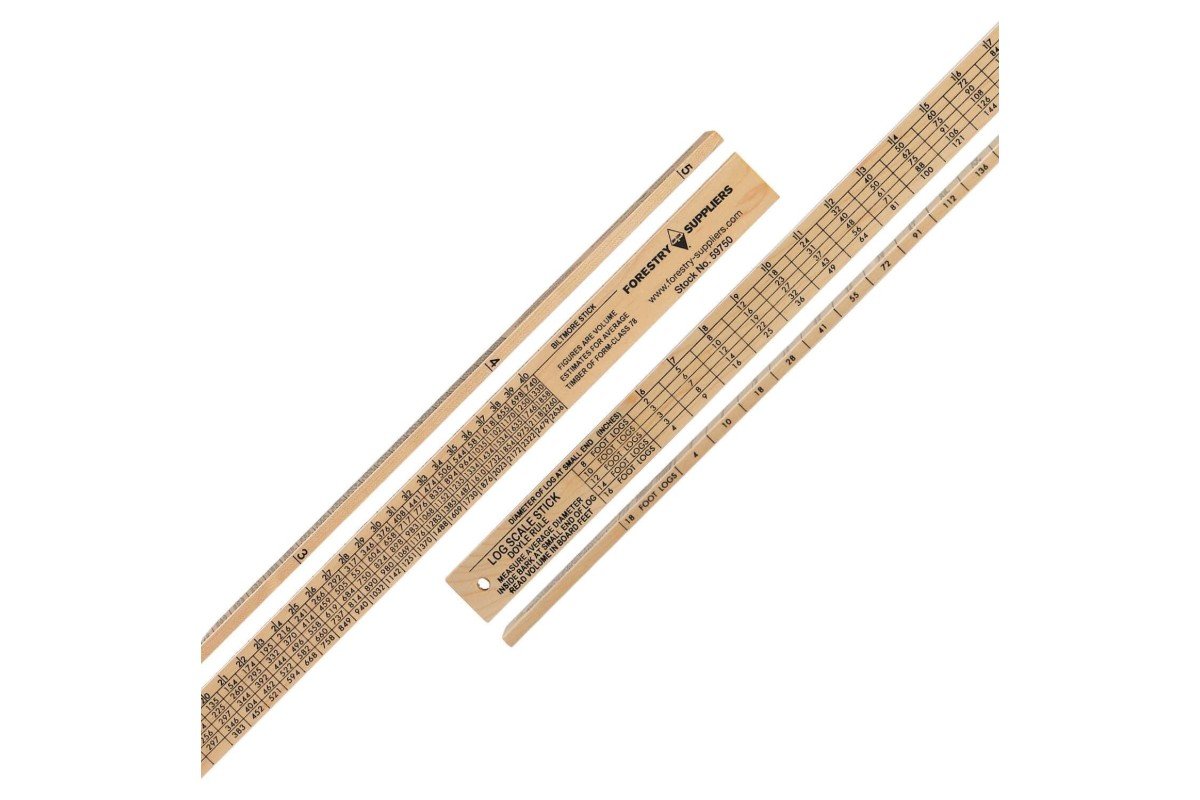
The Doyle log scale is the oldest board-foot rule still in everyday use, and if you buy or sell hardwood logs anywhere from the Ozarks to Appalachia, it's probably the number printed on your scale ticket. The math is short: measure the small end of the log inside the bark, subtract 4 inches, square what's left, multiply by the length in feet, and divide by 16.
That 4-inch subtraction explains almost everything people argue about. It's why a 12-inch, 16-foot log scales at 64 board feet on Doyle when the International 1/4-inch rule credits the same log with 95. It is also why sawyers running thin-kerf band mills (a sawmill that cuts with a long, thin loop of blade) keep stacking more lumber than the ticket said was in the log.
Below you'll find a calculator that shows Doyle, Scribner, and International side by side for one log or a whole load, the full Doyle log scale chart from 8 to 40 inches, and the scaling method mill scalers use on rough and out-of-round logs. It also covers the part most guides leave out: what the Doyle number means when you're the one doing the sawing.
Quick answer: Doyle board feet = (D - 4)² × L ÷ 16, where D is the small-end diameter inside the bark in inches and L is the log length in feet. A 16-inch by 16-foot log scales at (16 - 4)² = 144 board feet on the Doyle log scale.
Table of Contents
What the Doyle log scale is
A log scale (also called a log rule) estimates how many board feet of lumber a sawmill can cut from a log of a given diameter and length. Edward Doyle's rule is usually dated to 1825. The oldest surviving copy is the 1837 second edition of a pocket reference he published in Rochester, New York, according to Purdue Extension's guide to log and tree scaling. More than 95 log rules have been developed in the U.S. and Canada over the years. Three are still in common use: Doyle, Scribner, and International 1/4-inch.
Doyle is a formula rule, and every one of its assumptions hides inside that 4-inch deduction. Virginia Tech Extension describes it as a 5/16-inch saw kerf (the slot a blade or chain cuts) plus a 4-inch slabbing allowance, about double what a careful sawyer loses. The University of Tennessee adds that the rule allows only about 4.5 percent for sawdust and shrinkage where most rules allow 10 to 30 percent, and it makes no allowance for taper at all. Those errors pull in opposite directions. The result is a rule that's badly low on small logs, close on mid-size logs, and slightly high once you pass about 30 inches.
So why is it still everywhere? Because it's simple, and because hardwood prices adjusted to it generations ago. When an entire market buys and sells on the Doyle log scale, the price per thousand board feet already includes the rule's quirks.
Doyle log scale calculator
Enter the small-end diameter inside the bark and the log length. You'll get the Doyle scale, the Scribner and International 1/4-inch numbers for the same log, and the share of International volume that Doyle credits. Add a log count to scale a whole load, and if you've measured your own mill's overrun, enter it to see the lumber tally you can expect.
Calculator by MillingGuide.com
Scribner here uses the Bruce and Schumacher formula, which runs a little high on small logs compared with the published Scribner Decimal C tables. International is rounded to the nearest 5 board feet, the same way the official rule rounds. Logs over 20 feet should be scaled as two shorter logs. Working with sawn boards instead of logs? Use the board foot calculator, and if you need to know what a load will weigh on the trailer, the lumber and log weight calculator covers that.
The Doyle formula, worked through
Board feet (Doyle) = (D - 4)² × L ÷ 16, with D as the small-end diameter inside bark in inches and L as the length in feet. Three logs, start to finish:
- 12-inch by 16-foot log: 12 minus 4 is 8. Eight squared is 64. Multiply by 16 and divide by 16, and you're left with 64 board feet.
- 14-inch by 12-foot log: 10 squared is 100. Multiply by 12 to get 1,200, then divide by 16 to get 75 board feet.
- 20-inch by 10-foot log: 16 squared is 256. Multiply by 10 to get 2,560, then divide by 16 to get 160 board feet.
On a 16-foot log, the length term cancels out, which is where the old buyer's shortcut comes from: subtract four and square it. An 18-inch, 16-foot log is 14 squared, or 196 board feet. And because Doyle ignores taper, an 8-foot log scales at exactly half the 16-foot value for the same diameter. That's useful when your folding rule has no 8-foot line.
The formula stops making sense under about 8 inches. A 6-inch log works out to 4 board feet at 16 feet long, which says more about the rule than the log. Most markets treat anything under 8 inches on the small end as pulpwood, sold by weight rather than scaled as a sawlog.
Doyle log scale chart (8 to 40 inches)
Board feet by small-end diameter inside bark and log length, calculated from the Doyle formula and rounded to the nearest board foot (a lumber volume unit: 12 by 12 by 1 inch). Half values round down, which matches the Doyle table Purdue Extension publishes.
| Small-end diameter | 8 ft | 10 ft | 12 ft | 14 ft | 16 ft |
|---|---|---|---|---|---|
| 8" | 8 | 10 | 12 | 14 | 16 |
| 9" | 12 | 16 | 19 | 22 | 25 |
| 10" | 18 | 22 | 27 | 31 | 36 |
| 11" | 24 | 31 | 37 | 43 | 49 |
| 12" | 32 | 40 | 48 | 56 | 64 |
| 13" | 40 | 51 | 61 | 71 | 81 |
| 14" | 50 | 62 | 75 | 87 | 100 |
| 15" | 60 | 76 | 91 | 106 | 121 |
| 16" | 72 | 90 | 108 | 126 | 144 |
| 17" | 84 | 106 | 127 | 148 | 169 |
| 18" | 98 | 122 | 147 | 171 | 196 |
| 19" | 112 | 141 | 169 | 197 | 225 |
| 20" | 128 | 160 | 192 | 224 | 256 |
| 21" | 144 | 181 | 217 | 253 | 289 |
| 22" | 162 | 202 | 243 | 283 | 324 |
| 23" | 180 | 226 | 271 | 316 | 361 |
| 24" | 200 | 250 | 300 | 350 | 400 |
| 25" | 220 | 276 | 331 | 386 | 441 |
| 26" | 242 | 302 | 363 | 423 | 484 |
| 27" | 264 | 331 | 397 | 463 | 529 |
| 28" | 288 | 360 | 432 | 504 | 576 |
| 29" | 312 | 391 | 469 | 547 | 625 |
| 30" | 338 | 422 | 507 | 591 | 676 |
| 31" | 364 | 456 | 547 | 638 | 729 |
| 32" | 392 | 490 | 588 | 686 | 784 |
| 33" | 420 | 526 | 631 | 736 | 841 |
| 34" | 450 | 562 | 675 | 787 | 900 |
| 35" | 480 | 601 | 721 | 841 | 961 |
| 36" | 512 | 640 | 768 | 896 | 1,024 |
| 37" | 544 | 681 | 817 | 953 | 1,089 |
| 38" | 578 | 722 | 867 | 1,011 | 1,156 |
| 39" | 612 | 766 | 919 | 1,072 | 1,225 |
| 40" | 648 | 810 | 972 | 1,134 | 1,296 |
Need a length that isn't listed? Add the 8-foot and 10-foot values for an 18-foot log, or double the 10-foot value for a 20-footer. Doyle has no taper term, so the math stays linear.
Doyle vs Scribner vs International 1/4-inch
Same log, three answers. This table compares 16-foot logs using Purdue's published Scribner Decimal C and International 1/4-inch tables, with Doyle from the formula. The last column shows what share of the International volume Doyle credits.
| Small-end diameter | Doyle | Scribner Dec. C | International 1/4" | Doyle as % of Intl. |
|---|---|---|---|---|
| 8" | 16 | 30 | 40 | 40% |
| 10" | 36 | 60 | 65 | 55% |
| 12" | 64 | 80 | 95 | 67% |
| 14" | 100 | 110 | 135 | 74% |
| 16" | 144 | 160 | 180 | 80% |
| 18" | 196 | 210 | 230 | 85% |
| 20" | 256 | 280 | 290 | 88% |
| 22" | 324 | 330 | 355 | 91% |
| 24" | 400 | 400 | 425 | 94% |
| 26" | 484 | 500 | 500 | 97% |
| 28" | 576 | 580 | 585 | 98% |
| 30" | 676 | 660 | 675 | 100% |
| 32" | 784 | 740 | 770 | 102% |
| 36" | 1,024 | 920 | 980 | 104% |
| 40" | 1,296 | 1,200 | 1,220 | 106% |
Read down that last column. An 8-inch log gets 40 percent of its International volume on Doyle. At 12 inches it's about two-thirds, at 20 inches it's 88 percent, and the two rules meet right around 30 inches. Above that, Doyle scales higher than International. Virginia Tech's foresters point out that nearly every log in Virginia is under 30 inches, so in practice Doyle underestimates almost every log that crosses a scale there.
How each rule is built
Scribner (1846) is a diagram rule. J. M. Scribner drew 1-inch boards with a 1/4-inch kerf inside circles the size of log ends and counted them. It ignores taper, so it runs low on long logs, and the Decimal C version rounds every log to the nearest 10 board feet, which makes small-log values jump in steps. International 1/4-inch was worked out by Judson Clark from measured sawing losses, first with a 1/8-inch kerf and then revised to 1/4 inch in 1917. It assumes a half inch of taper every 4 feet and is the most consistent of the three, which is why foresters and most textbooks use it as the yardstick for the others.
Where each log rule is used
Local habit matters more than accuracy. Doyle dominates private hardwood timber across the South, the Ohio Valley, Appalachia and much of the Midwest, and Purdue calls it the most widely used rule on private timber in the East and South.
Scribner, almost always as Scribner Decimal C, has long been the rule on western and Lake States public timber (though the Forest Service has been moving to cubic measurement), and it's also used on southern pine sawlogs. International 1/4-inch is the standard for forest inventories and some public timber sales, including eastern national and state forest sales in Tennessee, but you'll see it far less often on a private log ticket. Not sure which one a buyer uses? Ask before the truck is loaded.
Converting a price from one log rule to another
Rules that scale low get paid at a higher rate per thousand board feet, so a price quoted on Doyle can't be compared with one quoted on International until you convert it. The University of Tennessee's log rule guide gives these rule-of-thumb factors for sawtimber prices:
| Price quoted on | Convert to | Multiply the price by |
|---|---|---|
| Doyle | Scribner | 0.75 |
| Scribner | Doyle | 1.33 |
| Doyle | International 1/4" | 0.62 |
| International 1/4" | Doyle | 1.6 |
| Scribner | International 1/4" | 0.83 |
| International 1/4" | Scribner | 1.2 |
These are averages across a typical mix of log sizes. On a load of small logs the real gap between Doyle and International is wider than the 0.62 factor suggests, so use the conversion as a starting point with a buyer, not as a final number.
Why the Doyle log scale underestimates small logs
Picture the end of a log with a square drawn inside it, roughly where the boards come from. On a 10-inch log the rounded wood outside that square is a big share of the circle. On a 30-inch log it's a thin rind. Doyle takes the same flat 4 inches off every diameter, so a small log gets charged a slab penalty that's far bigger, in proportion, than anything a sawyer loses. Take 4 inches off 10 and you've removed 40 percent of the diameter before squaring. Take it off 30, and you've removed about 13 percent.
Log buyers will tell you this is deliberate, and they have a point. A thousand board feet of 10-inch logs means many more logs to load, roll, open and edge than a thousand board feet of 24-inch logs, and small logs tend to saw out lower grades. Virginia Tech's guide describes Doyle as compensating the sawmiller for exactly those costs. The fair complaint from sellers is that the penalty is buried inside the volume, where it's hard to see, instead of showing up as an honest lower price per thousand for small logs.
If you're the seller, the lesson is short. Small logs pay poorly per log on the Doyle log scale, so make sure every one is measured carefully, and don't let a 12 1/2-inch log get called a 12.
What Doyle means if you run a portable sawmill
Overrun is the lumber you saw beyond what the log scale said was there, expressed as a percentage of the scale. Every rule produces some. Doyle produces the most, and thin-kerf band mills push it higher still, since the old rules were set up around circular saws cutting a 1/4-inch kerf or wider. A typical portable band mill blade cuts closer to 1/8 inch.
The best published number comes from a 2017 USDA Forest Service study by Ed Thomas and Neal Bennett in Forest Products Journal. They laser-scanned 32 hardwood logs, scaled each one on all three rules, and simulated sawing them. Average overrun came to 62.5 percent on Doyle, 31 percent on Scribner, and 17 percent on International 1/4-inch. The authors note those figures are close to what a well-run real mill should expect.
Put that in board feet. If your logs and your sawing look like the study's, 1,000 board feet bought on the Doyle log scale would saw out around 1,600 board feet of green lumber. Yours won't match exactly. Bigger logs shrink the gap fast, and sweep, rot, or heavy taper can erase it, so the only number worth trusting is the one you measure yourself.
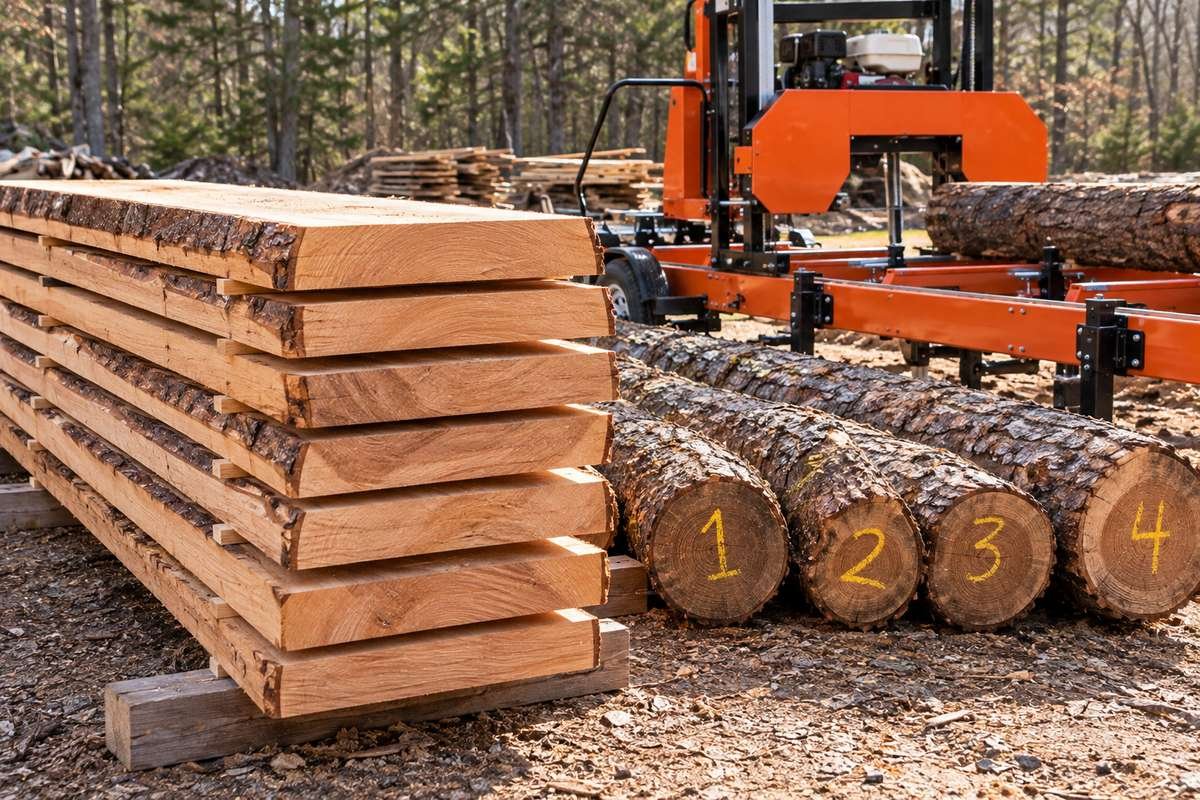
The advice that comes up again and again on sawyer forums like WOODWEB and the Forestry Forum is to run a short yield study on your own mill. It takes one afternoon.
- Pick 15 to 20 logs that look like what you normally saw, small and large.
- Scale every log on Doyle and on International, and write both numbers on the log end with a lumber crayon.
- Saw them the way you always do and tally the green lumber log by log.
- Divide each log's lumber tally by its scale and subtract 1. That's your overrun for each rule, and grouping the results by diameter shows where the Doyle gap is widest for your mill.
Two business decisions fall straight out of that number. When you buy logs, Doyle on small logs works in your favor, which is exactly why log sellers push back. When you custom-saw for other people, settle up front whether you're billing on the log scale or the lumber tally, because on a pile of 12-inch logs the difference can be more than half again. If you're still shopping for a mill, our portable sawmill reviews and the chainsaw mill vs bandsaw mill comparison cover the kerf and power tradeoffs that drive most overruns.
How to scale a log with the Doyle rule
Purdue's Daniel Cassens once watched 14 experienced timbermen scale the same 11 logs and come up with 14 different totals, from 1,434 to 1,795 board feet Doyle. After carefully examining every log, they agreed on 1,589 board feet. Most of that spread comes from loose measuring. This is the method that tightens it up.
- Measure the length with a tape. Logs are usually bucked with a few inches of trim allowance. A log that comes up short of a full foot gets scaled at the next lower foot for hardwoods, or the next lower even foot for softwoods.
- Find the small end. Doyle, like the other two rules, scales from the small end only.
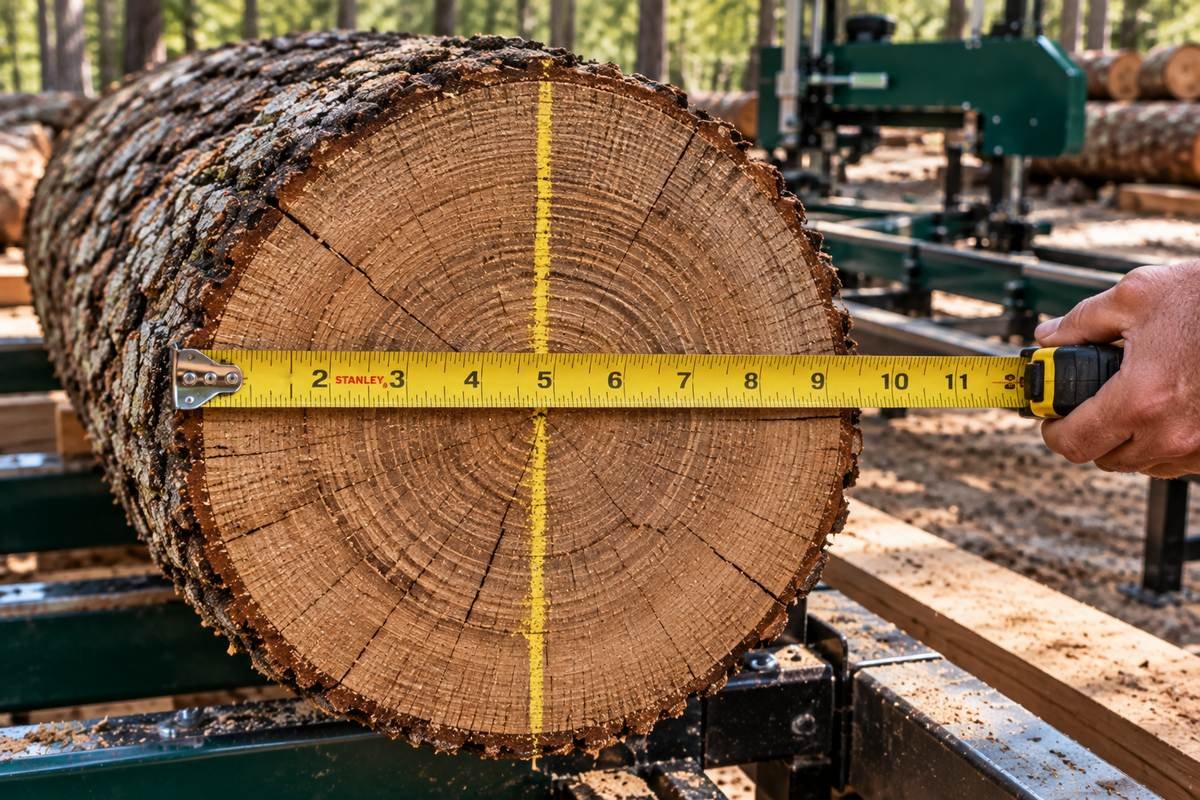
- Measure the diameter inside the bark, twice. Take one reading across the narrowest direction and a second at 90 degrees to it, then average the two. Very few logs are round.
- Round the way your market rounds. The University of Tennessee's guide tallies to the nearest inch, so 12 1/4 becomes 12 and 12 3/4 becomes 13. Plenty of buyers simply round down. Agree on it before you scale a load.
- Read the gross scale from the chart, a scale stick, or the calculator above.
- Deduct for defects to get net scale. Rot, splits, sweep, and crook come off the volume. Knots and bumps don't, because they lower the grade of the boards rather than the amount of wood.
Deducting for sweep, rot and crook
The Forest Service's cull rules are plain geometry. The simplest one: if a defect wipes out a full section of the log's length, deduct that fraction, so a 4-foot rotten section in a 16-foot log is a 25 percent cull. A defect that runs through only part of the cross section gets prorated by how much of the circle it takes. UT's worked example is a 6-foot defect filling a 60-degree wedge of a 16-foot log, which comes to 6/16 × 60/360, or about 6 percent.
Real log yards are rarely that formal. Purdue notes that most mills simply turn away badly crooked or rotten logs, and when one gets through, they scale it back by shortening the length instead of calculating a percentage. One more thing to watch: a log bucked right through a branch swell can measure an inch or more fatter on the small end than it is through most of its length. That's a bigger Doyle number for wood that isn't there.
Scaling standing trees on the Doyle scale
A timber cruiser can't measure the small end of a log that's still standing, so they measure diameter at breast height (DBH, 4.5 feet off the ground), count the merchantable (sound enough and big enough to sell or saw) 16-foot logs, and read volume from a tree table. The Doyle table most foresters use is Mesavage and Girard's form class 78, meaning the inside-bark diameter at the top of the first log is 78 percent of DBH. These values come from Purdue's FNR-191:
| DBH | One 16-ft log | Two logs | Three logs |
|---|---|---|---|
| 14" | 48 | 75 | 93 |
| 16" | 72 | 116 | 149 |
| 18" | 100 | 164 | 215 |
| 20" | 135 | 225 | 297 |
| 24" | 216 | 370 | 496 |
| 28" | 317 | 551 | 750 |
Trees with better form hold more wood. The rule of thumb is roughly 3 percent more volume for each point of form class above 78 and 3 percent less for each point below. Selling standing timber is a different job from selling logs, and a consulting forester's timber cruise (a measured survey of the standing trees) will nearly always pay for itself on a sale of any size.
Tools for scaling logs
A tape measure and the chart above will do the job. These three tools make scaling faster and more consistent from one load to the next:
- Folding Doyle log rule. The hardwood buyer's classic: a hinged wooden rule with Doyle board feet printed at each inch for the common lengths, usually 10 through 18 feet.
- Log scale stick. A straight hardwood stick with one rule printed on it, or all three on different faces. Biltmore-style versions add a DBH scale so the same stick works on standing trees.
- Diameter tape. It reads diameter straight from the circumference, which makes it the right tool for DBH. On a cut log end, two straight measurements inside the bark are more accurate, since a tape wrapped around the log includes the bark.
If you buy logs regularly, carry your own stick and scale every load yourself instead of relying on the seller's ticket. Once the boards are sawn, seal the ends the same day, sticker and air-dry the stack, and check it with a moisture meter before any of it goes indoors.
Frequently asked questions
How do you calculate board feet on the Doyle log scale?
Subtract 4 from the small-end diameter inside the bark in inches, square the result, multiply by the log length in feet and divide by 16. A 14-inch by 16-foot log scales at 100 board feet on the Doyle log scale.
Why does the Doyle log scale underestimate small logs?
It deducts a flat 4 inches from every diameter for slabs and edgings. That is a large share of a small log and a small share of a big one. So Doyle credits an 8-inch log with about 40 percent of its International 1/4-inch volume while scaling logs over about 30 inches slightly high.
Which is more accurate, Doyle or International 1/4-inch?
International 1/4-inch is the most accurate of the three common rules for predicting real lumber yield. In a 2017 USDA Forest Service study of 32 hardwood logs, average overrun was 17 percent on International, 31 percent on Scribner and 62.5 percent on Doyle.
Do you measure the small end or the big end of a log for Doyle?
The small end, inside the bark. Take two measurements at right angles to each other and average them, because most logs are not perfectly round.
How do you scale an 8-foot log if your Doyle rule only shows 10 to 18 feet?
Doyle ignores taper, so an 8-foot log is exactly half of the 16-foot value for the same diameter. A 16-inch log scales 144 board feet at 16 feet, so it scales 72 board feet at 8 feet.
Summary
The Doyle log scale is a pricing convention more than a measuring tool. It's simple, it's on most private hardwood log tickets across the South and Midwest, and it runs low on the 10- to 20-inch logs most small sawyers handle. Know which rule is on the ticket, measure the small end twice, and track your own overrun. Once you have that one number for your mill, Doyle becomes a number you can plan around.