
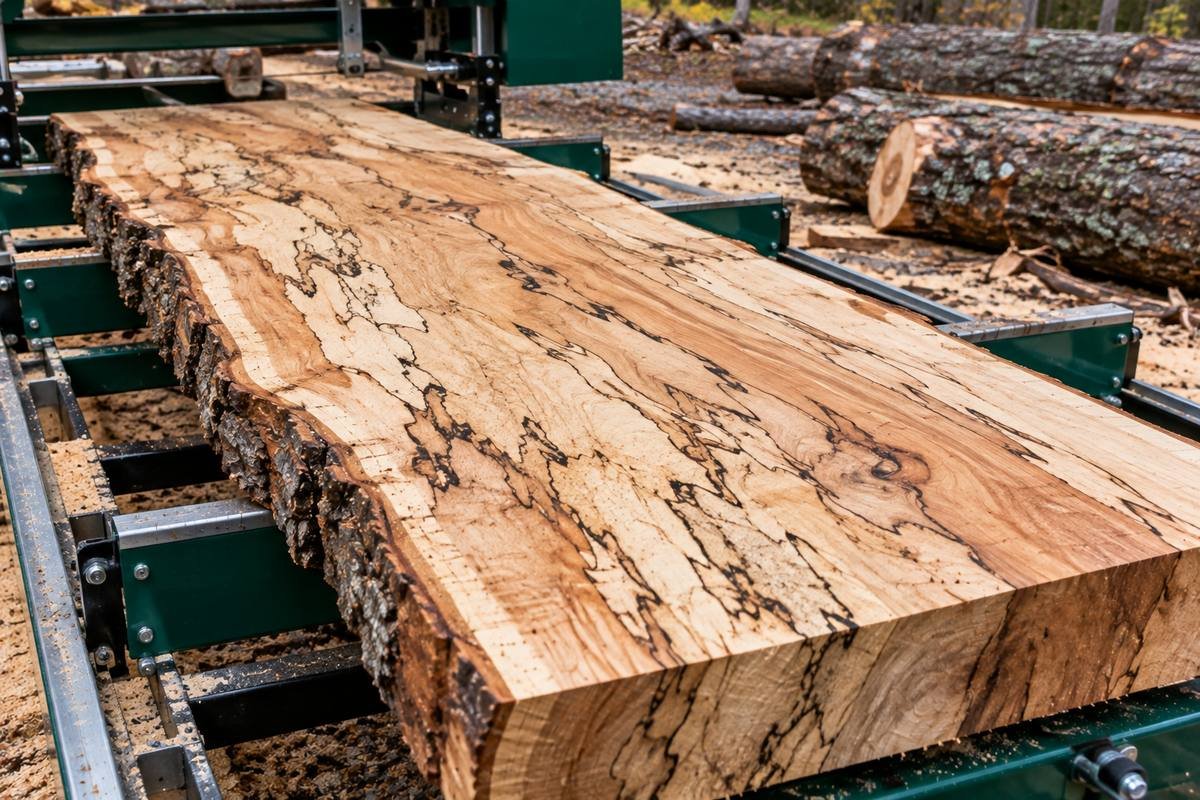
Spalted wood is lumber a fungus got into before you did, and that's exactly why it sells for two to five dollars a board foot (a lumber volume unit: 12 by 12 by 1 inch) instead of the price of firewood. The dark zone lines and pale blotches are a fungal signature, not a flaw, and on sugar maple or beech they can turn a log nobody wanted into the most requested slab in the stack.
Finding spalted wood isn't the hard part. Most sawyers already have some sitting on the landing right now, in logs that got pushed to the back of the pile because nobody wanted them fresh. Knowing when to cut is the hard part, because the same fungus that makes a log valuable will keep eating it until nothing's left worth sawing.
Quick Links
| Type | What causes it | Effect on the wood | What it looks like |
|---|---|---|---|
| Zone lines | Xylaria polymorpha and similar fungi marking territory | Mostly cosmetic, little structural loss | Thin black, brown, or red winding lines |
| White rot | Trametes versicolor, Bjerkandera adusta breaking down lignin | Real strength and weight loss, can go punky | Mottled white pockets, soft patches |
| Pigmentation | Chlorociboria aeruginascens, Scytalidium species | Minimal structural cost | Blue-green or other color staining |
| Combined (most logs) | More than one fungus working at once | Varies board to board, even within one log | A mix of lines, color, and soft spots |
What Spalting Is
Spalting is fungal activity in wood that leaves visible marks behind, and it comes in three distinct forms that behave differently once you're running a log through the mill.
Zone lines are thin, dark, winding streaks, usually black, brown, or red, that form where two fungal colonies meet or where a single fungus marks its own territory. A fungus called Xylaria polymorpha, dead man's fingers if you want the common name, is behind a lot of the zone lining in temperate hardwoods. Zone lines are mostly cosmetic. They don't eat much wood to make their mark, so a heavily zone-lined board can still be structurally sound.
White rot is the one to watch. Fungi like Trametes versicolor and Bjerkandera adusta break down lignin, the compound that gives wood its rigidity, and leave behind mottled white pockets and soft, punky patches that give spalted wood its texture and color. White rot is doing real damage the entire time it's working. A little of it adds character. Too much of it means the board won't hold together on the saw, let alone in a finished piece.
Pigmentation spalting, caused by fungi like Chlorociboria aeruginascens (the one behind the blue-green streaks sometimes called green oak) and various Scytalidium species, stains the wood without eating much of its structure. This is the safest type to find on a log, since it adds color at the least structural cost. Most spalted logs have some combination of all three happening at once, which is why two boards off the same log can look completely different and hold together completely differently too.
The Species Worth Setting Aside
Sugar maple, soft maple, birch, beech, aspen, and sycamore spalt faster and more reliably than most other species, which helps, because several of them are the exact logs that get pushed aside as low grade. A pale, close-grained hardwood gives the fungal pigments more contrast to work with, which is also why maple and beech produce the most dramatic figure of the common species.
Walnut and ash will spalt too, but less predictably, and walnut's dark heartwood (the darker, older wood at the center of a tree) hides zone lines that would stand out clearly in maple. If a log is already down, already low grade, and already one of these six species, that's a log worth setting aside instead of bucking straight to firewood.
How Long Spalting Takes
Lab studies pairing Trametes versicolor with Bjerkandera adusta on small wood samples found visible spalting in about eight weeks. Pair Polyporus brumalis with Trametes versicolor instead, and it ran closer to ten. Those numbers come from controlled conditions, not a log lying on wet ground through a Michigan spring, so field timing runs looser. Penn State Extension's own field demonstrations found real figures developing within a single season on the right species once a log was left on moist ground. One sawyer's case study on a downed Norway maple left untouched for two years still produced six usable boards once it finally went through the saw.
The practical range for a sawyer: start checking a set aside log at the two month mark, and expect anywhere from one season to two years before it's worth running, depending on species, ground contact, and how wet the spot is. A log buried in damp leaf litter spalts faster than one left up on skids in the sun.
Spalted or Just Rotten: How to Tell
This is the question that matters once you're standing over a log deciding whether to run it. There's no fixed rule, and sawyers who've cut hundreds of spalted logs still describe the gap between usable and wasted as a narrow window that's hard to predict in advance.
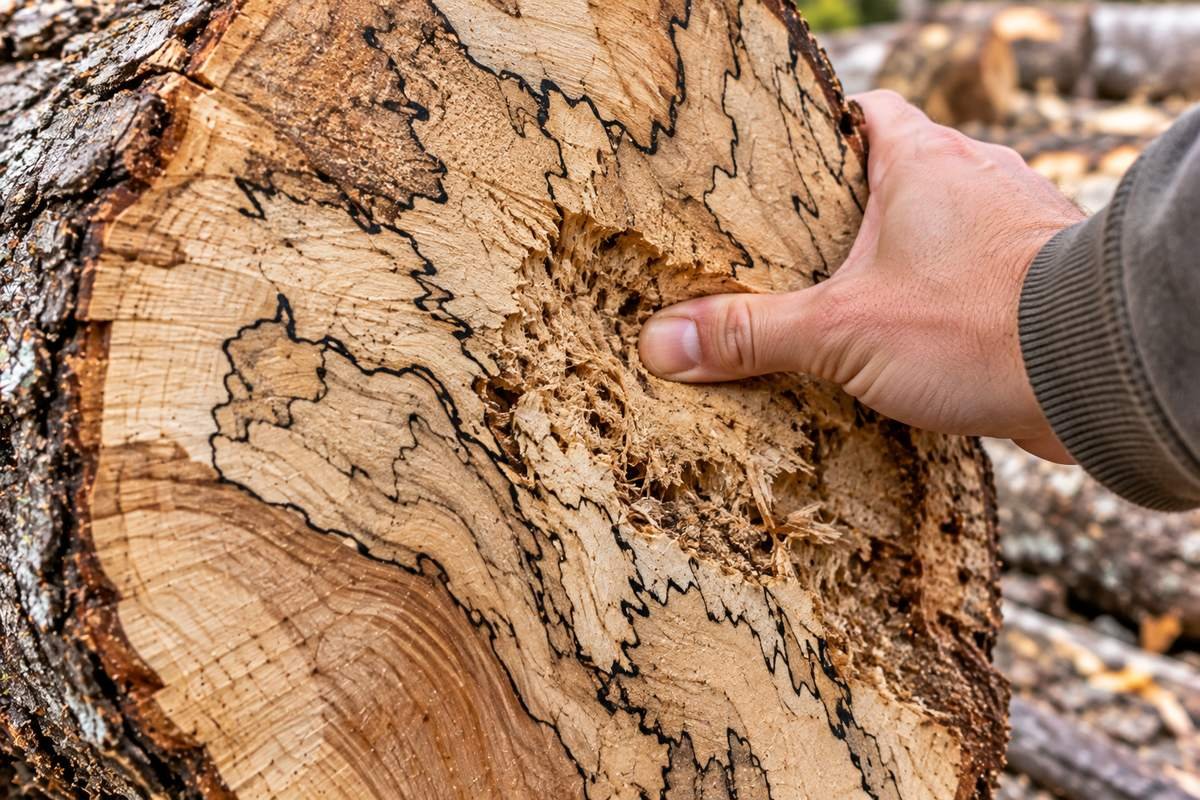
A few checks do hold up. Press a thumbnail into a suspect patch. Wood that's spalted but still sound resists like a hard pine. Wood that's gone to punk gives like styrofoam, and if it crumbles rather than compresses, that section is firewood, not lumber. Sound carries information too, since a spalted but solid board rings when you tap it, while a punky one thuds. Weight is a useful sign too, because white rot removes mass along with rigidity, so a log that feels unusually light for its size and species has probably lost more structure than the bark lets on.
None of those checks are perfect, and the wood under the bark can look fine while the inside has already gone soft, or the reverse. That unpredictability is exactly why experienced millers default to running the log anyway rather than trying to guess from the outside. One rule of thumb, repeated often enough in sawmill forums to count as conventional wisdom. Expect to lose close to three out of every four spalted logs to unusable material. Mill the whole batch anyway, because the one log in four that comes through is worth more than the three that don't.
Milling a Spalted Log Without Wasting the Figure
Spalted logs saw differently than sound ones, and a few adjustments keep you from losing the best figure to blade chatter or a board that falls apart mid-cut.
Cut thicker than you normally would. A spalted log that looks fine from the bark can have punky pockets an inch or more deep, and a 4/4 board cut right at that depth comes out with a soft streak or a hole in it. Going to 5/4 or 6/4 gives enough margin to plane through minor soft spots and still end up with a usable board.
Expect more blade drag and more debris buildup in soft sections, since punky wood doesn't cut as cleanly as sound wood. A sharp blade matters more here than on a straightforward sound log, not less, because a dull blade tears through already weak fibers instead of slicing them. Tearing turns a repairable soft spot into a board that splits in two coming off the mill.
Saw for the figure, not just for yield. Zone lines and color bands often run at an angle to the log's growth rings rather than following them. So the same thinking that decides quarter sawn vs plain sawn on a clean log still applies here, just with higher stakes. Cutting through the figure instead of along it can turn a showpiece board into a plain one.
Chainsaw mill users face the same tradeoff on a smaller scale (our chainsaw mill guide covers the base technique) with less room to adjust mid-log once the first cut is made. Taking one exploratory cut and looking at the exposed face before committing to an orientation is worth the extra few minutes on a log that's clearly carrying heavy color.
Drying It So the Fungus Stops
The fungus responsible for spalting doesn't quit just because the board left the mill. It stays active until moisture content (how much water is in the wood, as a percent of its dry weight) drops below about 20 percent. That means a stack of freshly sawn spalted lumber left to air dry slowly can keep spalting, sometimes past the point that was wanted, while it dries.
That cuts both ways. A board that looked lightly spalted off the saw can develop more figure over the following weeks, which helps if the goal was more color. It can also develop more punk, which isn't useful at all if the goal was a board that holds together. Checking the stack every couple of weeks during the first month or two, the same interval growers use when inducing spalting on purpose, catches the point where the look is right and the structure still is too.
Getting moisture content down faster than a normal air-dry schedule stops the fungus at whatever stage it's at when the wood crosses that 20 percent line. A moisture meter matters more here than on an ordinary load. Our moisture meter guide covers which models read punky, uneven wood accurately, which is its own small problem since spalted sections often read falsely high.
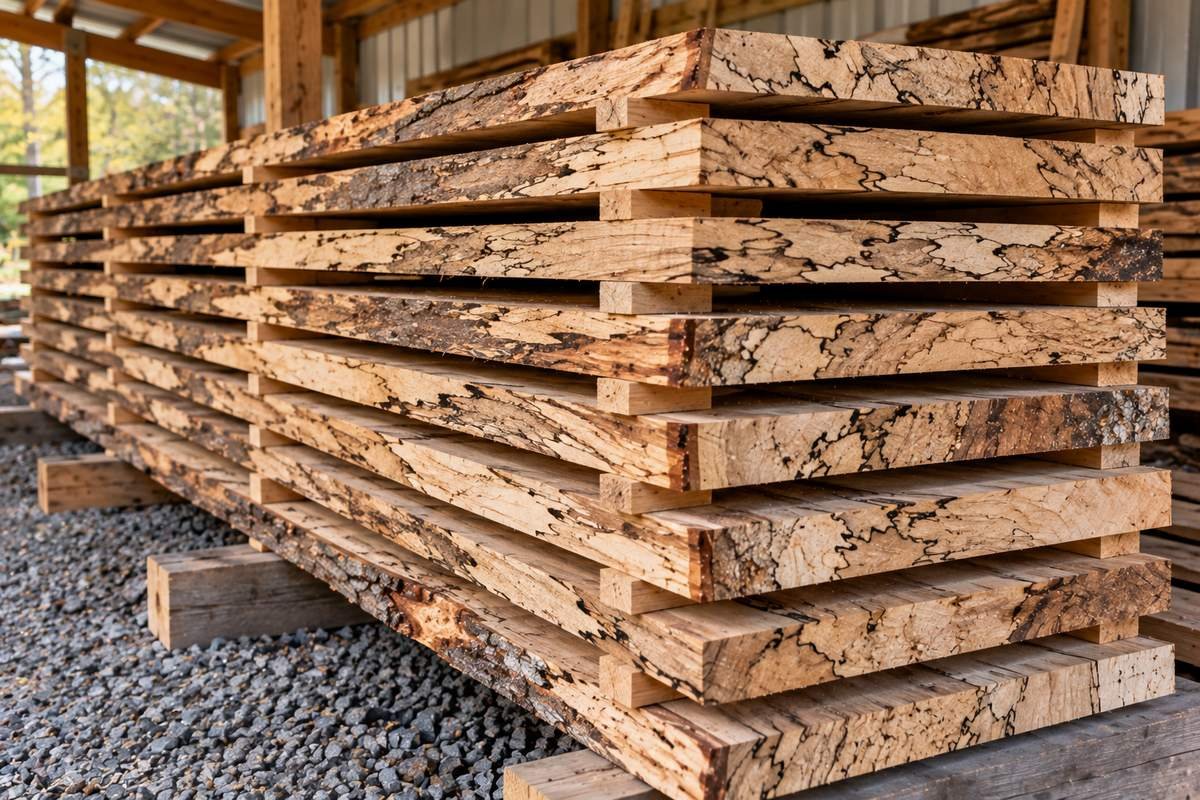
Stickering (stacking boards with thin spacers between them so air can flow) with extra airflow, and sealing the end grain the same way as any other board (see our end grain sealer guide), both help an already compromised board dry evenly instead of cracking along its softest line. Our general air drying guide covers the stacking and airflow basics that still apply underneath all of this.
What Spalted Lumber Is Worth
Pricing on spalted lumber swings more than almost any other category a small sawmill sells, and the price is a range, not one figure. Typical spalted maple moves at two to five dollars a board foot wholesale, spalted beech usually sits a little under that since the market for it is thinner. Heavily figured, thick slabs with dramatic color have sold online for upward of a hundred dollars a board foot. But that ceiling is rare, not typical, and it depends more on one buyer wanting one specific board than on any pricing formula.
Lightly spalted 4/4 that barely shows any figure is worth little more than clean lumber of the same species, so don't price every board off a spalted log as though it earned the premium. The premium belongs to the boards that show the figure, not the whole log. Board footage adds up fast on a figured log, so knowing the real board feet in a log before pricing it keeps the price fair for both sides. Most of this sells direct, through a website, a woodworking forum classifieds section, or word of mouth among turners and furniture makers, rather than through a retail yard that has no good way to price something this inconsistent.
Growing Your Own From Logs Nobody Wanted Anyway
If there's a stack of low-grade maple or beech logs that were never going to sell as lumber anyway, intentionally spalting them turns a write-off into inventory. Maple, birch, and beech work best for this, partly because their pale color gives the fungal stain somewhere to show, and partly because maple's hardness keeps the wood from going to mush before the figure develops.
The method that keeps showing up across woodworking forums and university write-ups. Cut the log into billets, pack them in an unsealed plastic bin or bag with damp vermiculite to hold even moisture without waterlogging the wood. Keep the whole setup somewhere dark at around 80 percent humidity and 80 degrees. Air-dried wood already carries dormant fungal spores, so it often spalts on its own, but tucking in a few fragments of already spalted wood or forest litter speeds things up by seeding the fungus directly.
Start checking at six weeks. Pull a sample piece out every two weeks after that and look at both color and softness. The moment it looks right, pull the whole batch and get it drying. The fungus doesn't know when to stop on its own and will turn a nicely spalted billet into a ruined one if you leave it in the bin too long.
What You're Breathing When You Cut This
Spalted wood dust carries live fungal spores along with the usual wood-dust irritants, and sawing or planing it throws much more of both into the air than clean lumber does. The allergic reaction some woodworkers get from spalted wood dust (itchy eyes, sinus irritation, or worse for anyone with a mold sensitivity) comes from inhaling those spores directly.
A dust mask rated for nuisance dust doesn't reliably filter spores. An N95 respirator is the minimum for any real work with spalted wood, and a P100 (a higher-grade filter that blocks more fine dust) is worth the extra cost if it's going to be a regular part of the mill's output rather than an occasional log. This matters most at the saw and the planer, where the dust is finest and exposure is heaviest, not just at final sanding.
Is spalted wood safe to use?
Yes, for finished pieces once sealed and sanded, since the fungus is no longer active in dried, finished wood. The real exposure risk is at the saw and sander, where fresh dust carries live spores.
Does spalted wood need to be stabilized?
Softer spots, especially anything punky, usually do. A thin cyanoacrylate glue soaks into soft turning stock, while a penetrating epoxy resin is the better call for larger structural gaps in a slab.
Can you stop spalting once it starts?
Mostly, by drying the wood below 20 percent moisture content, since the fungus goes dormant once it runs out of water to work with. It isn't fully killed, so rewetting the same board later can restart it.
Is all discolored wood spalted?
No. Plain rot without the pigmentation or zone lining, insect staining, and simple water staining all discolor wood without the pattern spalting produces. True spalting usually shows dark zone lines, mottled white pockets, or both.
How much does spalted wood sell for?
Typically two to five dollars a board foot for maple, somewhat less for beech, with heavily figured premium pieces occasionally bringing much more online. Lightly spalted boards with little visible figure are worth close to standard lumber pricing.