
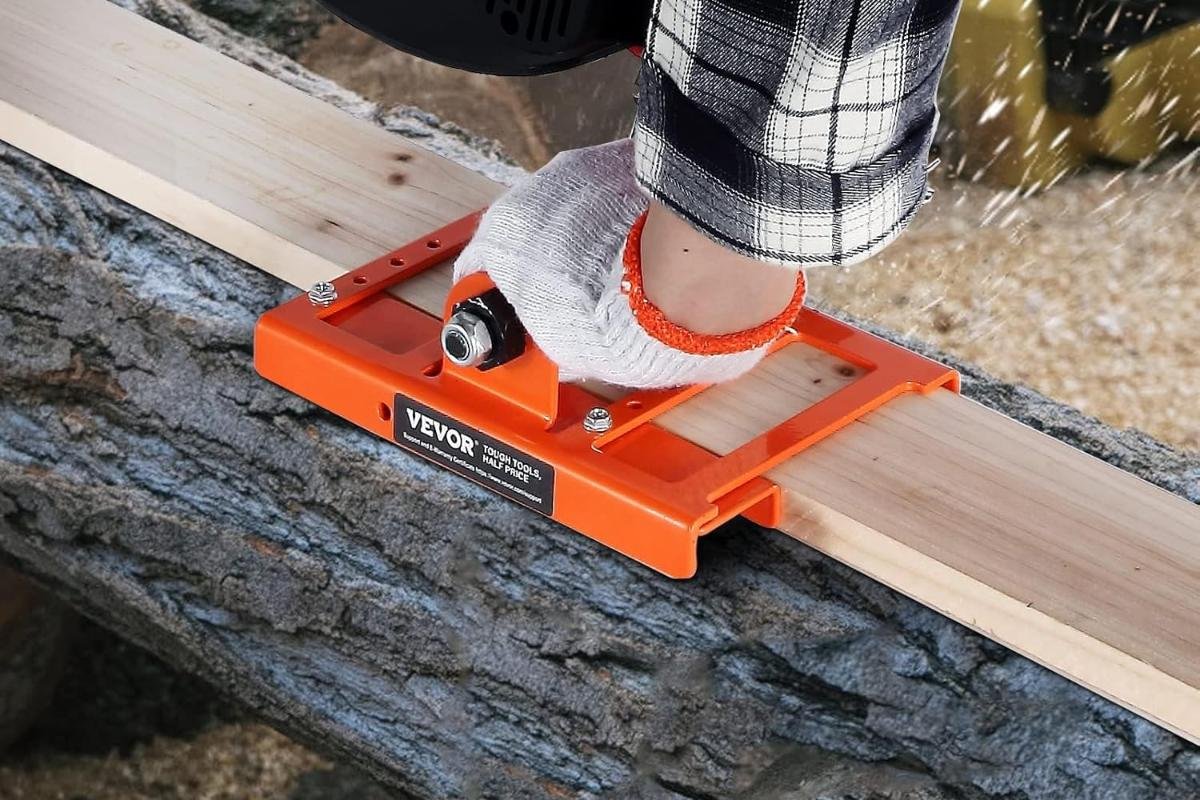
The best budget chainsaw mill attachment on the market right now is a cast-iron VEVOR bracket, and it's worth understanding exactly what that means before you buy one. It's tempting to treat it as a cheaper version of the rail-and-clamp mills we've covered elsewhere on this site, like the Granberg Alaskan Mill. It isn't. It's a different tool, built for a narrower job, and the buyers who end up happiest with it are the ones who understood that going in.
Table of Contents
What you're buying
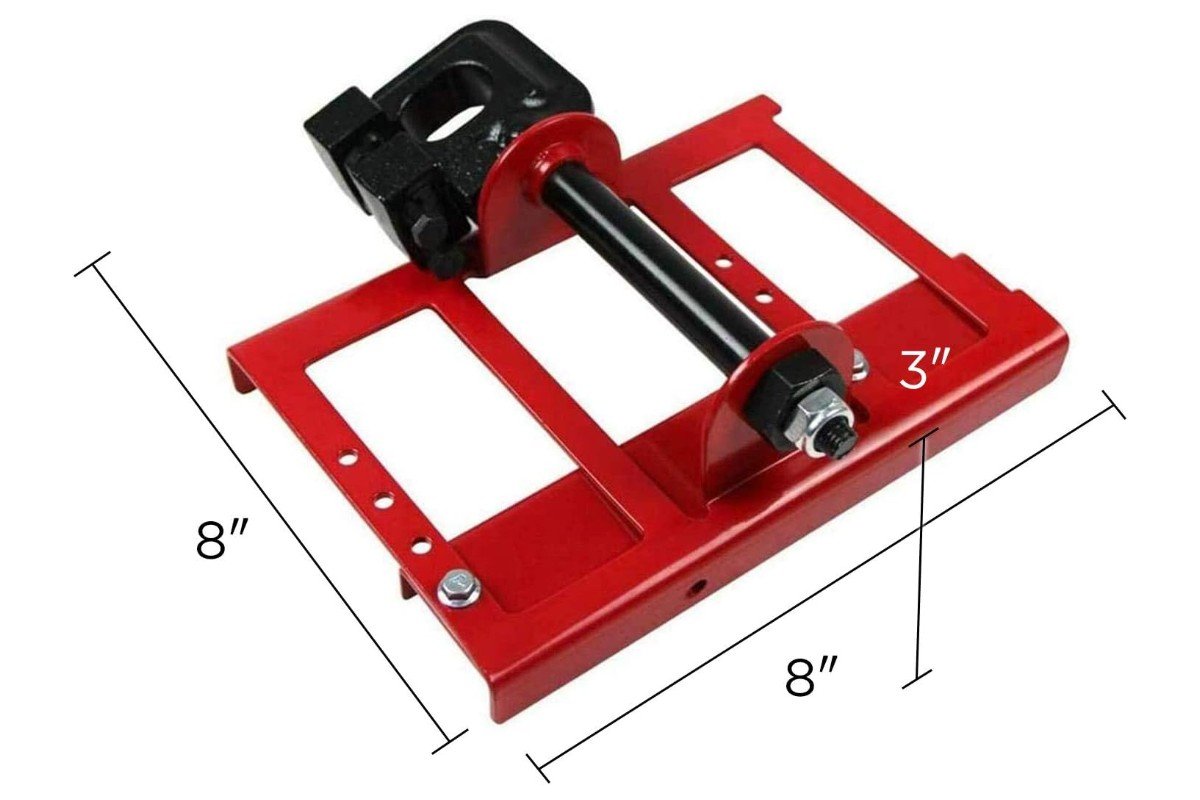
The rail mills we've reviewed (Granberg and the mid-tier VEVOR rail systems) clamp onto the full length of the guide bar and ride along an aluminum rail laid across the log. That is what lets them cut wide slabs the entire length of a trunk. The budget chainsaw mill attachment works differently. It's a small cast-iron bracket, about 3 lbs, that bolts onto the bar near the tip and rides against a fixed board or edge to guide a rip cut. There's no rail, no long guide bar clamp, and no slab-width capacity to speak of.
That's not a defect. It's a different kind of tool sold with similar marketing language. A rail mill answers "how do I turn this whole log into slabs." This bracket answers a smaller question: "how do I rip a straighter board off the edge of something I'm already cutting."
What it can and can't cut
The spec that matters most here is cutting width: 2 to 6 inches. Real 2×6 dimensional lumber measures 5.5 inches once milled, which puts it at the very top edge of this tool's range: several buyers in the product reviews specifically flag that full-size 2×6 stock is a tight fit, not a comfortable one. This attachment is built for narrow rips and small-scale boards, not for milling a log down into a stack of slabs the way a rail mill does. If wide slabs are the goal, a budget chainsaw mill attachment in this cast-iron bracket style is the wrong tool regardless of price.
Setting it up
Installation is a bolt-and-washer clamp job: you're securing the bracket to the bar with hardware, then setting cutting width using a set of pre-drilled adjustment holes rather than a smooth sliding scale.
That's the single most common complaint in buyer feedback: width adjustment jumps between fixed holes instead of sliding continuously, which reviewers describe as slow to fine-tune in the field. There's also a recurring note that in-box instructions are thin, and several buyers said they ended up figuring out the correct orientation from product photos rather than a manual. None of that makes the tool unusable: it means budget the first cut or two as a setup exercise, not a demo of the tool at its best.
What actual buyers say
Buyer sentiment on this budget chainsaw mill attachment runs positive on the fundamentals and specific on the friction points. The recurring praise is straightforward: it does what it says, it's an easy way into milling without spending much, and the build feels solid enough for the price. The recurring criticism is just as specific: the bolt-and-nut clamp system feels underdeveloped compared to a proper mount, and more than one buyer suggested threaded mounting holes would hold more securely than the loose bolt setup it ships with. Read together, the pattern is a tool that performs its actual job, narrow rip cuts, reliably, while the hardware around the edges is where the budget shows.
Who the Best Budget Chainsaw Mill Attachment Is For
A budget chainsaw mill attachment like this one makes sense for someone testing whether chainsaw milling is worth pursuing further, or who mostly needs narrow rips and edge boards rather than full slabs: check the current price on Amazon before deciding, since even a modest price jump starts closing the gap to the rail-mill tier. It's the wrong pick for anyone whose actual goal is turning logs into wide slabs. That job belongs to a rail-and-clamp mill like the Granberg, or the head-to-head options covered in our best chainsaw mill attachment overall guide.
A second option in the same category: YEFA vertical chainsaw mill
The VEVOR bracket isn't the only narrow-rip attachment in this price range. The YEFA vertical cutting chainsaw mill covers the same 2-to-6-inch cutting width in the same bracket-style category. It's worth knowing about because it answers a common complaint about the VEVOR: it mounts without drilling the bar, using a set-screw clamp instead of the VEVOR's bolt-and-washer setup.
That's not a clean upgrade, though. Reviewers report the same underlying tradeoff shows up in a different place: the set-screw clamp on the YEFA is the part that loosens under vibration, where the VEVOR's complaint was slower width adjustment. Both are the same category of tool wearing a different brand name, and neither one solves the fundamental limitation: this is a narrow-rip bracket, not a rail mill, whichever brand's version you buy.
Best for: buyers who specifically want to avoid drilling into a bar and are willing to trade that for a clamp that needs closer attention during a cut.
Setting realistic expectations for narrow-rip work
A cast-iron bracket attachment like this one isn't slow because it's poorly made: it's slow because of what it's mechanically doing. Every pass only removes one narrow rip at a time along a fixed edge, so turning even a modest log into usable boards means many separate cuts, each one re-clamped and re-checked, rather than the wide single passes a rail mill makes. Budget significantly more time per board than a rail-mill comparison would suggest, and don't judge the tool's value against a rail mill's pace: they're not solving the same problem at the same speed.
The upside of that same limitation: a narrow-rip attachment is far more forgiving of an uneven or unbarked log than a rail mill's first cut is, since it's only ever tracking a fixed edge rather than needing a leveled reference surface across the whole top of the log. For someone whose actual need is a handful of rough boards or edge trim rather than uniform slabs, that tradeoff can be a real advantage, not just a limitation to put up with.
When it's time to upgrade to a rail mill
Three signals tend to show up together when a narrow-rip bracket has stopped being the right tool. You're regularly wishing for boards wider than the 2-to-6-inch range, you're spending more time re-clamping between cuts than cutting, and the logs you have access to are wide enough that a handful of narrow rips would waste most of the usable wood. At that point, the better move is a rail-and-clamp mill like the ones in our best chainsaw mill attachment overall guide, not a second, more expensive bracket attachment that hits the same width ceiling.
Best Budget Chainsaw Mill Attachment: Is the VEVOR Worth It?
The best budget chainsaw mill attachment is a lightweight VEVOR rail mill, an affordable way to test chainsaw milling before upgrading. See how it compares to the Granberg Alaskan Mill.
Product SKU: B0C5BZYWFN
Product Brand: VEVOR
4
Pros
- One of the cheapest ways to try chainsaw milling
- Good for narrow rips and small boards off material you're already cutting
Cons
- No rail and no slab-width capacity, so it can't turn a full log into slabs
- Built for narrow rips only, not a substitute for a rail mill like the Granberg
Which one to buy
The budget VEVOR isn't a cut-rate rail mill: it's a different tool for a narrower job, and it does that job well once you understand what you're buying. For narrow rips and small boards, it holds up. As a way to slab full logs, it was never built for that, and no amount of careful setup changes that fact.
Quick answers
Can a budget chainsaw mill attachment cut a full-width slab?
No. Bracket-style budget attachments like the VEVOR and YEFA cut a narrow rip along a fixed edge, typically 2 to 6 inches wide: they can't slab a log the way a rail-and-clamp mill does. That capability starts at the rail-mill tier.
What's the difference between the VEVOR and YEFA budget attachments?
Both are narrow-rip bracket attachments in the same price range and cutting-width class. VEVOR clamps with bolts and washers. YEFA uses a set-screw clamp that mounts without drilling but has its own reported tendency to loosen under vibration. Neither solves the other's core limitation: narrow cutting width.
Is a budget chainsaw mill attachment a good way to try milling before spending more?
Yes, with the caveat that it tests a narrower slice of the hobby than full slabbing does. It's a reasonable way to learn basic chainsaw-guided cutting and decide if you like the process, but it won't tell you much about what milling wide slabs from a rail mill feels like.
How much time does a budget chainsaw mill attachment take compared to a rail mill?
Meaningfully longer per board, since each narrow rip is its own re-clamped cut rather than one wide pass. Don't compare its pace directly to a rail mill's: they're built for different jobs.