
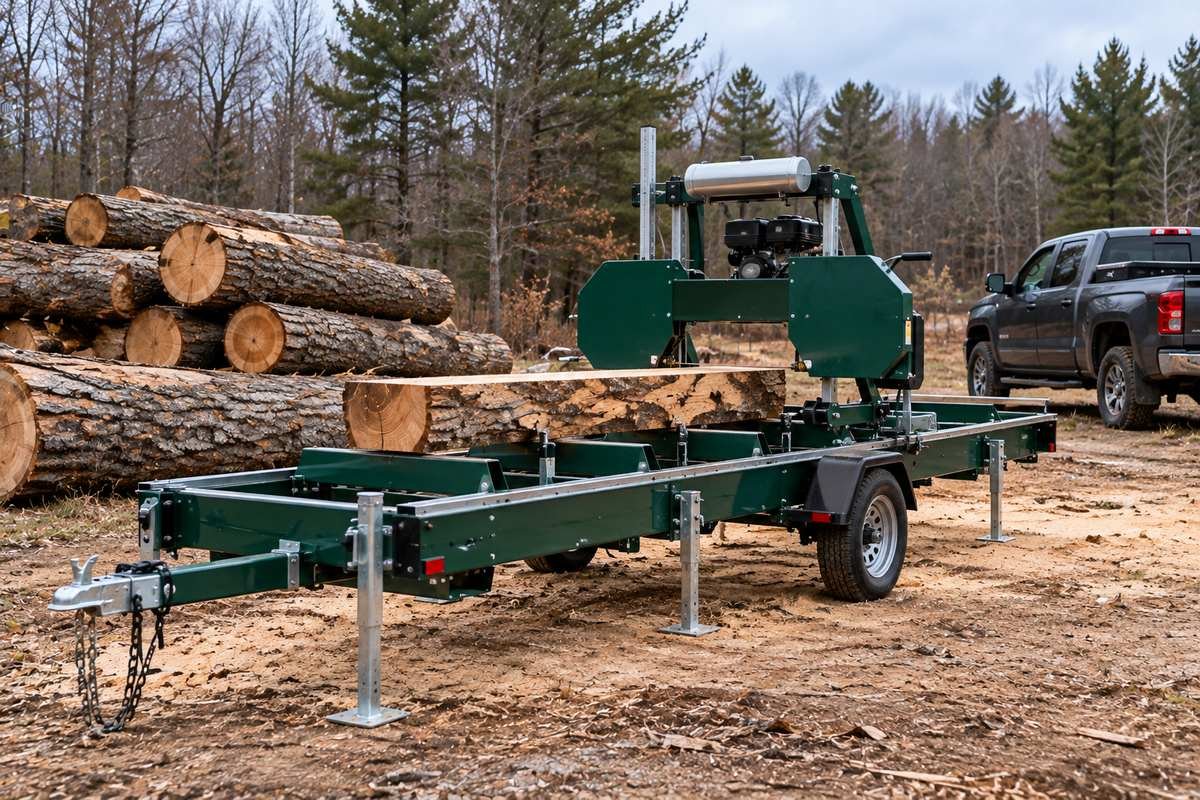
Most first-time mill owners learn what they need insured when a client asks for a certificate of insurance before the first paying job, and "portable sawmill insurance" turns out to mean four or five different policies, not one. Once you break it down, none of it's complicated, but skipping it isn't an option either. A single mobile bandsaw mill can represent tens of thousands of dollars sitting on an open trailer at a job site with no building around it. That's before anyone considers what happens if a client's fence, vehicle, or person gets hurt during a cut.
Here's what a portable sawmill insurance program needs to cover, what it costs, and the one paperwork detail almost everyone misses the first time a landowner asks for proof of coverage. This matters most for anyone running a mill commercially rather than for personal use, the exact audience our professional and commercial milling guide is written for.
Table of Contents
General liability: the baseline policy
Commercial general liability is the policy every other piece of portable sawmill insurance builds on. It protects against third-party claims: a client trips over a stacked board, a delivery truck backs into the mill, a spark from the engine catches dry brush near a job site. It also covers the legal defense costs if a claim turns into a lawsuit, which is often the larger expense even when the claim itself doesn't hold up.
For a small sawmill operation, a standard general liability policy with typical per-occurrence and aggregate coverage limits runs somewhat higher per month than a general small-business policy, according to rate data specific to sawmills and planing mills. That's on the low end compared to construction and landscaping, but still higher than a typical small-business average, since cutting equipment and job-site travel raise the risk.
Inland marine: covering the mill itself
This is the coverage most new owners miss entirely, because it doesn't exist for a stationary business the same way. A standard commercial property policy is written around a fixed address: a shop, a warehouse, a yard. A portable sawmill by definition isn't at that address most of the time. It's on a trailer, parked at a client's property, or sitting overnight at a remote job site, and standard property coverage often simply stops applying once equipment leaves the insured premises.
Inland marine insurance closes that gap with an equipment floater that follows the mill wherever it goes. It typically covers fire, theft during transit or overnight storage, collision damage while towing, and vandalism or falling debris at an unsupervised site, according to coverage details for portable sawmills and chippers.
Two details worth asking an agent about specifically. The first is agreed value coverage, so a total loss doesn't turn into a depreciation argument. The second is open perils wording rather than a named-perils list, since named perils only pay out for the specific causes of loss written into the policy.
Anyone still deciding between renting and buying a mill should factor this in either direction: our rental versus buying guide covers the cost side. Inland marine coverage is one more reason a rented mill can be simpler to start with, since the rental company typically carries this risk instead of you.
Product liability: after the lumber leaves
General liability covers what happens on the job site. Product liability covers what happens after, if lumber that came off your mill turns out to be structurally defective and causes damage or injury once it's built into something. A board with an undetected internal defect used in a deck frame or a barn beam is the kind of claim this policy exists for. Some of what it covers overlaps with general liability, but a standalone product liability policy is worth carrying once you sell lumber commercially rather than mill it for personal use.
Workers' compensation: the moment you add help
The instant a mill operation brings on a helper, even part-time or informally, most states require workers' compensation coverage as part of any complete portable sawmill insurance setup. This isn't optional paperwork.
Logging and sawmilling consistently rank among the more dangerous trades to work in. Workers' comp covers medical costs, lost wages, and disability benefits if a helper is hurt running the mill. That could be a blade injury, a crush injury from moving logs, or something as ordinary as a back injury from repetitive lifting. Skipping it for a single part-time helper is one of the most common and expensive mistakes a new operation makes, since an uninsured workplace injury becomes a direct out-of-pocket liability rather than a covered claim.
The paperwork detail first-timers miss
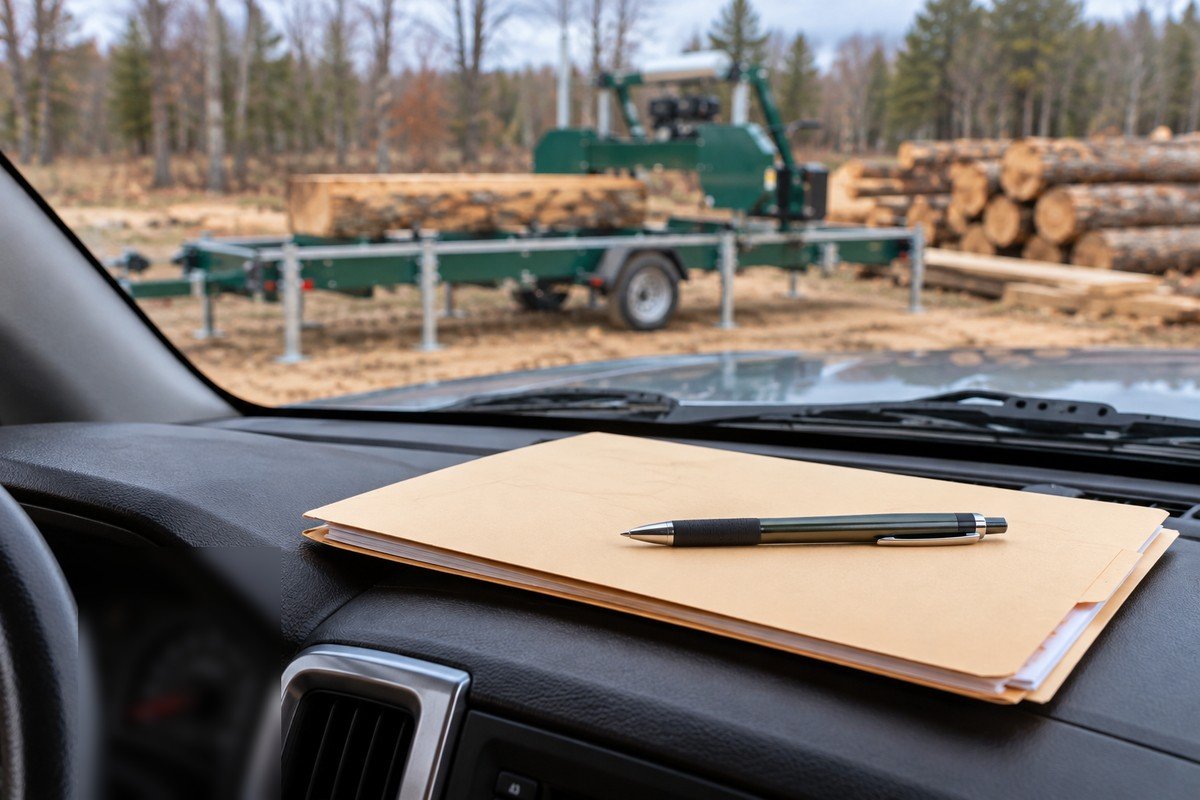
Almost every landowner or commercial client will ask for a certificate of insurance before the first job, and most will ask to be listed as an "additional insured." Handing over a certificate feels like enough. It often isn't.
Additional insured status is an endorsement, not a formality. Under the standard ISO (Insurance Services Office) form most carriers use (CG 20 43 12 19), that endorsement only extends coverage to the landowner or client if a written contract between the two parties exists and is on file. A certificate with no signed contract behind it can leave the landowner with no actual coverage, even though the paperwork looks complete on its face.
New operators who assume a certificate alone satisfies a client's request sometimes find that out only after something goes wrong. The fix costs nothing: a short written work agreement, on file with the insurance agent, before the mill ever gets unloaded on someone else's property.
What a realistic total budget looks like
For a solo operator running a single portable mill with no employees, a basic portable sawmill insurance package built from general liability and an inland marine equipment floater together typically costs noticeably more each month than general liability alone. The cost depends on the mill's insured value and how much the operation travels.
Add workers' compensation as soon as a helper joins, and add product liability once lumber sales move beyond occasional personal projects. None of these figures are quotes for portable sawmill insurance, and actual premiums depend on claims history, state, and the specific carrier, so treat this as a planning range rather than a number to hold an agent to.
Frequently asked questions
Do I need insurance to run a portable sawmill on my own property?
Legally, often not, if it's personal use with no employees and no paying clients. Practically, a mill represents a real financial loss if it's damaged or stolen, and an injury to a family member or visitor isn't covered by a homeowner's policy the way a dedicated equipment and liability policy would be.
What insurance does a landowner need before letting someone mill on their property?
The landowner should confirm the operator carries general liability insurance, get a certificate naming the landowner as an additional insured, and put a short written agreement in place with the operator, since additional insured status typically doesn't apply without one.
Does homeowner's insurance cover a portable sawmill?
Generally no. A homeowner's policy isn't built for commercial equipment, job-site liability, or product liability from lumber sold to others. A dedicated general liability and inland marine policy is the standard way commercial mill owners cover this instead.
How much does portable sawmill insurance cost?
A sawmill-specific general liability policy costs a moderate monthly amount for a standard $1 million/$2 million policy. Adding an inland marine equipment floater typically brings a solo operator's total noticeably higher, before adding workers' compensation or product liability.